
Daily Podcast full article
Tesla Cybercab Austin Launch: What Is Confirmed, What Is Still Missing
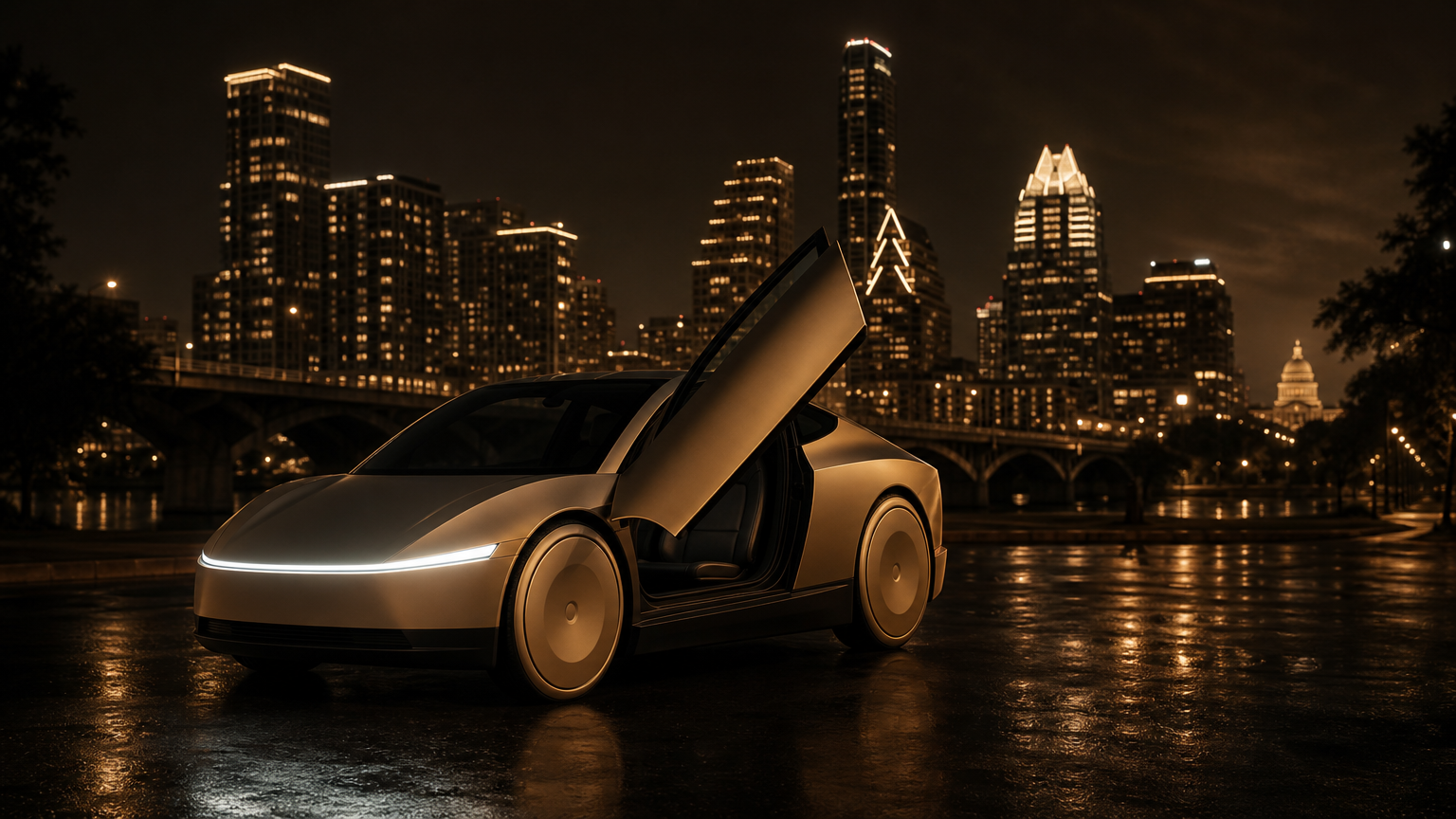
Tesla’s Cybercab rollout now looks less like a distant concept and more like an Austin service launch waiting for a date: Tesla has tied a Cybercab event to Robotaxi rides, Austin’s current Robotaxi network appears to be moving more decisively toward unsupervised operation, and fresh sightings of the Cybercab interface suggest the company is preparing a passenger-first vehicle rather than a conventional EV with the driver removed.
The short version
Tesla has not publicly announced an exact Cybercab launch date, but the company has now put an Austin Cybercab event into motion. The clearest fresh signal is the Cybercab launch-event sweepstakes: Tesla is giving Robotaxi riders entries for rides taken from August 17 through August 23, with five winners to be selected and notified on August 25. Not a Tesla App reported on August 19 that Tesla’s event page confirms Austin as the location, while noting that Tesla has still not disclosed the actual event date.
That matters because the Cybercab is not just another Tesla model. It is the purpose-built, two-seat Robotaxi vehicle designed around autonomy, with no steering wheel and no pedals. The current rollout story is therefore about three linked questions: when Cybercab joins the Austin Robotaxi service, whether Tesla’s existing driverless operations are stable enough to support it, and what “specs” matter in a vehicle built for passengers and fleet economics rather than private ownership.
Timeline: late-August event logic, but no hard public launch date
The present timeline is narrower than it was a week ago, but still not fully confirmed. Tesla’s contest mechanics create a clear sequence: ride-entry window through August 23, winner notification on August 25, then an Austin Cybercab launch event at a date Tesla has not yet published. Not a Tesla App’s reading is that the timing points to late August or early September, but the outlet also emphasized that Tesla has not formally confirmed the event date.
The cautious interpretation is important. A launch event is not the same thing as broad availability. Tesla could use the event for controlled rides, employee or invited-customer demonstrations, a limited Austin Robotaxi integration, or a staged announcement of the Cybercab’s next operating area. The company’s sweepstakes language confirms an event and location; it does not confirm how many Cybercabs will be bookable by ordinary riders on day one.
For readers tracking the immediate calendar, the next public checkpoint is August 25, 2026, when Tesla says five winners will be randomly selected and notified. If Tesla follows its usual event cadence, the event details may arrive only after that selection process.
The Austin prerequisite: unsupervised Robotaxi rides
The fresh operational backdrop is Austin. The Verge reported on August 20 that all 170 Tesla Robotaxi rides monitored in Austin over the previous two weeks by the crowdsourced Robotaxi Tracker were unsupervised, according to tracker creator Ethan McKanna. Those rides involved 54 different cars, and McKanna said plates previously marked as supervised had been confirmed as offering unsupervised rides.
That does not prove Tesla has solved autonomy at scale. The Verge also reported that the data source is crowdsourced, that Tesla does not publish detailed fleet data, and that the company did not respond to a request for comment. But if the tracker is directionally right, it means Tesla’s Austin Robotaxi network is becoming a live rehearsal for the Cybercab: a no-controls vehicle only makes sense if the service can operate without a human safety monitor onboard.
The same report also noted the competitive gap. Even with the apparent jump in Austin unsupervised rides, Tesla remains smaller than Waymo in the city; The Verge cited more than 300 Waymo driverless vehicles in Austin and about 4,000 across other cities. That comparison frames the Cybercab launch as a credibility test, not simply a product reveal.
Specs that matter now: cabin, controls, software surface
The Cybercab’s most important “spec” for this rollout is the absence of traditional controls. Fresh reporting around Austin continues to describe the Cybercab as a purpose-built robotaxi without a steering wheel or pedals, a design that raises the stakes for remote support, geofencing, emergency response and real-time autonomy performance.
A second live specification is the passenger software environment. On August 19, Not a Tesla App reported that a Cybercab had been spotted running its native in-car interface. The outlet described a familiar Tesla-style visualization with a gold Cybercab theme, plus Cybercab-specific controls including “Robotaxi” and “Rodeo” menus. It also described Rodeo feedback controls such as Short Oops, Long Oops, Win and Voice Note, which appear aimed at internal drive evaluation rather than normal passenger use.
That interface detail matters because it suggests Cybercab is still in a data-gathering and validation posture even as the launch event approaches. A mature passenger product would hide the engineering tools; a test or near-launch fleet needs fast feedback loops, clear incident labeling and a way for employees to grade autonomy behavior. In other words, the UI leak is not just a curiosity. It is evidence of how Tesla is trying to convert real Austin rides into training and validation data.
Safety context: one public stumble is enough to shape the rollout
The safety narrative turned more complicated this week. TechRadar reported on August 20 that a Tesla Robotaxi passenger in Austin filmed a ride in which the vehicle hit plastic traffic posts marking a curb extension and then continued driving. The report said the Robotaxi had no safety operator behind the wheel, while noting it was unclear whether a remote operator was involved.
One incident does not define a fleet, and the posts were flexible rather than a pedestrian, cyclist or vehicle. But for a Cybercab launch, perception matters. A vehicle with no steering wheel invites a sharper question than an ordinary autonomous Model Y: if the car makes an unexpected choice, who can intervene, how quickly, and by what mechanism?
That is why the Austin rollout is likely to be constrained. Tesla can generate enthusiasm with an event, but regulators, local officials, riders and competitors will judge the Cybercab by boring metrics: disengagement handling, obstruction response, emergency routing, pickup and drop-off reliability, and transparent incident reporting.
What is still unknown
Several central items remain undisclosed. Tesla has not published the Cybercab event date. It has not stated how many Cybercabs will initially operate in Austin. It has not clarified whether first public passengers will be sweepstakes guests, Tesla employees, invited Robotaxi users or ordinary app users. It has not provided a fresh public update on volume-production timing in the past 72 hours. And it has not given a city-by-city Cybercab expansion schedule.
The practical expectation, therefore, should be a limited Austin debut rather than a nationwide switch-flip. Tesla’s current signs point to a staged rollout: event first, controlled rides next, broader Robotaxi integration only if operations and public confidence hold up.
Bottom line
The Cybercab is now entering its make-or-break phase. The event is real, Austin is confirmed, the contest timeline points to late August or early September, and the existing Austin Robotaxi network appears to be moving toward unsupervised operation. Yet the same fresh reporting also shows why the rollout will be watched closely: Tesla’s autonomy claims are being tested in public, in real traffic, with a vehicle that removes the driver controls entirely.
For Tesla, Cybercab is the chance to prove that Robotaxi is not merely a Model Y pilot with extra branding. For Austin riders, it is the beginning of a more concrete question: would you climb into a two-seat Tesla with no steering wheel and trust the service layer around it?
Sources from the last 72 hours
- [1]Tesla Reveals Cybercab Event Location and How to Enter Without a Robotaxi RideAug 19, 2026, 12:00 PM UTC
- [2]Tesla Cybercab UI Reveals Split-Screen Map, Roaming and Rodeo ControlsAug 19, 2026, 12:00 PM UTC
- [3]Tesla’s Robotaxi gets caught crashing through traffic posts, just as it readies the purpose-built Cybercab for public roadsAug 20, 2026, 3:30 AM UTC
- [4]Tesla Robotaxis appear to go fully unsupervised in Austin ahead of Cybercab launchAug 20, 2026, 12:00 PM UTC
- [5]Tesla Robotaxis appear to go fully unsupervised in Austin ahead of Cybercab launchAug 20, 2026, 2:09 PM UTC
- [6]tesla.com
- [7]45179bb5-2a1f-4bc9-a93f-f86df27a1ff5.atarimworker.io
AI-generated article based on recent web research, then preserved as a dated editorial snapshot.
Comments
Be the first to comment.