
Daily Podcast full article
SpaceX reaches 100 missions, and the launch business looks increasingly industrial
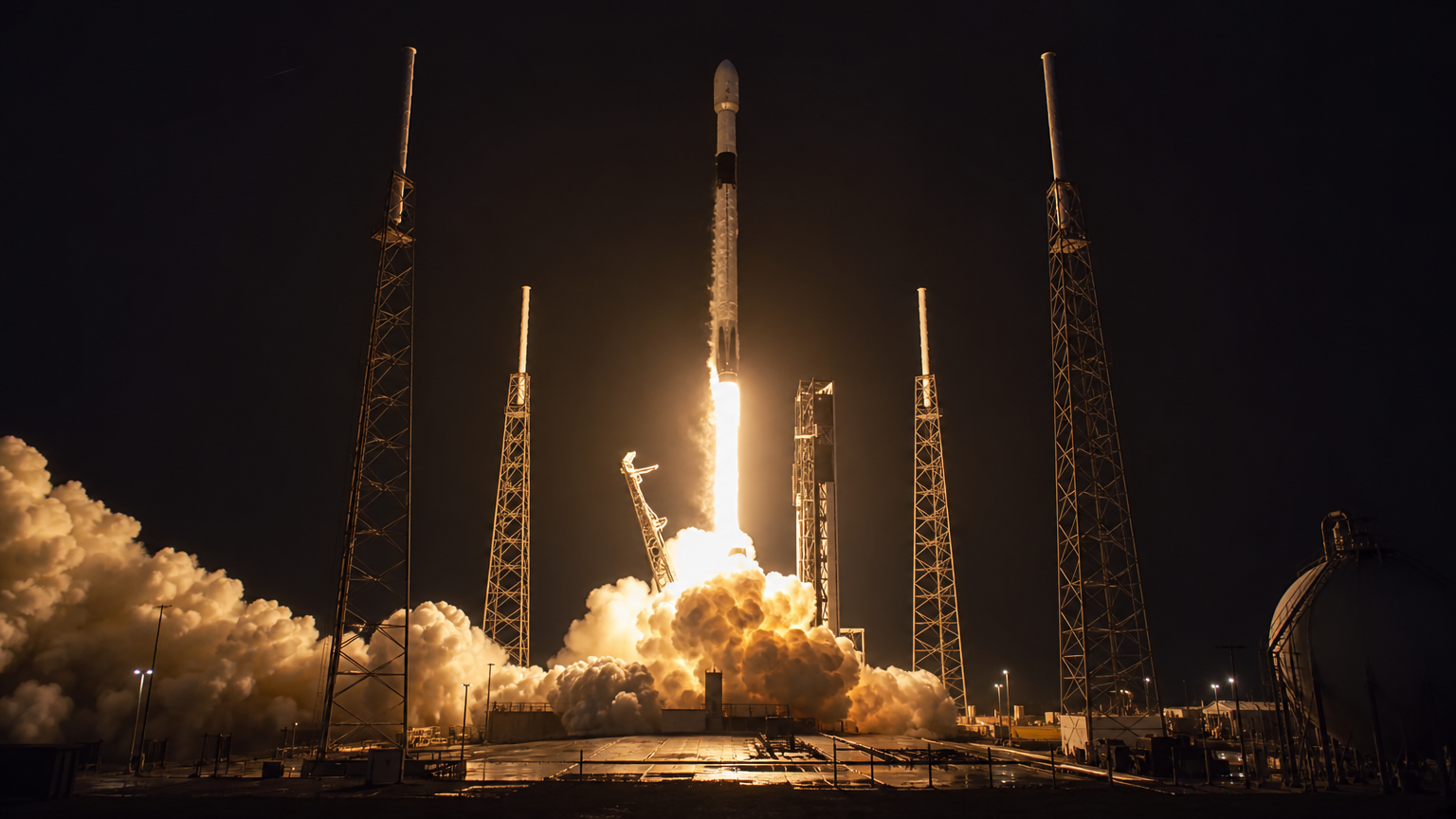
SpaceX has crossed the 100-mission mark for 2026, with Starlink launches from Vandenberg and Cape Canaveral showing how the company has turned orbital access into a high-tempo logistics system rather than a series of rare events.
A milestone with two useful counts
SpaceX’s latest century mark is best understood in two layers. On August 19, a Falcon 9 lifted off from Vandenberg Space Force Base carrying 24 Starlink satellites; Space.com counted that flight as SpaceX’s 100th mission of 2026 overall, the 97th Falcon 9 launch of the year, and the third straight year in which the company has reached triple digits. The booster, B1097, landed on the Pacific droneship Of Course I Still Love You about eight and a half minutes after liftoff, on its 12th mission.
That “overall” count matters because SpaceX’s annual activity also includes non-Falcon 9 missions. Space.com noted that the 2026 total at that point included one Falcon Heavy launch and two suborbital Starship test flights, while most of the calendar had been driven by Starlink deployment. By its reporting, 74 of the 100 missions had been Starlink-related, underlining how much of SpaceX’s cadence is now generated by its own broadband network rather than by traditional third-party launch demand.
A separate but closely related milestone was still unfolding as the week closed. Spaceflight Now reported on August 21 that SpaceX was preparing an overnight Starlink 15-20 launch from Vandenberg that it described as the company’s 100th orbital mission of the year. That mission was scheduled for 07:25 UTC on August 22 from Space Launch Complex 4 East, with 29 additional Starlink satellites and booster B1100 targeting the droneship Of Course I Still Love You.
The distinction is not just bookkeeping. Counting all SpaceX missions captures the full corporate tempo, including Starship tests. Counting orbital missions isolates the service that matters most to customers buying payload delivery. Either way, the message is the same: by late August, SpaceX was operating at a pace that most launch providers would regard as an annual target, not a year-to-date position.
Starlink is the flywheel
The main driver is Starlink. The August 19 milestone flight carried 24 Starlink satellites from California, and the next wave came quickly. On August 21, SpaceX launched Starlink 10-39 from Space Launch Complex 40 at Cape Canaveral Space Force Station, sending 29 more Starlink satellites toward low Earth orbit at 11:14 a.m. EDT after a scrubbed attempt the previous day.
That Florida launch showed how routine the business has become without making it simple. Weather and countdown discipline still matter: Bay News 9 reported that the first attempt was scrubbed seconds before liftoff and that the 45th Weather Squadron had flagged cloud and electric-field constraints. Yet the turnaround was measured in a day, not a campaign; the rocket returned to the pad flow, launched the next morning, and the first stage landed on A Shortfall of Gravitas in the Atlantic.
Starlink turns SpaceX into both supplier and anchor customer. It gives the company a reason to fly even when the external commercial market is uneven. It also creates a feedback loop: high launch rates expand the constellation; an expanding constellation supports broadband revenue and capacity; and that demand justifies more launches. Spaceflight Now reported that Elon Musk said Starlink had more than 11,000 satellites in orbit, while the same article described Starlink 15-20 as adding another 29 broadband satellites to low Earth orbit.
The result is a launch manifest that behaves less like a sequence of special missions and more like a transportation network. Some flights carry government or commercial payloads, but the backbone is internal demand. That is a structural advantage: SpaceX can keep hardware, recovery ships, pad teams, range coordination and refurbishment cycles active because it has a steady stream of its own payloads waiting.
Reuse is now measured in production terms
The clearest sign of industrialization is booster reuse. Starlink 10-39 used booster B1078 on its 30th flight, a milestone that Spaceflight Now described as making it the sixth booster to reach that mark. ClickOrlando likewise reported that the booster had previously supported Crew-6, SES O3b mPOWER-B, USSF-124, BlueBird 1-5, Nusantara Lima, Starfall Demo and 23 Starlink missions before landing again on A Shortfall of Gravitas.
This is where the economics of cadence become visible. A booster that flies dozens of times is not merely a recovered artifact; it is a recurring production asset. Its value lies in the integration of inspections, repairs, engines, tanks, avionics, transport, scheduling and pad availability. Each successful turnaround adds operating data, reduces uncertainty, and supports a planning model in which the next mission is expected rather than exceptional.
The recovery statistics are now large enough to be part of the story. Spaceflight Now reported that B1078’s Atlantic landing after Starlink 10-39 was SpaceX’s 652nd Falcon booster landing to date and the 164th on A Shortfall of Gravitas. The planned Starlink 15-20 launch, by the same outlet’s count, would have targeted the 653rd Falcon booster landing and the 220th on Of Course I Still Love You if successful.
Those numbers explain why SpaceX’s advantage is not just a rocket design. It is the whole chain: pads on both coasts, drone ships in both oceans, flight-proven cores, launch teams accustomed to rapid sequencing, and a constellation business that absorbs capacity. Rivals can copy parts of that architecture, but matching the system requires demand, hardware, sites and operational experience at the same time.
Florida and California now function as a dual-coast machine
The week’s geography matters. SpaceX was not leaning on a single range. The 100-mission overall mark came from Vandenberg, serving high-inclination Starlink shells over the Pacific. Two days later, Cape Canaveral sent Starlink 10-39 northeast from Florida. The next scheduled Vandenberg flight, Starlink 15-20, was due just hours after the Florida success, reinforcing the impression of a dual-coast cadence.
For the launch market, that means SpaceX has shifted the baseline. Customers, regulators and competitors now operate in a world where orbital launches by one company can cluster within days or even hours. That changes expectations for resilience: a scrub is no longer necessarily a major interruption; it can become another item in a densely managed schedule.
The risk is that routine language can hide the difficulty. Every mission still involves propellants, weather rules, range safety, marine recovery zones, satellite deployment, and orbital traffic management. But the significance of 100 missions is precisely that SpaceX has made these constraints repeatable. Its advantage is no longer only that it can launch and land a rocket. It is that it can do so often enough to make spaceflight look like infrastructure.
The larger signal
SpaceX’s 2026 century mark is therefore less a trophy than a market signal. The company is using Falcon 9 to feed Starlink, using Starlink to justify Falcon 9 flight rates, and using reuse to hold the system together. With the year only in late August, the company has already shown that triple-digit annual launch activity is not an exceptional surge but a new operating norm.
For competitors, the challenge is brutal: building a reliable rocket is only the first step. Matching SpaceX now means matching a manifest, a refurbishment pipeline, a recovery fleet, a satellite customer, and a launch culture that treats the next flight as imminent. That is why the 100-mission milestone matters. It shows that SpaceX’s real product is no longer just Falcon 9 or Starlink. It is cadence.
Sources from the last 72 hours
- [1]SpaceX launches its 100th mission of the year, sends Starlink satellites to orbitAug 19, 2026, 4:24 AM UTC
- [2]Live coverage: SpaceX to launch 100th orbital mission of 2026Aug 21, 2026, 12:00 AM UTC
- [3]SpaceX launches 29 Starlink satellites from Cape Canaveral following last-minute scrubAug 20, 2026, 12:00 AM UTC
- [4]SpaceX launches Starlink satellites from FloridaAug 20, 2026, 11:43 AM UTC
- [5]SpaceX successfully launches Starlink mission after it was scrubbedAug 19, 2026, 6:58 PM UTC
AI-generated article based on recent web research, then preserved as a dated editorial snapshot.
Comments
Be the first to comment.