
Daily Podcast full article
SpaceX Starship Recovery Turns an Indian Ocean Splashdown Into a Reuse Test
SpaceX’s recovery of Ship 40 off Christmas Island is not a relaunch-ready victory lap, but it is a rare engineering prize: a largely intact Starship upper stage that survived re-entry, floated for weeks, and can now be inspected for lessons on heat shielding, structures, towing and future rapid reuse.
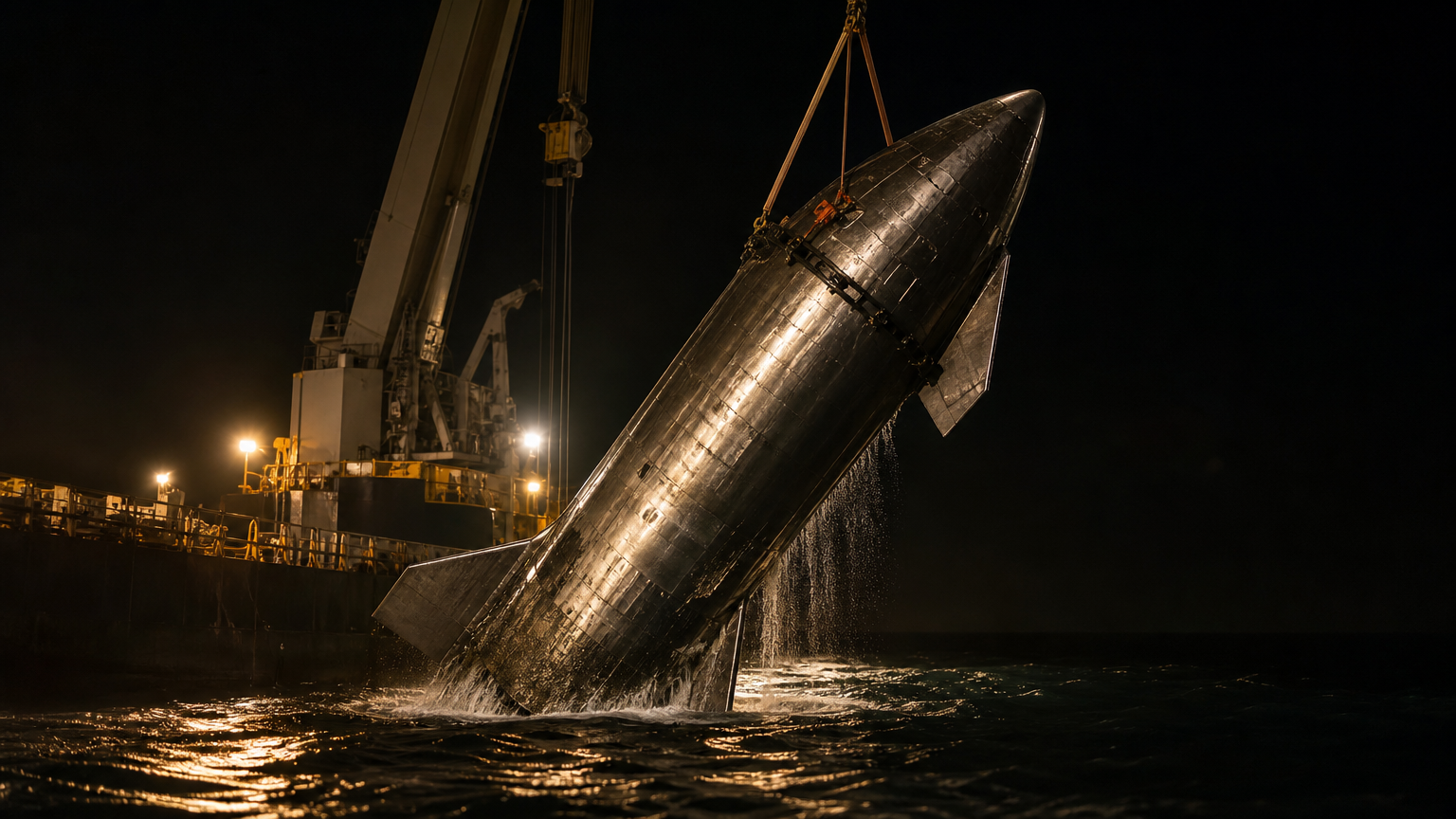
A rocket becomes a salvage operation
SpaceX has moved Starship’s Flight 13 upper stage, known as Ship 40, from a planned Indian Ocean splashdown into the calmer waters off Christmas Island after roughly 24 days at sea. The company’s update, amplified in fresh reporting by Space.com and the Guardian, says recovery teams guided the 52-meter vehicle close to the remote Australian territory so engineers can inspect it before any attempt to send it back to Starbase in Texas.
That phrasing matters. SpaceX has not announced that the spacecraft is back on land, refurbished, or available for another flight. It has said the vehicle was guided to a safer inspection area. The milestone is therefore narrower than “Starship is reusable,” but more significant than “a piece of debris was found.” Ship 40 appears to be the first Starship upper stage to return from space, remain in one recognizable structure after ocean landing, and be brought under deliberate recovery control.
The vehicle launched from Starbase on July 24 during the 13th integrated Starship flight test, flew a long suborbital profile, released Starlink satellites, re-entered, and landed in the Indian Ocean west of Australia. Guardian video coverage published this week shows the July 24 ocean landing and notes that the stage was recovered off Christmas Island nearly four weeks later.
Why the hardware matters
SpaceX’s Starship program is built around a concept far more ambitious than the Falcon 9 model. Falcon 9 recovers and reuses the first stage; Starship is designed to make both stages rapidly reusable. For the upper stage, the hardest problem is not merely reaching space. It is coming back through the atmosphere, surviving peak heating, controlling attitude through hypersonic and subsonic flight, relighting engines, and returning in a condition that can be inspected quickly and flown again.
Ship 40 does not prove that sequence is operational. Salt water is punishing for engines, valves, avionics, welds, insulation and tile interfaces. A vehicle that spends weeks floating in the ocean is not demonstrating airline-style turnaround. But it can still be immensely useful. A recovered upper stage is a physical record of the flight: heat-shield tiles, attachment hardware, flap edges, tank structure, welds, plumbing, engine bay components and impact scars can all be compared with telemetry and onboard imagery.
SpaceDaily’s fresh analysis made the useful distinction between “intact” and “undamaged”: the stage appears battered, with visible heat-shield wear and likely ocean-related damage, but it did not break into scattered wreckage before recovery crews gained control of it. That is precisely why engineers will want to see it. Reuse is not achieved by clean livestream footage; it is achieved by understanding which parts survived, which parts failed, and which parts only looked healthy in telemetry.
Christmas Island becomes an unexpected spaceport backdrop
The recovery also created a rare scene for Christmas Island residents: a black Starship upper stage floating offshore, attended by recovery vessels. The Guardian reported that locals described the spacecraft as the talk of the island and that an exclusion zone was in place to keep recreational boats away. An Australian Space Agency spokesperson told the outlet that SpaceX had towed the vehicle to Christmas Island after it re-entered and landed in international waters, while the federal government was engaging with the company on the recovery effort.
That local angle is not just color. Starship’s test campaign operates across enormous geography. A launch from South Texas can end with hardware in the Indian Ocean, forcing SpaceX to coordinate maritime assets, weather windows, jurisdictional questions and hazard controls far from its home infrastructure. If high-cadence Starship testing continues, the company’s operational competence at sea will matter almost as much as its launch-pad choreography.
A Starship is also an awkward object to tow. It is tall, cylindrical, lightly built for flight rather than waves, covered with heat-shield tiles, and equipped with flaps designed for atmospheric control rather than marine loads. Unlike a ship, it has no hull form, crew, propulsion, deck fittings or easy handling points. Keeping it intact for more than three weeks was therefore an engineering and logistics problem, not a simple act of towing a buoyant cylinder.
Recovery is not the same as reuse
The temptation is to call this a reusability breakthrough. It is better described as a reusability learning event. The recovered vehicle is unlikely to become a near-term flight article; the point is evidence. Engineers can assess where heating was worse than expected, whether tile loss followed predictable patterns, how flaps and hinges behaved after re-entry, and what loads the structure endured during splashdown and towing.
The biggest unknowns are causal. A damaged tile may have been affected during re-entry, during the flip and landing burn, during the moment the vehicle contacted water, during weeks of wave action, or during towing. Separating those causes will require correlating photos taken at different times, sensor data, temperature histories and direct inspection. That forensic work is the reason the salvage is valuable even if saltwater exposure rules out reuse of most hardware.
For SpaceX’s broader ambitions, the lesson is clear: the road to rapid reuse passes through messy intermediate steps. Falcon 9’s recovery history included failed landings, ocean impacts and incremental inspections before routine booster reuse became normal. Starship’s upper stage is a larger, hotter, more complex challenge. Ship 40’s survival gives SpaceX a rare full-scale test article that experienced the exact environment the company must master.
Market and mission implications
If Starship eventually becomes rapidly and fully reusable, its effect could reach far beyond SpaceX. A lower-cost heavy-lift system could change the economics of large satellite constellations, lunar cargo, propellant depots, space stations and deep-space mission architectures. The Flight 13 recovery does not deliver that future by itself, but it supports the engineering loop that could make it possible.
The milestone also has a communications value. Earlier in August, the recovery looked doubtful as rough seas complicated the operation. This week’s arrival off Christmas Island turned a possible loss into a visible symbol of persistence. For a test program that often advances by destroying or discarding hardware, the chance to study an intact returned stage is unusually powerful.
The bottom line
SpaceX has not yet demonstrated rapid upper-stage reuse. It has not shown a Starship ship returning to the launch tower, being caught, inspected, refueled and flown again. What it has done is preserve a uniquely valuable piece of post-flight hardware. Ship 40 survived launch, spaceflight, re-entry, splashdown, weeks of open ocean exposure and a difficult tow to calmer waters.
That is not the end state of Starship. It is the kind of intermediate victory that makes the end state more plausible. The recovered vehicle is a battered witness, not a reusable airliner. But for engineers trying to turn the world’s largest rocket into a routine transport system, a witness that can be touched, measured and taken apart may be worth more than any single successful video feed.
Sources from the last 72 hours
- [1]Starship lives! SpaceX craft arrives at Christmas Island after 24-day ocean ordealAug 18, 2026, 5:29 PM UTC
- [2]SpaceX Starship the talk of remote Australian island as Elon Musk’s engineers sent to retrieve itAug 19, 2026, 5:53 AM UTC
- [3]The moment SpaceX Starship spotted off Christmas Island landed in Indian Ocean – videoAug 19, 2026, 3:09 AM UTC
- [4]On 7 August, Elon Musk said Ship 40's ocean recovery was “not looking good.” Eleven days later, on 18 August, it was towed intact to waters off Christmas Island — the first Starship upper stage ever recovered intact after returning from space.Aug 19, 2026, 12:00 AM UTC
AI-generated article based on recent web research, then preserved as a dated editorial snapshot.
Comments
Be the first to comment.