
Daily Podcast full article
IBM and Dirac put quantum hardware back in focus
IBM’s newly connected cryogenic modules and Dirac Labs’ seed-stage quantum navigation push show the same market signal from opposite ends of the stack: quantum progress is moving from isolated lab demonstrations toward manufacturable, serviceable hardware.
The hardware problem is now the story
Quantum computing is often sold through algorithms, qubit counts and long-range promises of advantage. The latest news around IBM and Dirac Labs is more prosaic, and more important: the field is confronting the hardware bottlenecks that decide whether quantum systems can leave controlled laboratory settings and become infrastructure.
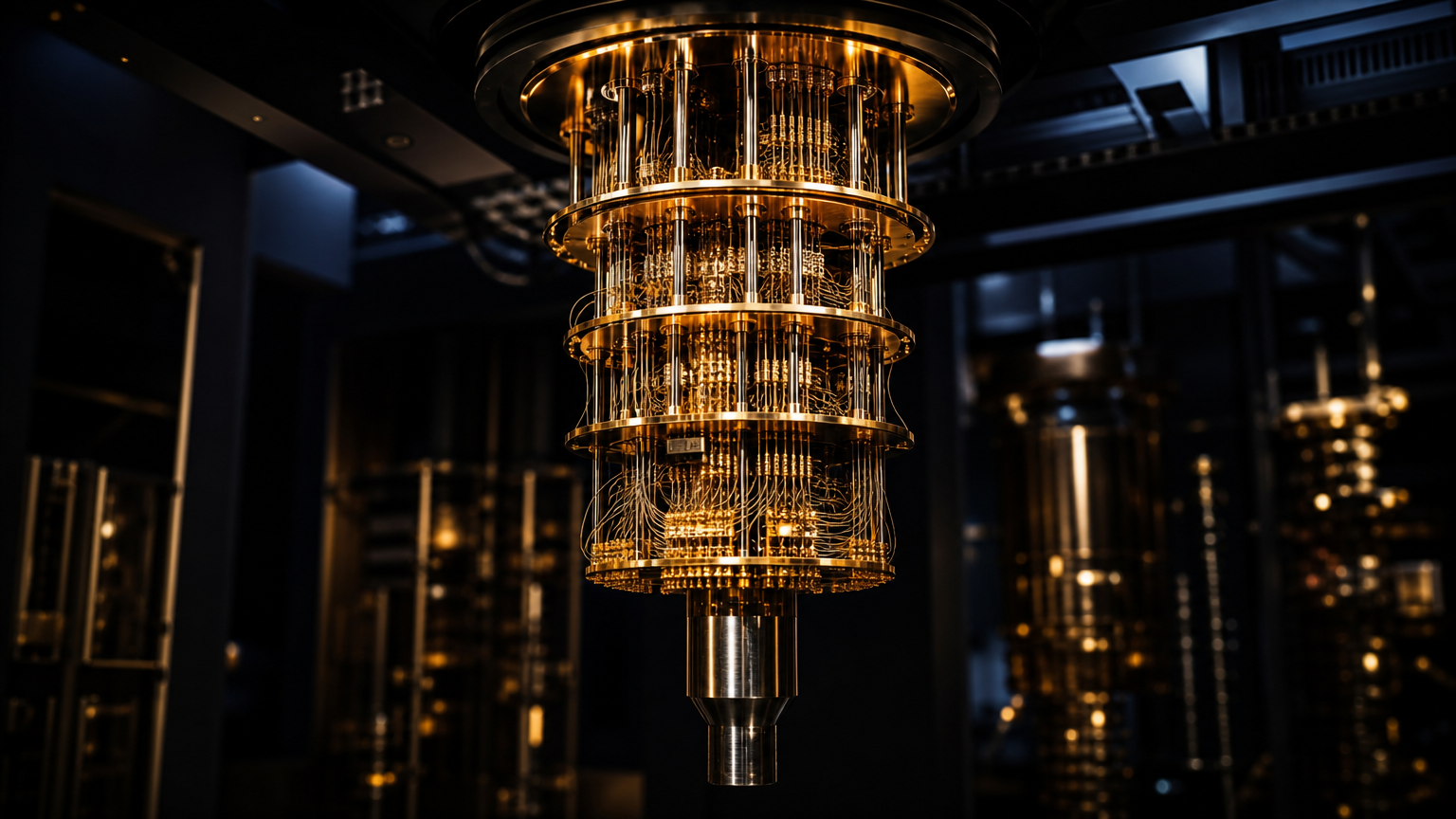
On August 19, IBM said it had joined and cooled two cryogenic modules into a single operating environment, a milestone aimed at the company’s plan for a fault-tolerant quantum computer called IBM Quantum Starling in 2029. IBM said the two operational modules, together more than eight feet tall and eight feet wide, reached 4 Kelvin in under five days and then below 15 millikelvin, while each module’s vacuum enclosure provides up to 12 times more wiring space than widely used IBM quantum systems.
A day later, Dirac Labs, a Madison, Wisconsin quantum navigation startup, announced $1.8 million in pre-seed funding to build prototypes of quantum sensors and take them into field trials for positioning where GPS is unavailable. Its system is aimed at underwater, underground and GPS-contested environments, using diamond-based quantum sensing hardware, AI signal processing and a design intended to be manufactured through semiconductor-compatible infrastructure.
These are very different bets. IBM is trying to scale superconducting quantum computing through modular cryogenic infrastructure. Dirac Labs is trying to productize quantum sensing for navigation. But both point to the same near-term reality: quantum technology will advance only as fast as packaging, cooling, control, manufacturing and deployment allow.
IBM’s refrigerator milestone is really a systems milestone
IBM’s announcement is not that a new quantum processor solved a breakthrough problem. The company’s own framing is about infrastructure: the refrigerators are designed to link hundreds of quantum chips in an ultra-cold, modular environment, and the architecture is meant to support fault-tolerant computing rather than simply house a larger single chip.
That matters because superconducting qubits need extreme cold and careful isolation from heat, vibration, electromagnetic noise and wiring-induced interference. IBM’s new box-shaped modular cells are intended to sit side by side, creating shorter interconnect paths than traditional cylindrical cryostats and leaving more room for cryogenic electronics and wiring. IBM’s technical blog says the design uses established dilution refrigerator technology but reshapes it into connectable “cells,” each with its own vacuum chamber, cooling hardware and thermal shielding.
The key engineering idea is modularity. Instead of assuming one refrigerator can endlessly grow, IBM is trying to make many cold environments behave like one scalable machine. The company says connected cells maintain low temperatures through protected cryogenic tunnels, while limiting thermal interaction between neighboring cells. It also says the architecture should let engineers upgrade or test parts cell by cell, rather than redesigning the whole cryogenic stack every time the quantum hardware changes.
For users, the promise is not immediate access to a radically more powerful machine. IBM said it plans to install Quantum Nighthawk processors into the cryogenic modules later this year for operational performance testing, while its roadmap calls for L-couplers to link multiple processors into a larger quantum computer with at least 1,000 programmable qubits by 2027.
What remains unproven
The milestone should be read carefully. Cooling two connected modules is necessary for IBM’s roadmap, but it is not the same as showing fault-tolerant computation across those modules. Quantum Brief’s analysis put the point bluntly: nothing was computed inside the connected system, and IBM has not yet entangled qubits across two modules or run a logical circuit spanning the joint.
That caveat is not a dismissal. In quantum hardware, the “plumbing” is the product. Fault-tolerant machines will need large numbers of physical qubits to protect smaller numbers of logical qubits, and that implies enormous demands on wiring, thermal load, control electronics and serviceability. If a future quantum computer is a data-center-style system of linked modules, then proving that modules can share a stable cryogenic environment is a foundational step.
IBM’s roadmap still depends on several hard tasks converging: reliable chip-to-chip quantum links, error correction that works at useful scale, fast decoding, stable processors and software that can exploit the machine. Live Science reported IBM’s claim that the modular “quantum fridges” could help it deliver a fault-tolerant computer in 2029, but the publication also framed infrastructure as the hurdle between today’s noisy systems and uninterrupted quantum operations.
Dirac Labs takes the other quantum path: sensing first
Dirac Labs is not chasing the same near-term product as IBM. Its target is quantum sensing, where quantum effects are used to measure the environment with high precision. The company says its positioning system measures features of Earth’s magnetic field, which can remain available where satellite navigation signals do not reach.
The company’s $1.8 million pre-seed round was led by TitletownTech, with participation from Automotive Ventures, Riceberg Ventures, quantumEDGE Ventures, Jude Gomila and Balaji Srinivasan, according to Chicago Quantum Exchange and SiliconANGLE. The money is meant to fund prototype quantum sensors and field trials.
The technical pitch is deployability. Dirac Labs says its diamond-based sensing platform uses engineered materials to measure Earth’s magnetic field, while AI models handle real-time signal processing and sensor fusion. The company also says the system is designed to plug into existing GPS device ports on airplanes, submarines and other vehicles without requiring platform redesign.
That last point is commercially important. Quantum sensing has often been easier to justify scientifically than operationally. A system that requires special handling, bespoke installation or expensive maintenance is a difficult sell beyond defense and research. Dirac Labs is explicitly arguing that semiconductor-compatible manufacturing and small, robust sensors can reduce the cost and integration barrier.
The naming footnote: Dirac, Diraq and the broader race
There is also a related, and easily confused, development in quantum hardware. Diraq, the Australian silicon spin-qubit company, announced on August 19 that it had opened its first U.S. laboratory in Chicago through the Illinois Quantum and Microelectronics Park’s On-Ramp program at mHUB. The facility includes dedicated cryogenic and measurement infrastructure, including two quantum refrigeration units, and Diraq said development work in Chicago already includes qubit measurements, cryogenic CMOS testing and component verification.
Diraq is separate from Dirac Labs. Yet its Chicago move reinforces the same theme: quantum hardware companies are clustering around places where cryogenics, fabrication know-how, measurement equipment, university talent and public-private infrastructure are available. Diraq says its silicon spin-qubit approach uses CMOS-compatible production processes and is designed to leverage established semiconductor manufacturing infrastructure.
Why this moment matters
The past 72 hours of announcements do not prove that useful quantum computing has arrived. They do show that the industry’s center of gravity is shifting from “can the physics work?” toward “can the hardware be built, connected, cooled, tested, manufactured and serviced?”
IBM’s answer is modular cryogenics for fault-tolerant superconducting systems. Dirac Labs’ answer is quantum sensing hardware that can be produced at scale and installed into existing platforms. Diraq’s answer is silicon spin qubits tied to semiconductor processes and U.S. lab capacity.
The common thread is industrialization. Qubits, sensors and quantum materials are no longer enough on their own. The winners will need supply chains, control stacks, packaging strategies, maintenance models and credible paths from prototype to repeatable deployment.
IBM has cooled the box it hopes will contain a future fault-tolerant machine. Dirac Labs has raised the money to test quantum navigation outside the lab. Diraq has added U.S. infrastructure to push silicon quantum devices forward. None of these is the finish line. Together, they show where the race is now being run: not in the headline number of qubits alone, but in the difficult hardware that lets quantum systems scale.
Sources from the last 72 hours
- [1]IBM Connects Its First Modular Cryogenic Systems in Milestone Toward Fault-Tolerant Quantum ComputingAug 19, 2026, 10:00 AM UTC
- [2]IBM’s new modular architecture for cryogenic systemsAug 19, 2026, 12:00 AM UTC
- [3]IBM's new 'quantum fridges' are nearly 200 times colder than deep space and could pave the way for fault-tolerant quantum computingAug 19, 2026, 5:15 PM UTC
- [4]IBM's latest fault-tolerance milestone is a refrigeratorAug 20, 2026, 12:00 AM UTC
- [5]Dirac Labs raises $1.8M to build a quantum universal positioning system for defense and commercial platformsAug 20, 2026, 12:00 AM UTC
- [6]Dirac Labs to scale quantum positioning tech after raising $1.8M to build its first prototypesAug 20, 2026, 12:00 PM UTC
- [7]Diraq Opens First U.S. Quantum Laboratory in ChicagoAug 19, 2026, 12:00 AM UTC
- [8]Diraq Opens 1st US Quantum Laboratory in ChicagoAug 19, 2026, 12:00 AM UTC
- [9]gamesbeat.com
AI-generated article based on recent web research, then preserved as a dated editorial snapshot.
Comments
Be the first to comment.