
Daily Podcast full article
China’s “Superman” robot: Unitree turns a viral leap into a stock-market test
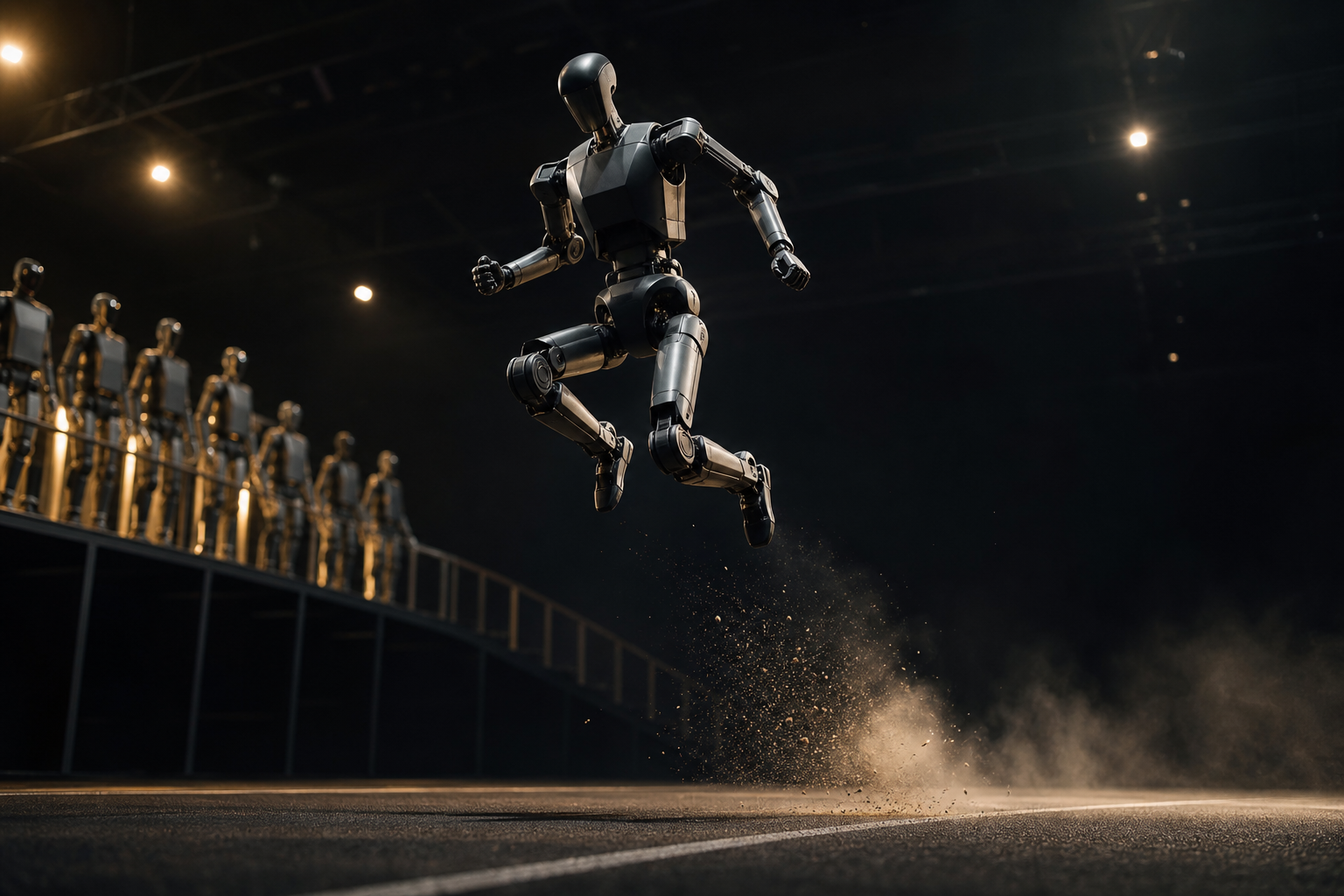
Unitree’s new humanoid “Superman” is being pitched as faster and springier than any human, with a claimed 12.66 m/s sprint and two-meter standing jump. The bigger story is not only the athletic demo, but the timing: the reveal landed just before Unitree’s blockbuster Shanghai debut, where investors are now valuing China’s embodied-AI ambitions in real time.
A robot launch built for maximum impact
Unitree’s “Superman” arrived with the kind of numbers designed to travel faster than the robot itself. According to Xinhua’s report carried by People’s Daily Online, the Hangzhou-based company unveiled the new humanoid on Monday, August 17, 2026, saying it can jump two meters from a standing start and sprint at a top speed of 12.66 meters per second, despite having legs only 0.85 meters long. Unitree also said the machine was developed in just over three months and still has room for optimization.
Those claims are remarkable because they shift the humanoid conversation from “can it walk?” to “how far can legged machines exceed human athletic limits?” The comparison with elite human performance is irresistible: The Next Web described the sprint claim as quicker over the ground than Usain Bolt at his peak, while the standing jump figure pushes the story into “superhuman” territory. But the phrasing matters. A top speed in a demo is not the same as a standardized 100-meter race, and a leap in a controlled clip is not proof of robust, repeatable field performance.
Why the two-meter jump matters
A humanoid robot with short legs that can jump two meters is not just a publicity stunt. It implies high power density in the joints, a light structure, aggressive motion control and the ability to absorb large landing forces without immediately destroying the machine. In practical robotics, however, athletic ability is only one layer of the stack. A robot that can leap may still struggle to perceive clutter, manipulate soft objects, recover safely around people or complete dull industrial tasks for eight hours.
That gap is exactly why “Superman” should be read as both a technical signal and a marketing object. Unitree is showing investors, suppliers and competitors that it can build dynamic hardware quickly. It is not yet showing that this specific platform can work autonomously in a warehouse, factory, hospital or home. The fresh reporting around the launch does not provide the measurement protocol, battery state, robot weight, terrain conditions, number of attempts or repeatability data. Until those details are public, the performance should be treated as a headline claim, not a benchmark standard.
The stock debut turned the robot into a market event
The timing was impossible to miss. Unitree’s robot reveal came just before its August 19, 2026, trading debut on Shanghai’s STAR Market. AP reported that Unitree shares initially jumped as much as 629% and closed 460% higher at 845 yuan, after being priced at 150.80 yuan. The company raised about 6.1 billion yuan, or roughly $904 million, in the listing.
That debut makes Unitree the first publicly traded humanoid-robot maker in mainland China, a status that turns the company into a live valuation benchmark for the sector. Xinhua said Unitree offered about 40.45 million shares, equal to 10% of post-offering share capital, with an expected post-IPO market capitalization of about 60.993 billion yuan. The same report put the offering price at a price-to-earnings ratio of 219.23, far above the recent average for general equipment manufacturing peers.
In other words, investors are not merely buying today’s robot sales. They are buying the possibility that humanoids become a major platform technology: part machine tool, part AI endpoint, part logistics worker, part national industrial project. “Superman” gave that thesis a vivid body.
China’s embodied-AI lead is real, but uneven
The Unitree story is also a China story. AP, citing Omdia, reported that about 15,000 humanoid robots were shipped globally last year, with Unitree and AGIBOT each shipping more than 5,000. For the first half of 2026, Omdia estimated Chinese humanoid robot makers’ total global shipments at around 18,500 units.
Xinhua added another angle: in the first half of 2026, China-developed quadruped robots accounted for nearly 70% of global sales, according to data from China’s Ministry of Industry and Information Technology. That matters because humanoids are not emerging from nowhere; they are being built on a supply chain of actuators, batteries, sensors, reducers, control systems and manufacturing processes that China has been scaling through industrial robots and robot dogs.
Still, the sector’s dominance in shipments should not be confused with full autonomy leadership. Many current humanoids are purchased for research, education, entertainment, security trials and promotional deployments. The commercial question is whether they can reduce labor costs or open new capabilities at a price buyers can justify. That is a harder test than running fast in a video.
The World Robot Conference showed the same tension
Unitree’s debut coincided with the opening of the 2026 World Robot Conference in Beijing. AP reported that the event features more than 300 exhibitors and around 3,000 products during a five-day showcase. Unitree’s booth was one of the attractions, with robots boxing, dancing and playing table tennis against a human opponent.
But the same conference also exposed the industry’s limits. AP described companies trying to move robots beyond demonstrations into factories and real-world applications, while noting that one helper robot attempting to fold a shirt could not complete the chore after several minutes. That small failure is more important than it looks. Folding cloth is trivial for humans because we combine vision, touch, force control, prediction and improvisation. For robots, it remains a dense autonomy problem.
This is the central paradox of humanoids in 2026: a machine may backflip, punch the air, run at extraordinary speed or jump like a sci-fi character, yet fail at laundry. Dynamic locomotion and general-purpose manipulation are different frontiers. “Superman” is impressive because locomotion is hard. It is not proof that general-purpose robot labor has arrived.
What investors are really betting on
Unitree’s financials give the story substance. AP reported that the company generated about 1.7 billion yuan in revenue in 2025, mainly from humanoid and quadruped robots, and that more than 40% came from overseas. Xinhua reported first-half 2026 revenue of about 1.15 billion yuan, up 48.54% year on year.
The IPO proceeds are expected to support advanced robot R&D and a manufacturing base, according to AP. That capital could help Unitree move from viral engineering to more repeatable production. But the listing also raises expectations. A company valued on future industrial transformation has less room for ordinary hardware problems: warranty costs, component shortages, safety incidents, export barriers, margin pressure and customer disappointment.
There is also geopolitics. AP reported that the U.S. accounted for roughly 13% of Unitree’s 2025 revenue, before a U.S. Federal Communications Commission ban on imports of new foreign-made humanoid and quadruped robots in July on national-security grounds. Unitree said the ban applies to its new models and could affect future U.S. sales, while existing approved models can still be sold.
The sober read on “Superman”
The correct response to Unitree’s “Superman” is neither panic nor dismissal. The robot appears to be a serious demonstration of high-performance legged hardware, and it arrives from a company that already has scale, revenue and a newly public market valuation. At the same time, the superhuman framing is narrower than it sounds. Running and jumping are not the same as working.
What Unitree has dropped is not a finished robotic Superman. It has dropped a signal: China’s humanoid race is moving fast, capital markets are now directly funding it, and the next phase will be judged less by viral clips than by deployment data. The real test is whether “Superman” can become less of a spectacle and more of a worker.
Sources from the last 72 hours
- [1]Chinese robot maker Unitree to debut on Shanghai market WednesdayAug 18, 2026, 12:46 AM UTC
- [2]Unitree, China’s humanoid robot champion, lists in Shanghai on 19 August after record demandAug 17, 2026, 3:11 PM UTC
- [3]Shares in Chinese humanoid robot maker Unitree soar in its Shanghai trading debutAug 19, 2026, 5:01 AM UTC
- [4]From robot dogs to helpers, China puts robotics ambitions on display at world conferenceAug 19, 2026, 11:59 AM UTC
- [5]apnews.com
- [6]apnews.com
AI-generated article based on recent web research, then preserved as a dated editorial snapshot.
Comments
Be the first to comment.