
Daily Podcast full article
Unitree’s $62B Shanghai debut turns robot hype into a public-market stress test
Unitree Robotics’ first day on Shanghai’s STAR Market was more than a hot IPO. The humanoid- and quadruped-robot maker became a live benchmark for how Chinese investors are pricing embodied AI: scarce, strategic and exciting, but still far ahead of proven mass-market robot demand.
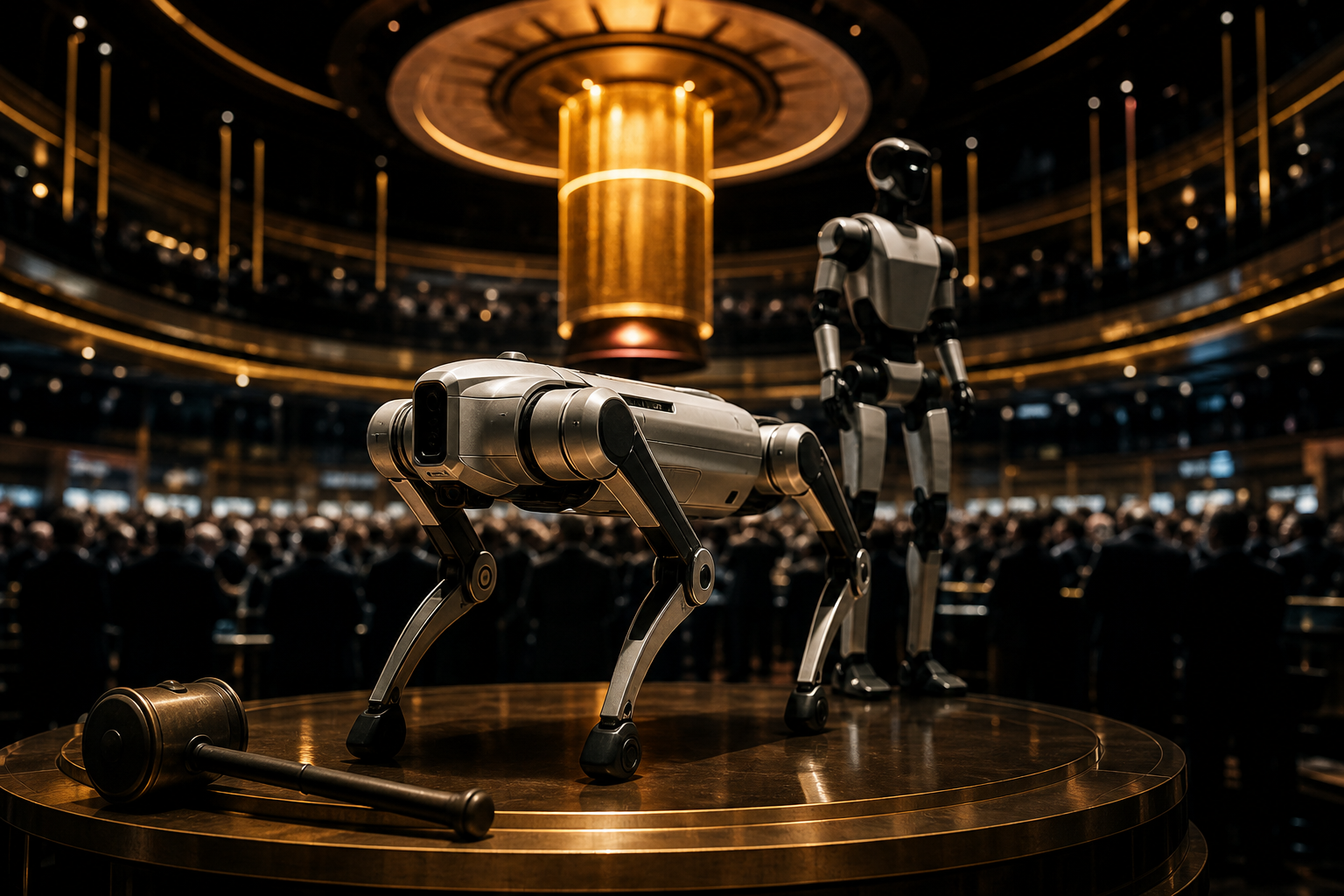
A debut built for scarcity
Unitree Robotics’ Shanghai listing produced the kind of first-day move that instantly becomes a market reference point. Associated Press reported that the Hangzhou-based company’s shares initially rose as much as 629% in their Wednesday trading debut on the Shanghai Stock Exchange’s STAR Market, after being priced at 150.80 yuan. The company raised about 6.1 billion yuan, or $904 million, and the shares closed 460% higher at 845 yuan. That closing level alone gave Unitree a valuation far beyond the $9 billion implied by the IPO price; the intraday spike, based on the 1,100 yuan opening cited by Spanish market coverage, put the company in the roughly $62 billion to $66 billion zone depending on exchange-rate and share-count assumptions.
The mechanics matter. Sina Finance, citing the company’s listing announcement, said Unitree issued 40.4464 million A-shares, equal to 10% of post-IPO share capital, leaving only 30.0877 million unrestricted tradable shares at the start, or 7.44% of the enlarged total. The same notice put 2025 revenue at 1.699 billion yuan and the diluted static price-to-earnings ratio at the offer price at 219.23 times, already high before the first trade multiplied it.
That float structure helps explain why the move was so violent. The public market was not asked to absorb a mature industrial champion with a broad free float; it was offered a narrow slice of a company that investors see as a rare pure-play bet on embodied AI. In such a setup, valuation is not just a discounted cash-flow exercise. It becomes a contest over access.
Why investors treated Unitree as strategic
Unitree is not merely a meme stock with robot videos. AP described it as one of China’s largest humanoid robot makers and noted that it was founded in 2016 by Wang Xingxing in Hangzhou, a city that has become central to China’s recent technology narrative. The company makes humanoid robots and quadruped robot dogs, and AP said it generated about 1.7 billion yuan in 2025 revenue, with more than 40% coming from overseas markets.
Reuters reporting published Monday, two days before the debut, added to the strategic aura. Unitree said it would start trading on August 19 after raising 6.1 billion yuan, and Reuters described it as the world’s biggest humanoid-robot maker by sales. The same report said its IPO was more than 8,000 times oversubscribed by retail investors, a record for Shanghai’s technology-focused STAR Market, and that Unitree had cumulatively produced and delivered about 18,000 bipedal humanoid robots across multiple models as of July.
Those numbers do not prove mass adoption, but they change the conversation. Many robotics startups still sell a story about future deployments. Unitree can point to delivered units, recognizable products, international revenue and a public filing trail. For Chinese investors searching for an A-share proxy for robotics, that combination is unusually scarce.
The conference backdrop amplified the trade
The IPO landed on the same day that China opened the 2026 World Robot Conference in Beijing. AP reported that organizers expected about 3,000 products across the five-day event, and Unitree’s booth was among the main attractions, with robots boxing, dancing and even playing table tennis. The timing gave the listing a public-relations stage: while the stock price exploded in Shanghai, Unitree’s machines were performing in Beijing.
That spectacle is part of the opportunity and part of the problem. AP’s conference reporting also underscored that many humanoid robots remain better at demonstrations than practical work; one helper robot shown at the event struggled with the simple task of folding a shirt. For Unitree and its peers, the next valuation battle is therefore not whether robots can impress crowds, but whether they can deliver reliable returns in factories, warehouses, services and consumer settings.
Unitree tried to sharpen the performance story just before the listing. Reuters reported that on Monday the company unveiled a high-speed robot nicknamed “Superman,” saying it had been developed in just over three months, could jump two meters from standing and had reached 12.66 meters per second. The company also said the robot remained a work in progress.
The valuation signal
The most important read-through is not that Unitree is “worth” precisely $62 billion, $66 billion, or any other single number after one trading session. The more durable point is that mainland investors have now created a public valuation anchor for embodied AI. AP quoted Morningstar analyst Kangyuxiao Li saying Unitree gives mainland investors direct exposure to a leading company in the sector, while also warning that the real competitive test will be reliable performance and attractive returns on investment at scale.
That is the right tension. At the IPO price, Unitree was already expensive by conventional industrial standards. After the first-day surge, the market was not valuing a robot maker on today’s earnings alone. It was capitalizing several beliefs at once: that China can scale hardware faster than competitors, that humanoid robots will move from staged demonstrations into paid deployments, that Unitree’s cost structure and supply chain will let it defend share, and that future robotics listings will validate the scarcity premium rather than dilute it.
There is also a geopolitical layer. AP described advanced robotics, often called embodied AI, as a key sector in U.S.-China technology rivalry, and said China leads the U.S. in production capacity and scaling ability for humanoid robots. Its report cited Omdia estimates that about 15,000 humanoid robots shipped globally last year, with Unitree and AgiBot each shipping more than 5,000; for the first half of 2026, Omdia estimated Chinese humanoid makers’ global shipments at about 18,500 units.
What could break the story
The risk is that scarcity can reverse. The float is tight, expectations are huge, and future listings could give investors more robotics choices. Reuters noted that Unitree is backed by Tencent, Alibaba and DeepSeek, which strengthens its institutional halo, but public investors will now demand operating proof: repeat purchases, enterprise deployments, software reliability, service margins and a path from research orders to everyday commercial use.
For now, Unitree’s debut says more about capital-market appetite than about the final shape of the humanoid robot industry. The stock’s first day turned embodied AI into an investable A-share theme at a scale normally reserved for electric vehicles, semiconductors or internet platforms. Whether that is visionary price discovery or speculative overshoot will depend on how quickly Unitree can convert robots that dance, box and sprint into robots that customers deploy because they save money.
Sources from the last 72 hours
- [1]China’s Unitree unveils ‘Superman’ robot as fervour builds ahead of Shanghai debutAug 17, 2026, 12:35 PM UTC
- [2]La fiebre de los robots humanoides triunfa en bolsa: el fabricante chino Unitree debuta en Shanghái con subidas del 486%Aug 19, 2026, 1:21 PM UTC
- [3]宇树科技:2025年营收16.99亿元 8月19日科创板上市Aug 17, 2026, 12:16 PM UTC
- [4]Shares in Chinese humanoid robot maker Unitree soar in its Shanghai trading debutAug 19, 2026, 5:01 AM UTC
- [5]Explore the future of robotics at the 2026 World Robot Conference in BeijingAug 19, 2026, 11:59 AM UTC
- [6]apnews.com
- [7]apnews.com
AI-generated article based on recent web research, then preserved as a dated editorial snapshot.
Comments
Be the first to comment.