
Daily Podcast full article
SpaceX expands Starlink as debris scrutiny moves from orbit to the Moon
SpaceX’s latest Starlink launch listings show the company still adding satellites at unmatched speed, but fresh reporting and agency-linked imagery also point to a second story: the more SpaceX fills near-Earth space with working hardware, the more regulators, rivals and scientists focus on what happens when spacecraft, rocket stages and satellites stop working.
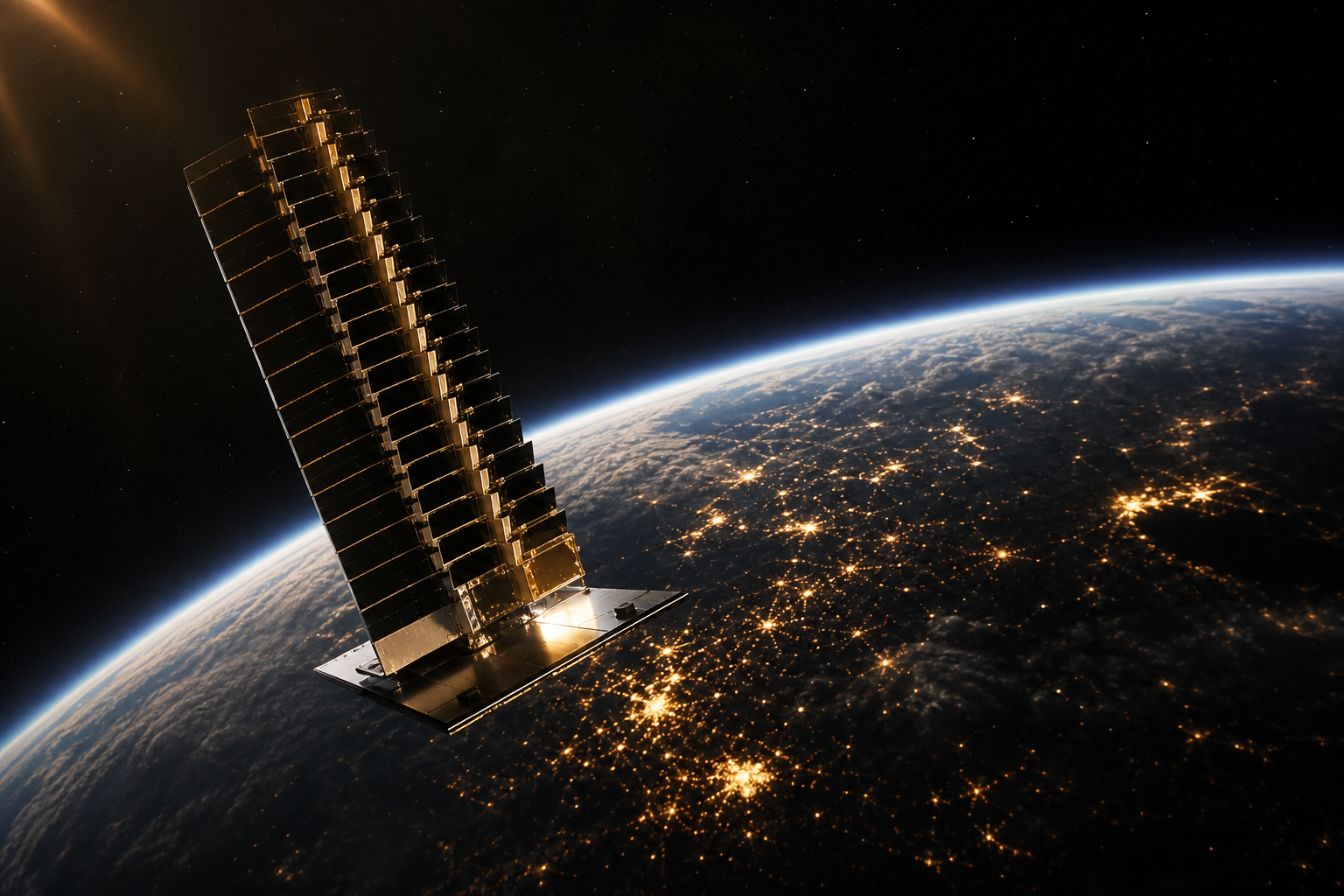
A new Starlink batch keeps the machine moving
SpaceX’s Starlink buildout is no longer a story of isolated milestones. It is a continuous industrial cycle: build satellites, launch them on Falcon 9, land the booster, repeat, then use the growing network to fund the next round. The latest public launch trackers placed Starlink Group 17-50 on the calendar for August 19, 2026 at 02:00 UTC, from Space Launch Complex 4E at Vandenberg Space Force Base in California, carrying a listed batch of 24 Starlink satellites to low Earth orbit. Space Launch Live also identified the mission as using Falcon 9 booster B1097 and the drone ship Of Course I Still Love You, while WatchIsUp separately listed the same date, payload type and mission purpose.
That matters because the cadence is the business model. Starlink is not merely a satellite constellation; it is the customer that keeps SpaceX’s launch system busy, the proof case for booster reuse, and the revenue engine that gives the company strategic room to outlaunch most competitors. Every additional group of satellites improves capacity, regional density and resilience, while each launch strengthens SpaceX’s internal flywheel: SpaceX can launch Starlink cheaply because it owns the rocket, and it can keep the rocket line hot because Starlink needs launches.
The Starlink Group 17-50 listing also underscores how normalized mega-constellation expansion has become. A 24-satellite deployment from Vandenberg is no longer treated as an extraordinary event but as another production flight. That normalization is SpaceX’s advantage. Rivals that must buy rides from other launch providers cannot easily copy a system in which spacecraft design, launch supply, booster recovery, ground terminals and consumer subscriptions all sit inside one corporate stack.
The launch market is watching SpaceX’s priorities
The expansion comes as the broader satellite industry is showing fresh anxiety about access to launch capacity. An Ars Technica item surfaced in technology-news feeds on August 17, 2026 under the headline “Satellite operators are in panic mode due to a worsening launch crisis,” asking what happens if Falcon rockets stop flying at the scale the market has come to depend on. The same feed timestamped the item at 11:00:26 UTC, placing the concern squarely inside the current news cycle.
The issue is not that SpaceX lacks demand. It is that SpaceX increasingly has its own demand. If Starlink, Starlink Mobile and future satellite-based compute services consume more of the company’s launch capacity, outside satellite operators may find that the world’s most dependable commercial launch pipeline is less available to them. For SpaceX, that is a rational vertical-integration strategy. For competitors, it is a bottleneck. For regulators, it raises the old question of whether a dominant infrastructure provider can also be the dominant user of that infrastructure without distorting the market.
This is why routine Starlink flights deserve attention. A launch like Group 17-50 is not just another broadband deployment. It is a visible sign that SpaceX’s internal priorities increasingly shape the tempo of low-Earth-orbit development. The more Falcon 9 flies Starlink, the harder it becomes for satellite broadband competitors, Earth-observation startups and national operators to plan around the same launch ecosystem.
Debris risk becomes harder to dismiss
The debris side of the story sharpened this week through a different SpaceX object: a Falcon 9 upper stage that hit the Moon on August 5, 2026. NASA-linked discussion of new Lunar Reconnaissance Orbiter imagery circulated on August 18, saying LRO captured images between August 11 and 12 of the crater left by the impact. The crater was described as about 60 feet wide and less than 10 feet deep, formed when a Falcon 9 upper stage from the January 2025 Firefly Blue Ghost 1 mission struck the lunar surface.
That lunar impact is not the same risk category as Starlink satellites reentering Earth’s atmosphere. It did not threaten people on the ground. But symbolically, it is powerful. It shows that space debris is no longer confined to abstract orbital diagrams or distant policy debates. Hardware from commercial missions can become a long-lived navigation and impact problem in cislunar space, exactly the region governments and companies now want to use for lunar landers, relays, cargo missions and eventual human infrastructure.
The Moon crash also reframes SpaceX’s sustainability argument. SpaceX often emphasizes that Starlink satellites are designed to deorbit and demise in the atmosphere. That design philosophy is central to the company’s answer to debris criticism. But spent upper stages, failed satellites, disposal anomalies and high-energy mission profiles do not all fit neatly into the same risk model. The more often SpaceX launches, the more edge cases it creates.
Starlink reentries are a feature and a warning
Fresh explainer coverage from iTechGuides on August 18, 2026 cautioned that available August evidence did not verify claims of a new solar storm destroying a large Starlink batch, while still noting that solar activity can accelerate orbital decay and that a failed satellite left at higher altitude can remain a debris-management concern for longer. The same article referred to 2026 reporting that 260 Starlink satellites had been disposed of between December 2025 and May 2026, based on a SpaceX FCC filing.
That distinction is important. More Starlink reentries do not automatically mean SpaceX is failing. In many cases, disposal is the intended safety valve: satellites nearing end of life are brought down rather than abandoned. Yet scale changes the public perception of that safety valve. A constellation with thousands of spacecraft will naturally generate more deorbits, more visible reentries, more collision-avoidance decisions and more questions about how much uncertainty is acceptable.
SpaceX’s core argument is that lower orbits, active maneuvering and planned disposal reduce long-term debris risk. Critics counter that a very large constellation can still increase operational complexity, radio-spectrum pressure and the number of possible failure modes. Both points can be true. Starlink may be safer per satellite than older, higher-altitude systems while still increasing the aggregate burden on space-traffic coordination.
The next phase is governance, not just engineering
The current picture is therefore mixed. SpaceX is expanding from a position of strength: a Starlink mission from Vandenberg, a reusable Falcon 9 booster, and a launch cadence few others can match. At the same time, the debris conversation is broadening. It now includes not only Starlink reentries and collision avoidance in low Earth orbit, but also upper-stage disposal in lunar space and the industrial consequences of one company controlling so much launch capacity.
For policymakers, the question is no longer whether Starlink works. It does. The question is whether the rules around spectrum, orbital coordination, post-mission disposal, lunar traffic and launch-market access can keep up with the speed of SpaceX’s flywheel. SpaceX’s lead is operational. The challenge it poses is systemic.
Sources from the last 72 hours
- [1]Falcon 9 Block 5 | Starlink Group 17-50 - Launch Countdown - Aug 2026 | Space Launch LiveAug 19, 2026, 12:00 AM UTC
- [2]Falcon 9 Block 5 | Starlink Group 17-50 - Countdown Timer | WatchIsUpAug 19, 2026, 12:00 AM UTC
- [3]Sun Is Knocking Starlink Satellites Out of Orbit? 2022 ExplainedAug 18, 2026, 12:00 AM UTC
- [4]NASA’s LRO Images Falcon 9 Crater on Moon, Learns New DetailsAug 18, 2026, 12:00 AM UTC
- [5]RSS Technology News of Gizmodo, Lifehacker, Geekwire, Google, CNET, and more.Aug 17, 2026, 11:00 AM UTC
AI-generated article based on recent web research, then preserved as a dated editorial snapshot.
Comments
Be the first to comment.