
Daily Podcast full article
Tesla Optimus Gen 3: the “5,000 tasks” claim meets the hard reality of humanoid robots
Tesla’s Optimus Gen 3 is being pitched as the moment the Tesla Bot stops being a stage prop and becomes a mass-production platform. The freshest public record, however, points to a more careful reading: bold claims about thousands of possible tasks, factory-scale ambitions and AI-driven autonomy are colliding with the still-unsolved difficulty of making humanoids reliable in ordinary human spaces.
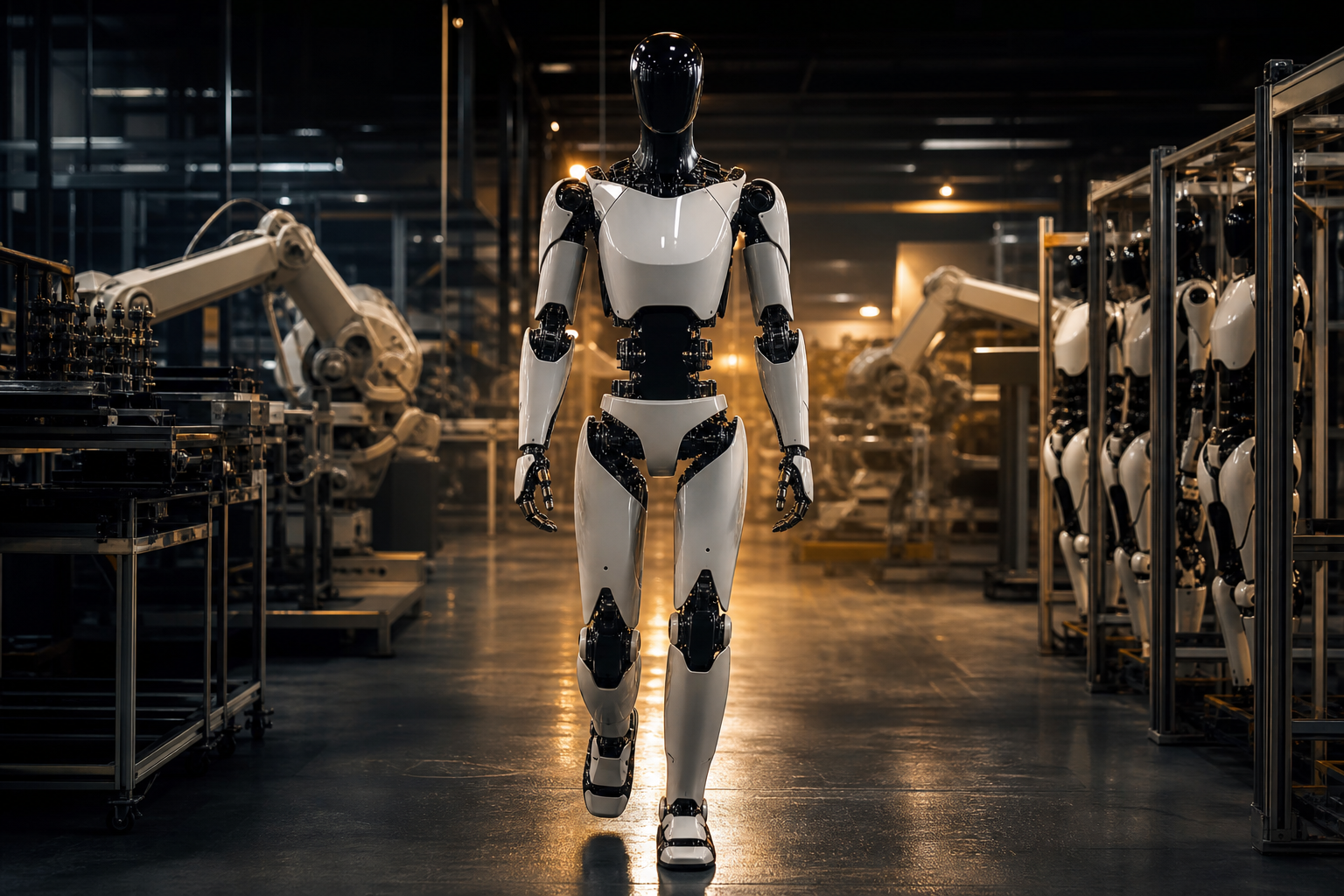
The headline is big. The evidence is narrower.
The latest viral framing around Optimus Gen 3 is dramatic: Tesla Bot is “finally nutty” and can do 5,000 tasks. The August 18 8news.ai subject page presents Gen 3 as Tesla’s first truly mass-production-oriented humanoid platform, with upgraded hands, a planned production start before the end of 2026, and a first line described around a one-million-robots-per-year ambition. It also ties the project to Tesla’s broader AI stack: perception, planning, simulation, large-scale training and the ability to work in changing real-world environments.
But that same framing should be read as a claim about the direction of the program, not as independent proof that Optimus Gen 3 is already completing 5,000 verified household or factory tasks. The fresh public material available in the 72-hour window does not show a new Tesla primary release demonstrating such a benchmark. The more defensible takeaway is that Tesla is trying to define Optimus as a general-purpose platform: a machine that can learn and chain many small behaviors, not a robot that has already passed a transparent 5,000-task certification.
What “5,000 tasks” really implies
A humanoid robot task is not just “pick up an object.” It is a bundle of perception, grasping, balance, force control, memory and recovery. “Pick up a cup” becomes many tasks once the cup is wet, inside a cabinet, near a sleeping pet, beside a child, upside down, fragile, full, or partly hidden. That is why the 5,000-task idea is both plausible as a long-term software goal and dangerous as a marketing shorthand.
The 8news.ai summary emphasizes that Gen 3 would need real-time 3D understanding for homes: moving people, pets, toys, furniture changes and no fixed routes. It also describes a need for planning under uncertainty, such as detecting a child crossing the robot’s path while the robot carries a glass. That is the right technical frame. A household robot is not judged by whether it can do one clean demonstration. It is judged by whether it can fail safely, recover gracefully and repeat useful work for hours.
The AI trend supports Tesla’s thesis — but not yet the conclusion
There is fresh research momentum behind the kind of architecture Tesla would need. A robotics paper submitted to arXiv on August 17 introduces a hierarchical vision-language-action model, τ0-VLA, designed for long-horizon manipulation. The authors describe a system that generates subtasks, uses execution memory, searches over alternatives when needed and relies on a lower-level policy to execute across robot embodiments. They report training on 40,115 hours of heterogeneous real-world data and say extra test-time computation improves next-subtask prediction and long-horizon task success.
That matters because it shows where the field is going: robots need something closer to deliberation, memory and subtask planning, not just reflexive motor control. It also underscores the size of the gap. If state-of-the-art research is still focused on improving long-horizon manipulation through hierarchical planning, then a commercial humanoid that reliably performs thousands of open-ended tasks remains an engineering climb, not a finished product.
Tesla’s advantage is that it thinks in platforms. Cars gave it camera-based perception, fleet data, embedded inference computers, batteries, motors, thermal systems and high-volume manufacturing discipline. Optimus could reuse parts of that culture. But driving and domestic manipulation are different worlds. A car mostly moves through open space while avoiding contact. A humanoid must intentionally touch, pull, twist, lift, wipe, carry, open, close and hand over objects whose condition changes moment by moment.
Mass production is the second challenge
The August 18 subject page presents the production story as central: Gen 3 is not just a smarter prototype; it is the design Tesla wants to manufacture at scale. It describes supply-chain development, a first production line and capacity ambitions comparable to automotive output. That is why Optimus is so important to Tesla bulls. If a humanoid robot becomes a repeatable manufactured product, the addressable market could be much larger than cars.
Yet robotics manufacturing is not automotive manufacturing with legs attached. A humanoid contains many high-load joints, actuators, sensors, fingers, cables, compute modules and safety-critical control loops. Small tolerance problems can become walking problems. Minor hand wear can become dropped objects. Battery life, heat, noise, maintenance and serviceability all matter. The most difficult part of the Tesla story may not be making one impressive robot. It may be making thousands that behave consistently after months of work.
The skeptical note from the same news window
Fresh commentary is not uniformly euphoric. TechRadar, in an August 16 article built around Musk’s long-standing view that Tesla Bot could become a generalized substitute for human labor, explicitly notes that humanoid robots are not anywhere near ready for broad real-world deployment. It also says many observers see 2027 as a more serious production year and frames Tesla’s mass-manufacturing hopes as still ahead, after delays.
That skepticism is not anti-robot. It is the baseline for judging all humanoid companies. The sector has moved beyond science fiction, but not beyond physics, reliability and safety. Robots can now do striking demos, and foundation models are improving their ability to translate language into action. The remaining question is whether they can deliver paid, boring, repetitive usefulness every day.
Why Gen 3 still matters
Optimus Gen 3 matters because it is Tesla’s first serious attempt to join three hard things at once: humanoid dexterity, embodied AI and automotive-scale production. If the new hand design, autonomy stack and manufacturing line converge, Tesla could move the category from boutique robots to industrial platforms. Even a limited factory robot that handles materials, fetches tools, sorts parts or performs inspection support would be significant.
The stronger interpretation of the “5,000 tasks” claim is therefore not that buyers should expect a robot butler imminently. It is that Tesla is trying to build a generalist machine whose skill library can expand over time. The real milestone will be public evidence: uncut demonstrations, task lists with pass rates, safety data, battery endurance under load, maintenance intervals, teleoperation disclosure and customer deployment results.
Until then, Optimus Gen 3 is best seen as a high-stakes transition point. It may be Tesla’s most ambitious product since the Model 3 ramp. It may also expose how much harder the physical world is than software roadmaps suggest. The robot can be “nutty” and still not be ready. Both things can be true.
Sources from the last 72 hours
- [1]Tesla Bot Gen 3 Is Finally Nutty — Can Do 5,000 Tasks! · Tesla · 8news.aiAug 18, 2026, 11:22 AM UTC
- [2]Quote of the day by Elon Musk: '[The Tesla Bot] has the potential to be a generalized substitute for human labor over time' — a bold prediction on the future of work | TechRadarAug 16, 2026, 10:00 PM UTC
- [3][2608.16885] $τ_0$-VLA: a Hierarchical Robot Foundation Model with World-Model-Guided Test-Time ComputationAug 17, 2026, 5:59 PM UTC
AI-generated article based on recent web research, then preserved as a dated editorial snapshot.
Comments
Be the first to comment.