
Daily Podcast full article
SpaceX’s 100-launch target turns rocket flight into industrial infrastructure
SpaceX is preparing to mark its 100th mission of 2026 with another Starlink launch from California, a milestone that says less about a single Falcon 9 flight than about the company’s transformation of launch into a high-frequency logistics system for satellites, connectivity and, increasingly, compute infrastructure.
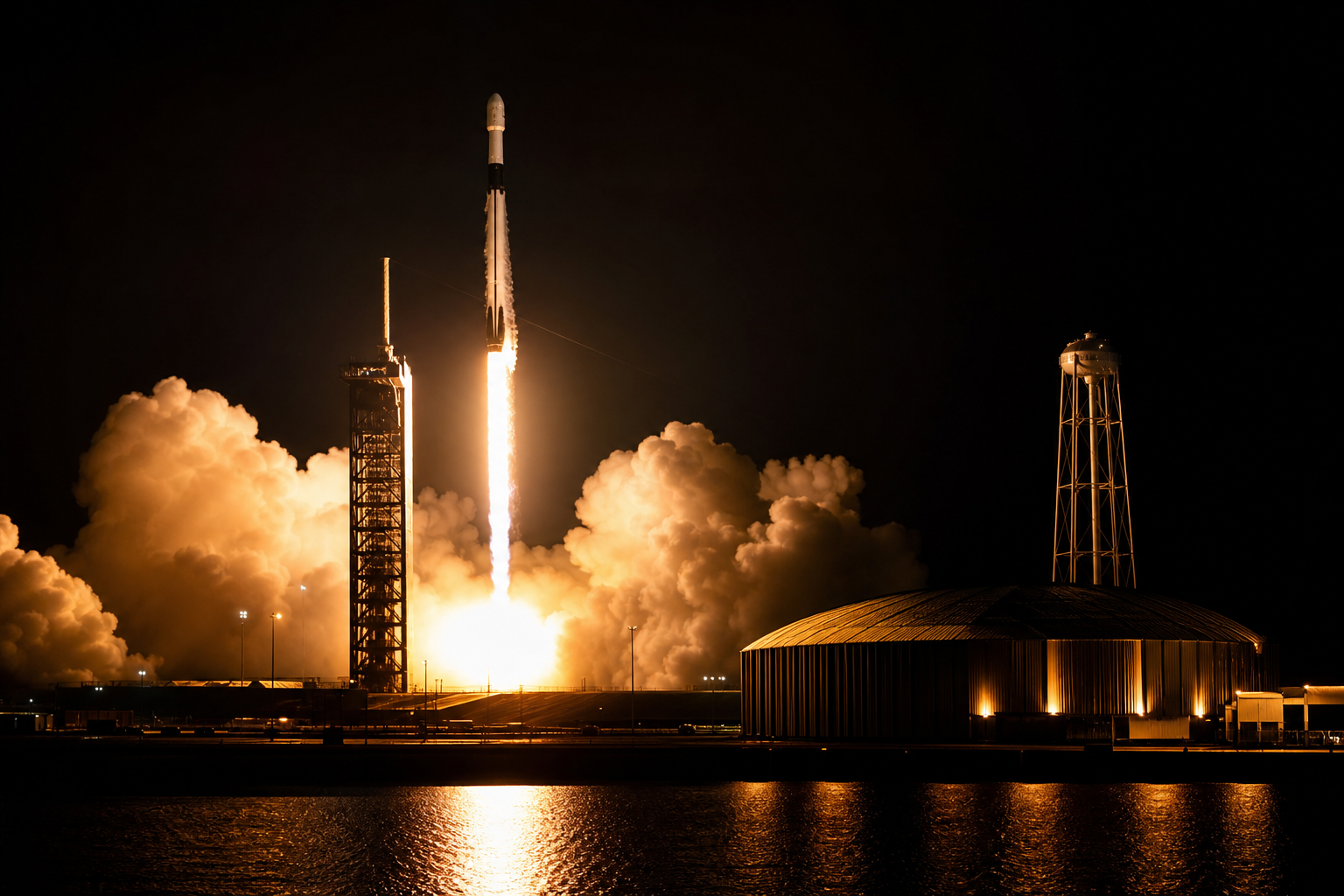
A century mark built on routine
SpaceX is again close to the annual century line. The company is targeting a Falcon 9 launch from Vandenberg Space Force Base in California during a four-hour window opening at 10 p.m. EDT on August 18, or 02:00 UTC on August 19. Space.com reported that the Starlink Group 17-50 mission would be SpaceX’s 100th mission of 2026 overall and the 97th Falcon 9 flight of the year, carrying 24 Starlink satellites to low Earth orbit.
That framing matters. The milestone is not a lunar landing, a crewed debut or a once-a-decade flagship science mission. It is a broadband satellite deployment, flown on a partially reusable rocket, from a military spaceport that has become part of a high-throughput commercial launch network. The mission plan is familiar: Falcon 9 climbs out of Vandenberg, sends another Starlink stack toward low Earth orbit, and returns its first stage to the drone ship “Of Course I Still Love You” in the Pacific. Space.com said the booster, B1097, was assigned to its 12th mission and that satellite deployment was expected about 61.5 minutes after liftoff.
In an earlier era, a 100th launch in a calendar year would have sounded like a national-program statistic. For SpaceX, it is becoming an operating metric.
Why the 100th mission is mostly a Starlink story
The fastest way to understand SpaceX’s launch cadence is to follow the payloads. Space.com reported that 73 of the company’s 2026 launches so far have been devoted to Starlink, and that the constellation consists of nearly 11,000 operational satellites.
That means the 100-launch target is not merely a sign of demand from outside customers. It is also a vertically integrated buildout: SpaceX manufactures satellites, launches them on its own rockets, expands its own network, and then sells connectivity services on top of that orbital infrastructure. The company is both the railroad and a major shipper on the railroad.
The result is a feedback loop. More launches add satellites. More satellites improve network density, coverage, resiliency and capacity. Better network performance supports more users and higher-value services. That, in turn, creates pressure to launch more spacecraft. In this model, Falcon 9 is not just a rocket; it is the replenishment mechanism for a global telecommunications platform.
The Group 17-50 mission fits exactly into that machine. It is not notable because 24 satellites is a huge payload by modern SpaceX standards. It is notable because the same basic process can happen again and again with short intervals, known recovery procedures and reused hardware.
Cadence is the competitive moat
The 100th mission comes days after SpaceX set another operational record. On August 15 in U.S. time, the company launched two Falcon 9 rockets just 38 minutes apart, breaking its prior shortest interval between orbital flights by 27 minutes, according to Space.com.
That doubleheader underlines the larger shift. SpaceX’s advantage is not simply that it can reuse boosters. It is that reuse has been turned into scheduling power. Pads, droneships, recovery teams, range coordination, satellite production and launch operations all have to function as one industrial system. A record measured in minutes between orbital missions suggests a company optimizing not only rockets but workflows.
For competitors, that is a difficult target. Building a reusable rocket is one challenge. Building the operating system around it — refurbishment capacity, launch licenses, pad access, fleet management, ground crews, maritime recovery, satellite integration and customer scheduling — is another. The launch vehicle is only the most visible part of the factory.
SpaceX’s own history shows the acceleration. Space.com noted that the company first topped 100 launches in 2024 with 138 missions, then flew 170 times in 2025. The same report said the 2026 count includes 97 Falcon 9 missions, one Falcon Heavy mission and two Starship suborbital test flights as SpaceX approaches the latest century mark.
Falcon 9 still carries the business
The near-term story remains Falcon 9, even as the long-term narrative is Starship. Falcon 9 is mature, reusable, widely manifested and trusted by commercial, government and internal Starlink missions. It is also the vehicle that makes the Starlink deployment curve plausible.
The 100th-mission launch profile illustrates the economics of repetition. A booster on its 12th flight is no longer a novelty; it is scheduled capacity. Drone-ship landings are not public-relations theater; they are inventory recovery. The payload is not experimental; it is another increment of a network whose commercial value depends on density.
That does not mean cadence is risk-free. High-frequency launch operations raise questions about range availability, environmental impact, launch-site wear, orbital debris, astronomy interference and the resilience of a constellation that must be continuously replenished. But those risks are now part of a running industrial system rather than hypothetical debates about a future megaconstellation.
Starship is the promised step-change
Space.com reported that SpaceX wants Starship eventually to take over the load from Falcon 9 and Falcon Heavy, with Elon Musk previously describing ambitions for multiple Starship launches per day and roughly 1,000 annual missions.
That is the strategic horizon behind the 100-launch milestone. Falcon 9 has industrialized medium-lift launch. Starship is intended to industrialize heavy lift at much larger scale. If Falcon 9 made Starlink’s current constellation possible, Starship is supposed to make larger satellites, larger replenishment batches and more ambitious orbital infrastructure economical.
For now, however, Starship remains developmental. The 2026 mission mix cited by Space.com includes two suborbital Starship test flights, compared with 97 Falcon 9 flights. That ratio is the clearest reminder that SpaceX’s present business is still carried by Falcon 9, while its valuation narrative increasingly points to Starship-enabled futures.
The financial meaning of launch frequency
The market relevance of the 100th mission is that SpaceX is no longer just a launch provider. It is a capital-intensive infrastructure company whose value case depends on turning launch frequency into revenue-generating networks. Starlink is the clearest example, but the same logic can extend to direct-to-device connectivity, national-security satellites, hosted payloads and future compute architectures.
That is why a routine Starlink launch can matter to investors beyond the space sector. Every mission is a data point in SpaceX’s ability to deploy physical infrastructure faster than rivals. If the company can keep compressing time between launches, lower the marginal cost of orbital delivery and maintain reliability, it gains pricing and strategic leverage across several markets.
But cadence also cuts both ways. A company that launches constantly must spend constantly: satellites, rockets, ground stations, spectrum coordination, staff, ships, pads and future Starship facilities. The bullish case is that scale drives down unit costs and opens markets competitors cannot reach. The cautious case is that the same scale demands enormous capital before all revenue streams mature.
The bigger shift
The real significance of SpaceX targeting 100 missions by mid-August is cultural as much as technical. Orbital launch is being reframed from an episodic event into a logistics service. The countdown still looks dramatic, but the business model increasingly resembles infrastructure operations: repeatable, scheduled, measured, optimized.
If Starlink Group 17-50 flies as planned, the headline will say SpaceX hit 100 missions for the year. The deeper story is that the company has made that number feel almost expected. That expectation may be SpaceX’s strongest position — and its biggest burden. Once spaceflight becomes industrial, the market stops applauding every launch and starts asking whether the system can compound.
Sources from the last 72 hours
- [1]Watch SpaceX launch its 100th mission of the year tonightAug 18, 2026, 12:00 AM UTC
- [2]New record! SpaceX launches 2 Falcon 9 rockets just 38 minutes apart (video)Aug 16, 2026, 2:54 AM UTC
- [3]r/SpaceX Starlink 17-50 Official Launch Discussion & Updates Thread!Aug 17, 2026, 12:00 AM UTC
- [4]Upcoming Space Launches for August 18, 2026Aug 18, 2026, 12:00 AM UTC
AI-generated article based on recent web research, then preserved as a dated editorial snapshot.
Comments
Be the first to comment.