
Daily Podcast full article
Nvidia’s $105B OpenAI Ohio backstop turns AI infrastructure into project finance
Nvidia is no longer just selling accelerators into the AI boom. Its new Ohio arrangement for an OpenAI-leased SB Energy campus makes the chipmaker a strategic credit supporter, equity investor and exclusive compute supplier in one of the largest AI data-center commitments yet disclosed.
The deal: not a chip order, but a credit backstop
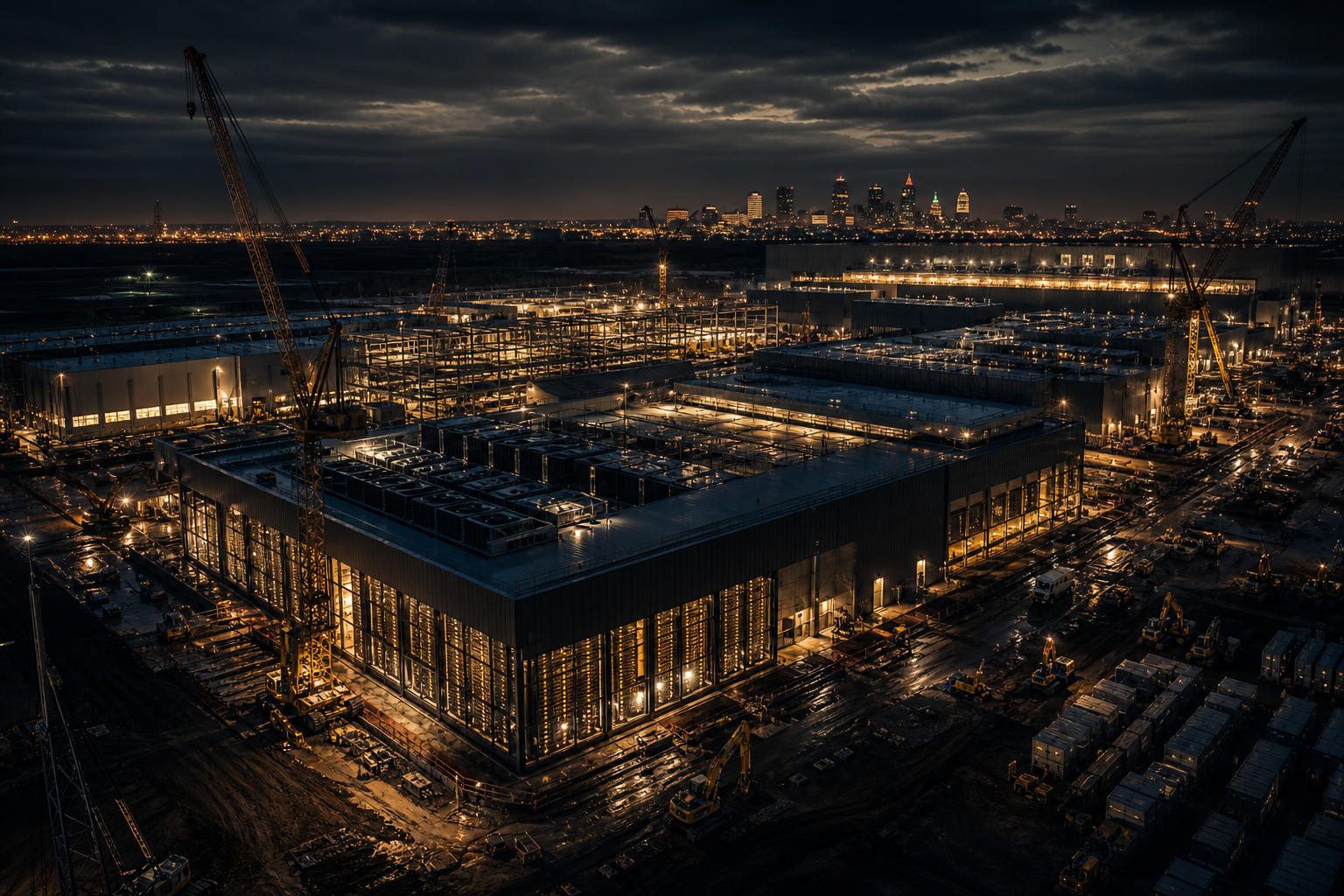
Nvidia’s latest move in the AI infrastructure race is less a conventional sale than a financial architecture. On August 17, Nvidia disclosed that it had entered agreements connected to the PORTS-Pike Technology Campus in Pike County, Ohio, where SB Energy will build, own and operate a data center under a 20-year lease to OpenAI. Nvidia will be the exclusive AI compute infrastructure provider, while OpenAI will be the customer for roughly 8 IT-gigawatts of capacity.
The headline number is enormous: Nvidia’s initial aggregate payment obligation is capped at $105 billion. But the SEC filing shows why “financing” is an incomplete label. The agreements are residual value guaranties tied to about 4.25 gigawatts of IT load. Nvidia’s obligation is conditional and is expected to apply only after relevant premises are ready for service, with that readiness expected to begin in 2028.
In plain terms, Nvidia is not simply wiring $105 billion to OpenAI. The filing says Nvidia would pay if OpenAI becomes insolvent and defaults, or fails to make lease payments, and only for a shortfall between a guaranteed minimum lease value and what SB Energy recovers through reletting or sale. Nvidia can also assume the lease, require reletting, initiate a sale process, terminate the lease, or defer remedies for up to one year while paying specified project costs. OpenAI has agreed to reimburse and indemnify Nvidia for amounts Nvidia actually pays.
That structure matters. It is designed to give SB Energy and its financiers confidence that the first phase can be funded and built, while giving OpenAI access to frontier-scale compute without paying for the full campus before capacity exists. It also gives Nvidia something strategically valuable: a long-lived site that is committed to Nvidia systems.
Why Ohio, and why now?
OpenAI says it has secured approximately 8 IT-gigawatts at PORTS-Pike, working with SB Energy, Nvidia and the U.S. Department of Energy. The company describes the project as a six-year buildout through 2032, with 35,000 construction jobs and 2,500 long-term operating jobs expected. It has also promised an additional $40 million community grant fund, on top of SB Energy’s earlier $40 million commitment, and up to $84 million in Codex credits for eligible Ohio college students.
The site is symbolically potent. OpenAI says SB Energy is developing the campus across private land and remediated federal land at the former Portsmouth Gaseous Diffusion Plant, turning a Cold War industrial and national-security site into AI infrastructure. The first 800 megawatts are expected to become available in 2028, largely using existing AEP infrastructure; later phases depend on new power plants, transmission, permits, environmental reviews and financing.
Nvidia’s release frames the project around what CEO Jensen Huang calls “land, power and shell” capacity: the physical layer needed before GPUs, CPUs, networking and software can be productive. Nvidia says the initial deployment is designed for 4.25 IT-gigawatts of AI factory capacity and will use its full-stack DSX AI factory platform, including GPUs, CPUs and networking. Nvidia also retains an option to extend the opportunity beyond the initial capacity, while its SEC filing says it can provide support for approximately an additional 3.8 gigawatts at its sole discretion.
The strategic bargain for each party
For OpenAI, the campus is a hedge against the central bottleneck in frontier AI: reliable, very large-scale compute. The company says it will start paying only as completed capacity becomes available and expects to fund those commitments through business growth, cash flow and capital raised from investors. That shifts the project from a single upfront burden into a staged capacity contract, though it does not eliminate OpenAI’s long-term obligation.
For SB Energy, the arrangement turns a mega-project into something more bankable. A 20-year OpenAI lease is powerful; Nvidia’s credit support makes it more so. Nvidia is also investing $1.5 billion in SB Energy, joining SoftBank Group and OpenAI as stakeholders and supporting SB Energy’s ambitions as an AI infrastructure developer. Goldman Sachs and JP Morgan advised SB Energy, while Morgan Stanley advised Nvidia.
For Nvidia, the upside is even broader. The company is not only supplying chips. It is helping secure the land, power and shell where future Nvidia systems will be installed and upgraded. Nvidia says the campus will exclusively host Nvidia AI compute, and OpenAI says Nvidia and OpenAI will collaborate on design, testing and commissioning.
That makes the Ohio project a flywheel. Nvidia’s credit strength helps make the campus financeable. The campus creates future demand for Nvidia hardware, networking and software. OpenAI’s model-development needs justify the capacity. SB Energy turns power and real estate into an AI infrastructure platform. Each participant strengthens the other’s business case.
The risk: circularity, leverage and concentration
The same flywheel also explains the concern. Axios reported that the deal is likely to revive worries about a “circular” AI bubble, because Nvidia is supporting infrastructure that will exclusively use Nvidia chips, with OpenAI as the tenant and SB Energy as owner. Axios also noted that the campus will have 8 IT-gigawatts of computing capacity powered by 10 gigawatts of new energy generation, and that Nvidia’s guarantee covers up to $105 billion in conditional lease and power payment obligations.
Semafor placed the agreement inside a broader debate about debt-fueled AI expansion, citing worries that off-balance-sheet credit structures are becoming more difficult for investors to assess. The point is not that the Ohio project is inherently unsound; it is that the AI buildout increasingly depends on large, interlocking commitments among the same technology, infrastructure and finance players.
The SEC filing tries to draw boundaries around Nvidia’s exposure. The cap is $105 billion for the initial commitment; obligations depend on trigger events; OpenAI indemnifies Nvidia; and obligations can terminate after lease milestones, OpenAI termination rights, a satisfactory OpenAI credit rating or other events. Still, a guarantee of this size can matter even if no cash is immediately paid, because it links Nvidia’s balance sheet to the performance of a vast AI tenant and a complex energy-and-data-center buildout.
What to watch next
The immediate test is not whether the full 8 IT-gigawatts appears overnight. OpenAI itself says the full campus will not be built all at once. The relevant milestones are more practical: permits, financing, transmission, power-plant development, water-use reporting, local hiring, and the first 800 megawatts targeted for 2028.
The second test is accounting and investor interpretation. Markets will ask whether Nvidia’s backstop is a prudent way to secure demand for its AI platform or a sign that GPU demand increasingly needs vendor-supported financing. The answer may be both. In heavy industry, suppliers have long helped finance customers. What is new is the scale, speed and strategic concentration of AI infrastructure.
The third test is community credibility. OpenAI has promised annual reporting on local hiring, community investment, water use and project-related energy use. It says the project will pay its own energy and infrastructure costs, use closed-loop air-cooled systems to reduce ongoing water demand, and prioritize local workers and suppliers. Those commitments will be judged over years, not in a launch-day press release.
The Ohio campus shows where the AI race is heading. Frontier models are no longer limited by algorithms alone; they are limited by power, land, permitting, transmission, financing and balance-sheet capacity. Nvidia’s role in Ohio blurs the line between vendor, strategic financier and infrastructure gatekeeper. For OpenAI, it is a route to the scale it believes it needs. For Nvidia, it is a bet that the best way to sell the next generation of AI compute is to help build the industrial system that will consume it.
Sources from the last 72 hours
- [1]OpenAI joins PORTS-Pike projectAug 17, 2026, 12:00 AM UTC
- [2]NVIDIA Guarantees SB Energy's PORTS-Pike Technology Campus in Ohio to Exclusively Host NVIDIA AI ComputeAug 17, 2026, 12:00 AM UTC
- [3]0001045810-26-000069Aug 17, 2026, 12:00 AM UTC
- [4]OpenAI announces massive Ohio data center with Nvidia guaranteeAug 17, 2026, 2:31 PM UTC
- [5]Nvidia to provide up to $105 billion backstop for OpenAI data centerAug 17, 2026, 10:51 PM UTC
AI-generated article based on recent web research, then preserved as a dated editorial snapshot.
Comments
Be the first to comment.