
Daily Podcast full article
Superconducting qubit chain points to a hardware route for cutting dephasing
A new npj Quantum Information paper proposes an open chain of superconducting qubits with alternating XX and YY ultrastrong interactions that can encode one logical qubit whose pure dephasing rate tends to zero as coupling strength or chain length increases. The result is theoretical, not yet a chip demonstration, but it reframes an important question for quantum hardware: useful stability may come not only from more error correction, but from qubits whose interaction symmetry removes a major noise channel before correction begins.
A fresh claim: make phase noise structurally disappear
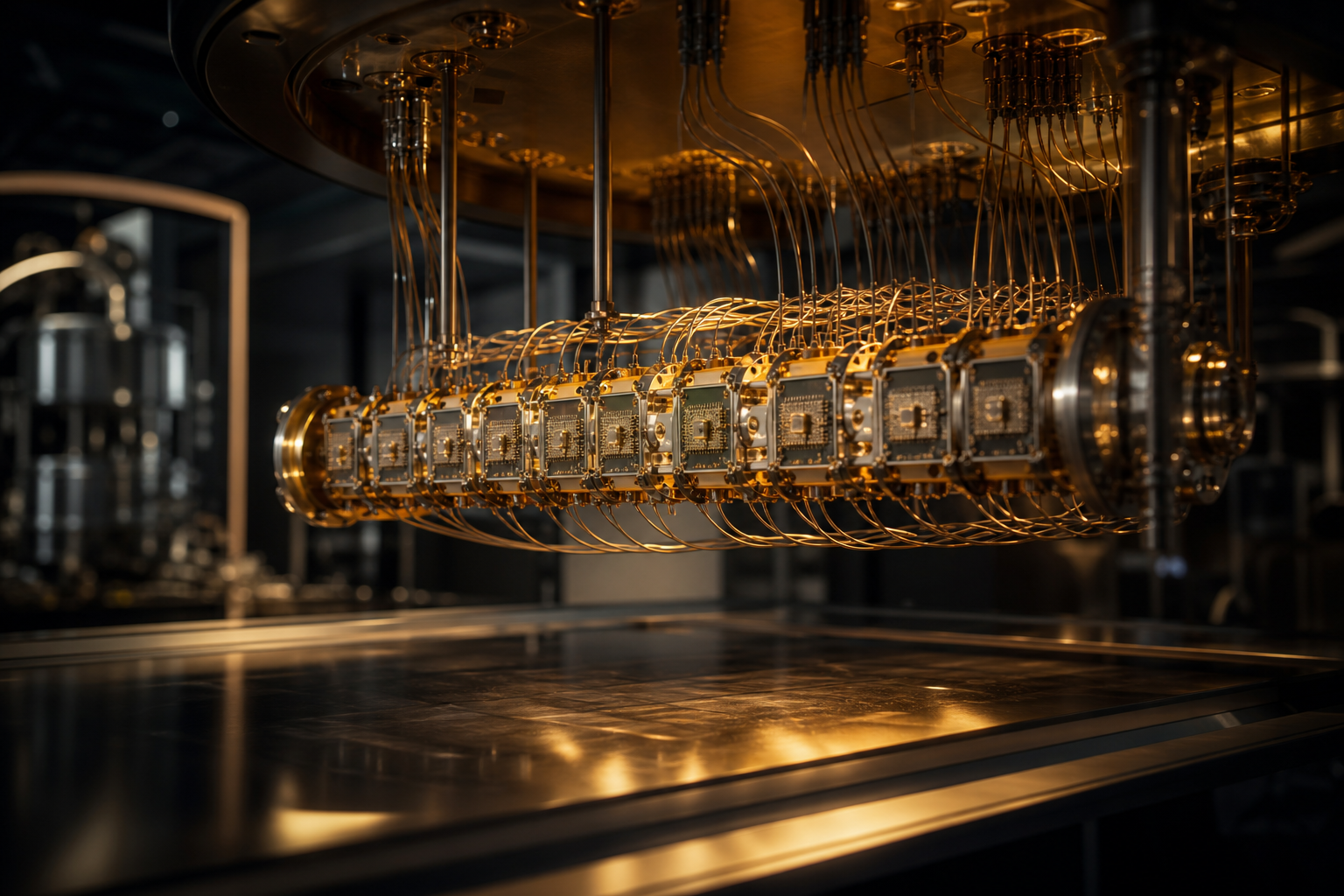
A paper published on 15 August 2026 in npj Quantum Information reports a theoretical design for a “noise protected logical qubit” built from an open chain of superconducting qubits. The core proposal is deceptively simple: couple neighboring qubits in an alternating pattern, XX then YY, and operate the chain in the ultrastrong-interaction regime. Roberto Stassi, Shilan Abo, Daniele Lamberto, Ye-Hong Chen, Adam Miranowicz, Salvatore Savasta and Franco Nori write that the two lowest energy eigenstates of the chain can be used as a logical qubit, with both pure dephasing and relaxation times improved relative to the individual physical qubits. Most strikingly, they report that increasing either the interaction strength or the number of qubits suppresses the logical qubit’s pure dephasing rate to zero, while the relaxation rate is reduced to half that of a single physical qubit.
That claim matters because dephasing is one of superconducting quantum computing’s stubborn enemies. In simple terms, a qubit can fail by losing energy to its environment, usually discussed as relaxation or T1, or by losing the phase relationship between its quantum states, discussed as dephasing or T2. The new paper defines pure dephasing as arising from energy fluctuations that scramble relative phases, while relaxation is driven by environmental fluctuations that induce transitions and energy loss. The authors’ promise is not that all error mechanisms vanish. It is narrower and therefore more plausible: the chain’s symmetry can make one damaging class of phase noise effectively invisible to the encoded logical state.
What is different about the XX–YY chain
Many protected-qubit ideas rely on building an energy landscape or code space that is difficult for local noise to disturb. This paper places the protection in the interaction pattern. The authors compare their alternating XX–YY model with a more conventional Ising-like chain in which qubits interact along the same X direction. In the Ising case, strong coupling can reduce pure dephasing, but it leaves a severe relaxation vulnerability because the relaxation susceptibility in one channel grows with the number of qubits. The alternating model is intended to avoid that tradeoff by using two orthogonal coupling directions.
The Nature paper states that the proposed system is an open chain of three or more artificial atoms, with interactions alternating between X and Y directions. It says the resulting suppression of pure dephasing and relaxation improves as either the coupling strength or qubit number grows, and that the design is more robust than the Ising model against symmetry-breaking noise. The authors also say their numerical simulations, performed with the QuTiP library, support high-intrinsic-fidelity single- and two-qubit gates.
This last point is essential. Noise-protected qubits often face a painful bargain: the more isolated the protected states are from the environment, the harder they are to control. If the control pulses couple poorly to the protected subspace, gates become slow, lossy or require temporarily breaking the very protection that made the qubit attractive. Stassi and colleagues are arguing that the XX–YY chain avoids at least part of this penalty. The design is not simply a memory; it is proposed as a logical qubit that can still be manipulated.
Why “zero dephasing” should be read carefully
The phrase “dephasing to zero” is powerful, but it should not be mistaken for a finished fault-tolerant architecture. The published paper is a theory and simulation result, and Springer Nature flags the manuscript as an early, unedited version provided for access before final production editing.
The protection also depends on engineering conditions that are not trivial. The authors propose a possible circuit realization using three flux qubits: the first two would be linked through a Josephson junction to produce an ultrastrong XX interaction, while the second and third would share a capacitor to produce a YY interaction. Tech Times, reporting on the work on 16 August 2026, emphasized the same practical caveat: XX ultrastrong coupling has a clearer experimental path in superconducting circuits, while the ultrastrong YY coupling needed for the alternating chain remains the harder part to realize and validate.
So the result is not a claim that tomorrow’s commercial transmon processors can switch on a new mode and erase dephasing. It is a design principle: use alternating coupling symmetry in a superconducting chain to encode information into states less exposed to local phase noise.
What it could change in the error-correction debate
The timing is important because quantum computing roadmaps increasingly revolve around error correction. Surface-code approaches, bosonic codes, cat qubits, tunable couplers, fast reset and leakage-reduction schemes all attack different pieces of the same problem: physical devices are too noisy to run deep computations directly.
Another npj Quantum Information paper published on 15 August 2026 illustrates that broader engineering push. Liangyu Chen and collaborators report a fast, unconditional reset and leakage-reduction protocol for fixed-frequency transmon qubits, using tunable couplers to move unwanted excitations to readout resonators, with the combined multi-level reset, leakage reduction and coupler reset taking 88 ns and achieving fidelities above 99%.
Placed beside that work, the XX–YY chain points to a complementary layer of the stack. Reset and leakage reduction help error-correction cycles start clean and remove population outside the computational subspace. The Stassi proposal tries to reduce one error source before the cycle even begins. If such a chain could be fabricated, calibrated and integrated with high-fidelity gates, it could lower the physical error rate that quantum error correction must handle. That would not eliminate error correction, because relaxation remains and real chips introduce disorder, crosstalk, thermal photons and control imperfections. But removing or sharply suppressing pure dephasing at the hardware level could reduce overhead.
The open questions
Three questions now dominate.
First, can the required YY ultrastrong coupling be built in a superconducting circuit with the right strength, reproducibility and isolation from parasitic terms? The paper’s proposed flux-qubit implementation is a starting point, not an experimental demonstration.
Second, does the symmetry protection survive fabrication disorder? The paper argues that the alternating chain is more robust than the ultrastrong Ising model against symmetry-breaking noise, but real devices bring frequency spread, unwanted ZZ terms, calibration drift and lossy materials.
Third, can this idea migrate from flux-qubit demonstrations to the transmon-heavy ecosystem used by most industrial superconducting platforms? Flux qubits are natural candidates for ultrastrong coupling experiments, but transmons dominate scaled processors because of their mature fabrication, control and coherence record.
The significance
The best way to read the 15 August result is as a hardware-level proposal with a sharp target: make the encoded qubit insensitive to pure dephasing by design. It is not a proof that useful quantum computers are suddenly closer by a fixed number of years. It is, however, a reminder that progress may come from better-behaved physical building blocks, not only from larger codes laid on top of noisy ones.
If the alternating XX–YY chain is experimentally confirmed, it would add a new option to the protected-qubit toolkit: a logical superconducting qubit whose noise budget is reshaped by coupling symmetry itself. For a field wrestling with the cost of error correction, that is a development worth watching.
Sources from the last 72 hours
- [1]Noise protected logical qubit in an open chain of superconducting qubits with ultrastrong interactionsAug 15, 2026, 12:00 AM UTC
- [2]Noise protected logical qubit in an open chain of superconducting qubits with ultrastrong interactions — PDFAug 15, 2026, 12:00 AM UTC
- [3]Superconducting Qubit Chain Drives Dephasing to Zero Without Error CorrectionAug 16, 2026, 2:55 PM UTC
- [4]Fast, unconditional reset and leakage reduction in fixed-frequency transmon qubitsAug 15, 2026, 12:00 AM UTC
AI-generated article based on recent web research, then preserved as a dated editorial snapshot.
Comments
Be the first to comment.