
Daily Podcast full article
Starcloud’s orbital AI test turns a stunt into an infrastructure question
Starcloud’s H100-in-orbit demonstration remains a small experiment, not a space data center. But fresh reporting has sharpened what actually happened: NanoGPT was trained aboard Starcloud-1, Gemma was run for inference, and the larger debate is now shifting from “can AI run in orbit?” to “which workloads, economics and risks could ever justify moving compute off Earth?”
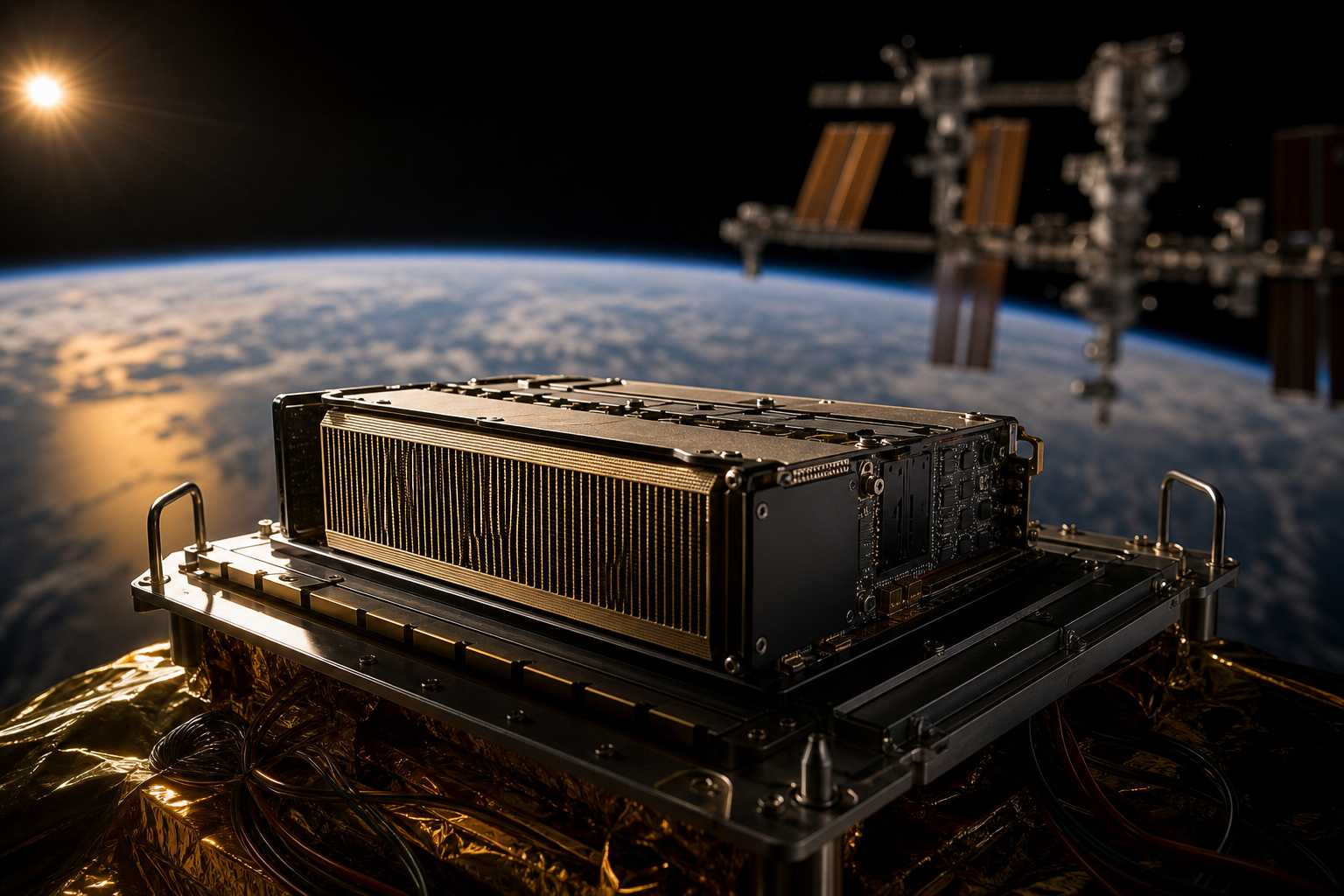
The milestone, stripped of hype
Starcloud’s orbital AI claim is no longer just a futuristic pitch about data centers in space. Fresh reporting published on August 16 details a narrower but still important milestone: on December 10, 2025, Starcloud said an Nvidia H100 aboard its Starcloud-1 satellite trained a language model in low Earth orbit, saved the resulting checkpoint and used it to generate text while circling the planet. The satellite was described as operating hundreds of kilometres above Earth, with the H100 belonging to the same accelerator family used in terrestrial AI data centers.
The crucial distinction is what was trained. Starcloud did not train Google’s Gemma in space from scratch. According to the same fresh account, the spacecraft ran inference with a preloaded version of Gemma, while the model actually trained onboard was Andrej Karpathy’s NanoGPT using Shakespeare text. That matters because inference proves a model can execute in orbit; training proves the spacecraft can perform the more demanding loop of forward passes, loss calculation, backpropagation and weight updates away from any human technician.
That makes the achievement both real and limited. NanoGPT is a compact educational implementation of a GPT-style transformer, not a frontier model. The Shakespeare dataset is tiny compared with modern training corpora, and Starcloud has not publicly released enough information to reproduce the run: no full hyperparameter set, energy profile, loss curve, model checkpoint or independent telemetry archive has been made public, according to the August 16 report. The safest description is therefore not “ChatGPT trained in space,” but “the first publicly reported orbital training of a small GPT-style language model on a data-center-class accelerator.”
Why an H100 in orbit matters anyway
The point of the test is not that a Shakespeare model became useful. It is that a commercial accelerator built for data centers operated inside a spacecraft and completed a training workload. On Earth, H100-class hardware usually lives inside racks supported by heavy electrical distribution, cooling systems, high-bandwidth networking and maintenance crews. In orbit, Starcloud had to make the chip live with vacuum, radiation, limited power, thermal constraints and remote operations.
That shift is the core of the experiment. Vacuum does not cool electronics the way people intuitively imagine; without air, heat cannot simply convect away. It must be conducted through hardware and radiated into space. Radiation can corrupt memory or trigger faults in electronics that were not originally designed as radiation-hardened spacecraft components. A successful short run does not prove years of reliable service, but it does show that a modern AI software stack can survive the transition from server room to autonomous satellite at least long enough to perform a meaningful computation.
The demonstration also forces a useful separation between three possible orbital-compute markets. The first is symbolic proof-of-concept work, which Starcloud-1 has now supplied. The second is near-term in-space processing, such as analyzing satellite imagery or sensor data near where it is generated, reducing the need to downlink raw data. The third is the most ambitious: large-scale training or inference infrastructure that competes with terrestrial cloud data centers. Starcloud’s test supports the first and gestures toward the second. It does not yet validate the third.
The real infrastructure question
If AI compute moves into orbit, the argument will not be that space is easy. It will be that some constraints on Earth are becoming harder: power availability, land, water, permitting, grid interconnection and latency to space-generated data. Starcloud’s premise is that orbital platforms could use abundant solar energy and avoid terrestrial cooling water, while processing spaceborne data closer to its source. But the August 16 analysis also emphasizes the counterweight: frontier AI training is a distributed-systems problem involving thousands of accelerators, enormous datasets and constant synchronization. A single H100 training NanoGPT avoids most of that difficulty.
Data movement is the least glamorous but perhaps most decisive issue. Shakespeare can be preloaded or transmitted easily. Frontier training data cannot. Even if optical links improve, training large models in orbit would require moving huge datasets and intermediate results across spacecraft and down to Earth with reliability comparable to terrestrial cloud networks. That is why inference and edge processing remain more plausible early markets than full-scale frontier training.
The current investor and public conversation reflects that split. Over the August 15 weekend, an Intuitive Machines investor thread highlighted management discussion of strategic partnerships and bids connected to orbital data centers, treating the category as an emerging commercial market rather than a one-company idea. The thread is not a primary source for Starcloud’s technical performance, but it shows how quickly “orbital data center” has moved into the vocabulary of space-infrastructure investors.
A separate August 16 public discussion about SpaceX-style orbital AI data center ambitions shows the other side of the mood: excitement about launch economics and energy abundance sits beside skepticism over cost, cooling, orbital crowding, debris and maintenance. Again, social media is not evidence that a business model works, but it is useful evidence that the category has entered mainstream debate and that the objections are now practical rather than purely imaginative.
What Starcloud has and has not proved
Starcloud has proved, on the public record available this week, that a data-center-class GPU can run a small language-model training job in orbit. It has also clarified a path for early orbital compute: run inference or analytics close to satellites and transmit answers rather than raw data. That could be valuable for Earth observation, defense, disaster response, maritime monitoring or any application where raw space data is bulky and time-sensitive.
It has not proved that orbital data centers are cheaper than terrestrial ones. It has not shown multi-GPU training in space, long-duration H100 reliability, repairability, high-throughput orbital networking or a credible route to replacing a terrestrial hyperscale campus. It has not solved the economics of launching, upgrading and eventually deorbiting hardware that becomes obsolete quickly by data-center standards.
The right frame is therefore neither “science fiction” nor “inevitable replacement.” Starcloud-1 is an engineering proof point at the beginning of a long infrastructure experiment. The milestone matters because the location changed. AI training, however small, crossed the atmosphere and worked.
What to watch next
The next serious indicators will be less theatrical than the first H100 headline. Watch for longer-duration telemetry, independent technical disclosures, customer workloads, radiation and thermal-performance data, and evidence of multi-accelerator operation. Watch whether early customers want orbit because their data is already there, rather than because space sounds cheaper. And watch whether launch companies, chipmakers and cloud providers converge around specific architectures instead of broad visions.
For now, Starcloud’s achievement is best read as a door opening, not a market arriving. The first orbital LLM training run did not move the cloud into space. It showed that one important piece of the cloud can survive there.
Sources from the last 72 hours
- [1]In December 2025, startup Starcloud trained the first large language model ever trained in orbit, using an NVIDIA H100 — the same class of GPU built for Earth's AI data centres, now running roughly 500 kilometres above the planet.Aug 16, 2026, 12:00 AM UTC
- [2]Orbital Data Centers and Intuitive MachinesAug 15, 2026, 12:00 AM UTC
- [3]The potential effect of SpaceX and their long term plan to put 1 million AI data centers in the orbit.Aug 16, 2026, 12:00 AM UTC
AI-generated article based on recent web research, then preserved as a dated editorial snapshot.
Comments
Be the first to comment.