
Daily Podcast full article
SpaceX’s 38-minute Falcon 9 doubleheader turns launch cadence into market power
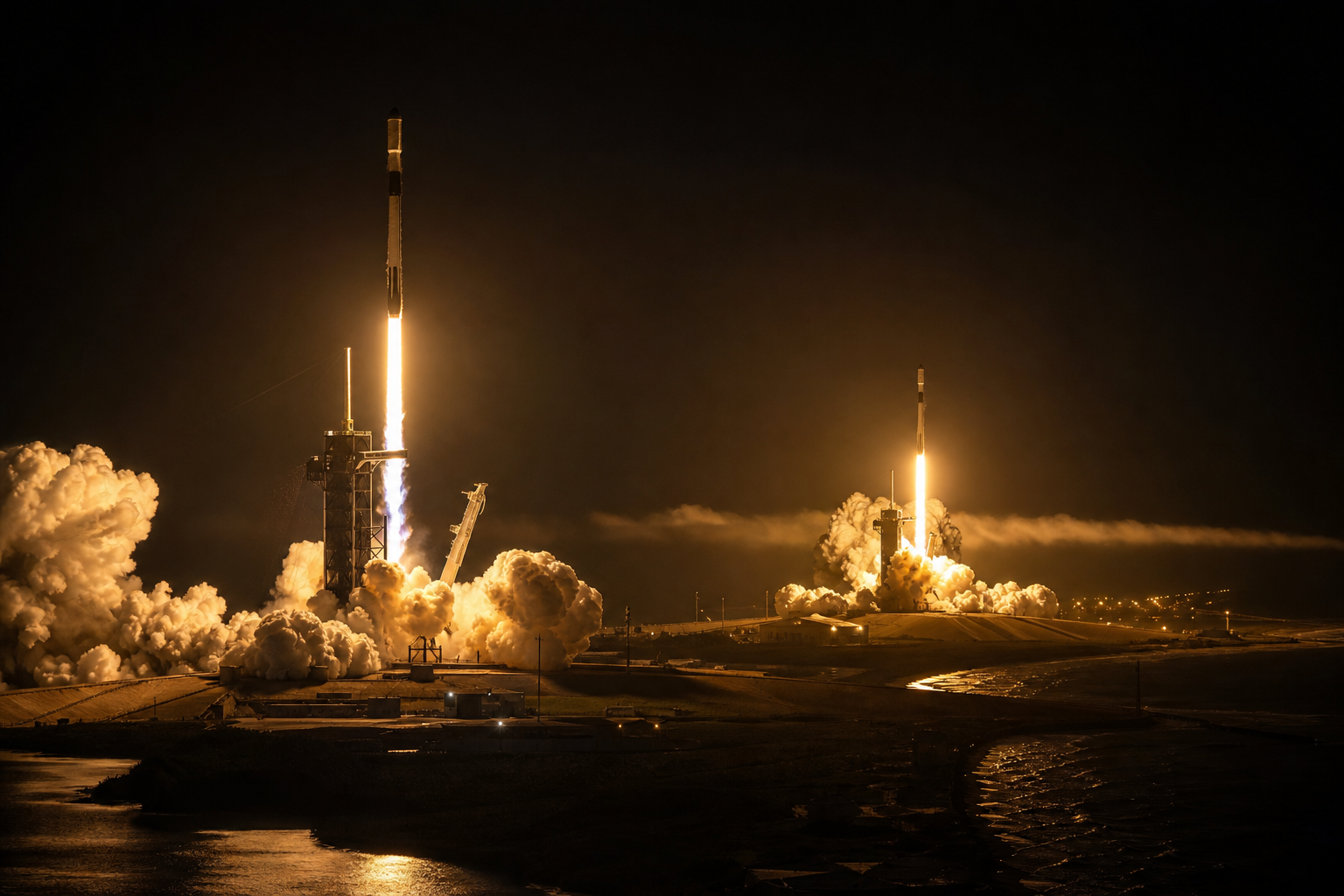
SpaceX’s latest dual-coast Falcon 9 sequence was not just a spectacular scheduling trick. With a Globalstar commercial mission from Florida and a classified U.S. Space Force mission from California separated by only 38 minutes, the company showed how launch cadence, reusability and government-commercial demand are reinforcing one another.
A record measured in minutes
SpaceX has moved launch tempo from a quarterly achievement to an operational metric, and its latest benchmark is unusually stark: two Falcon 9 rockets left opposite U.S. coasts just 38 minutes apart. Emirates News Agency reported that the first mission launched from Cape Canaveral Space Force Station in Florida at 9:12 p.m. Eastern on Saturday, carrying eight Globalstar satellites to low Earth orbit, while the second lifted off from Vandenberg Space Force Base in California at 9:50 p.m. Eastern with the classified USSF-366 mission for the U.S. Space Force.
Kazinform, citing WAM, framed the same sequence as a new launch record and added that SpaceX said the eight Globalstar spacecraft were successfully deployed, with separations occurring over roughly six minutes beginning about 56.5 minutes after liftoff. News 12, which covered the event from the perspective of U.S. skywatchers, also reported the 9:12 p.m. and 9:50 p.m. Eastern launch times and identified the two missions as Globalstar 2-R Launch 1 and USSF-366.
The raw interval matters because it compresses several difficult systems into one public number. A launch company does not simply light two rockets close together. It has to align weather, range safety, mission control staffing, pad readiness, propellant loading, downrange recovery assets, customer constraints and post-launch tracking. In this case, the two missions also used different launch ranges and different coasts, making the achievement less about one launch pad’s turnaround time and more about distributed launch operations.
Commercial and defense demand in the same hour
The payload mix is as important as the stopwatch. The Florida mission served Globalstar, a Louisiana-based telecommunications company, while the California launch supported a classified U.S. Space Force mission. WAM reported that one Falcon 9 carried eight Globalstar satellites and the other carried USSF-366 for the Space Force. That pairing captures SpaceX’s central advantage: the same reusable Falcon 9 architecture can serve commercial communications and national-security customers with little visible change in operating model.
For Globalstar, rapid launch access helps refresh and extend a low-Earth-orbit communications network. For the Space Force, the value is different: dependable access to orbit, discretion for classified payloads and the ability to place spacecraft on schedule from Vandenberg. For SpaceX, the common factor is volume. Each additional customer category improves fleet utilization, keeps pad teams active and spreads fixed infrastructure costs over more missions.
This is the “backing” behind the cadence. It is not only financial-market enthusiasm or brand prestige. It is the steady demand signal from operators that need satellites in orbit and from government agencies that need launch capacity treated as strategic infrastructure. The 38-minute sequence showed commercial and defense customers effectively sharing the same industrial base within a single prime-time hour.
Reusability turns cadence into infrastructure
News 12 reported that the Florida booster was flying for the 14th time and returned to Cape Canaveral’s Landing Zone 40, while the California booster was on its 18th flight and landed on the SpaceX droneship Of Course I Still Love You in the Pacific. Those details matter because cadence is not sustainable if every flight consumes an entire rocket. SpaceX’s operating model depends on boosters moving through inspection, refurbishment, assignment and relaunch like high-value transport assets rather than one-off hardware.
The two landings also show why the geography of recovery matters. A Florida return-to-launch-site landing simplifies some logistics by bringing the booster back to land near the launch complex. A Pacific droneship landing supports trajectories from Vandenberg where returning to the launch site may not fit performance or range requirements. In both cases, recovery is not a side show. It is part of the cadence machine.
The deeper point is that SpaceX is no longer competing only on payload mass, price or reliability in isolation. It is competing on the ability to make launch availability feel routine. When missions can be stacked minutes apart from different ranges, customers gain scheduling confidence. That confidence can influence satellite design, constellation replenishment plans and defense acquisition assumptions.
A competitive moat that is hard to copy
Rivals can design capable rockets, but cadence is harder to replicate than a spec sheet. It requires production flow, launch-site permissions, trained crews, range coordination, mission software, reusable hardware, recovery vessels and a backlog large enough to keep the system exercised. SpaceX’s 38-minute doubleheader is therefore a signal to competitors: the benchmark is not one successful launch, but repeated, synchronized operations.
The dual-coast timing also shifts how the market reads launch capacity. A single provider that can support a telecom replenishment mission and a classified military flight on the same evening has more than rocket inventory. It has institutional trust from different customer classes. That trust becomes self-reinforcing: more missions create more operational data, more data improves confidence, and confidence draws more missions.
There are still limits. Weather can interrupt the neatest manifest. Range availability is finite. Booster refurbishment can reveal surprises. Classified missions add undisclosed constraints. And a record interval does not automatically mean every customer will get a launch slot on demand. But the latest sequence suggests SpaceX’s bottleneck is increasingly about system optimization rather than proof of basic capability.
Why this record matters now
The most important lesson from the 38-minute mark is that launch is becoming more like network operations. Satellite broadband, mobile connectivity, Earth observation and defense architectures all depend on the ability to replace, thicken and upgrade constellations quickly. A company that can fly frequently can support faster technology refresh cycles in orbit. That matters when satellites are no longer rare national assets but operational nodes in larger networks.
SpaceX’s latest achievement also underscores a strategic asymmetry. Customers do not merely buy a rocket; they buy access to a launch ecosystem. In that ecosystem, Falcon 9’s reusable boosters, Florida and California launch sites, landing zones, droneships and practiced mission teams form a single service. The Globalstar and USSF-366 missions showed that ecosystem functioning at compressed speed.
The spectacle was visible in the sky, but the substance was in the schedule. Thirty-eight minutes is short enough to sound like a stunt. It is also long enough to reveal an industrial system working across two coasts, two customers and two recovery profiles. That is why SpaceX’s acceleration matters: it turns launch cadence into backing, and backing into an even stronger cadence.
Sources from the last 72 hours
- [1]SpaceX launches 2 Falcon 9 rockets just 38 minutes apartAug 16, 2026, 7:28 AM UTC
- [2]SpaceX launches two Falcon 9 rockets just 38 minutes apartAug 16, 2026, 2:24 PM UTC
- [3]Did you see it? SpaceX launches two Falcon 9 rockets minutes apart from FL, CAAug 16, 2026, 1:27 PM UTC
AI-generated article based on recent web research, then preserved as a dated editorial snapshot.
Comments
Be the first to comment.