
Daily Podcast full article
Tesla Optimus Gen 3: No Fresh Proof of $1/Hour Housekeeper Replacement
Tesla’s humanoid-robot story remains powerful, but the latest 72-hour evidence does not support the viral claim that Optimus Gen 3 is already replacing housekeepers at $1 per hour. Fresh reporting instead shows Tesla’s autonomy ambitions still moving through cautious, constrained rollouts.
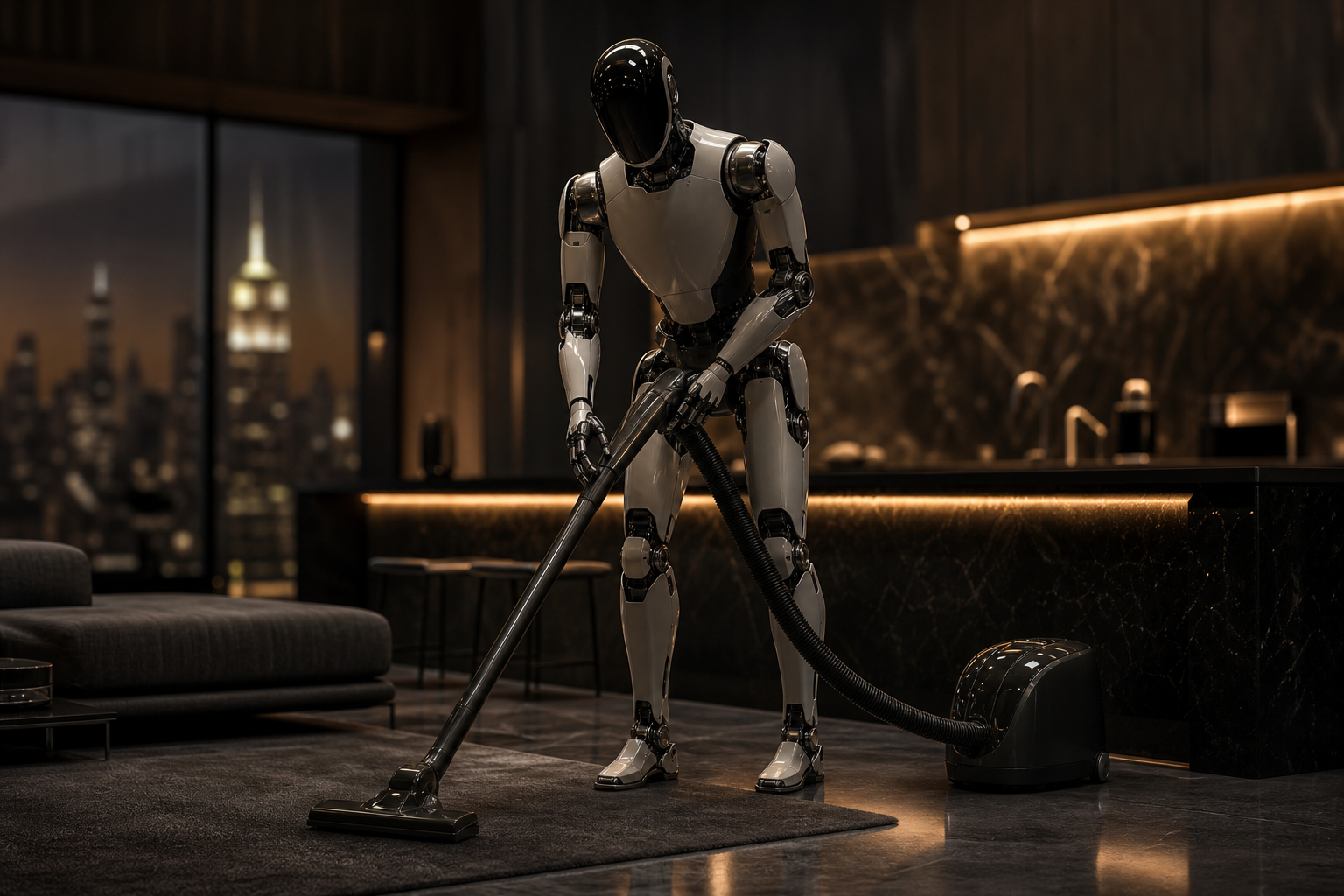
The claim versus the verifiable picture
The headline claim is dramatic: “New Tesla Bot Gen 3 Replacing Housekeepers With $1/Hour.” It suggests a finished domestic robot, a commercial labor price, and a near-term displacement of human cleaners. Based on fresh sources available in the 72-hour window ending August 16, 2026 at 01:00 UTC, that is not the current, verifiable state of the story.
There was no fresh Tesla announcement in that window confirming an Optimus Gen 3 public launch, a consumer release date, a housekeeper-replacement program, or a $1-per-hour operating cost. The strongest fresh evidence around Tesla’s physical-AI strategy points elsewhere: regulators are still limiting Tesla’s autonomous-transport expansion, and investor forums are still debating whether the company’s AI products can scale beyond carefully staged deployments.
Axios reported on August 14, 2026 that Tesla asked Nevada for permission to operate as many as 5,000 robotaxis in the Las Vegas area, but the Nevada Transportation Authority capped the permit at just 10 vehicles and imposed restrictions. That matters for Optimus because Tesla’s robot thesis is tied to the same broad claim: cameras, neural networks, AI infrastructure and manufacturing scale can move from cars into the physical world. The fresh regulatory signal is not “mass deployment is here.” It is “deployment is still conditional.”
Why robotaxi news matters to a humanoid robot story
Optimus, Cybercab and Tesla’s AI infrastructure are separate products, but they belong to one strategic narrative. Tesla is trying to convince investors and the public that it is no longer mainly an EV maker. It wants to be seen as a physical-AI company: autonomous vehicles move people, humanoids move objects, and large compute systems train the models behind both.
That is why the Las Vegas permit story is relevant. Axios’ August 14 newsletter framed the Nevada decision as a reality check: 10 vehicles is far from the 5,000 Tesla sought, and the limited approval resembles the company’s cautious early rollouts in other robotaxi markets. If Tesla’s road-based autonomy is still being scaled city by city and permit by permit, the burden of proof is even higher for a humanoid robot operating inside private homes, around stairs, pets, children, breakable objects, cleaning chemicals and closed doors.
A robotaxi route is constrained by maps, roads and traffic rules. A home is less structured. Housekeeping requires object recognition, soft manipulation, planning, privacy handling, safe motion around humans and the ability to recover from unexpected messes. The difference is not just mechanical. It is legal, social and operational.
The $1/hour number is an economic hypothesis, not a product price
The $1-per-hour figure should be treated as a projection, not a demonstrated Tesla service price. To reach such a number, a robot would need a low purchase price, high utilization, long service life, low maintenance, cheap charging, minimal remote human assistance, and very low failure rates. If a machine needs frequent supervision, repair visits, battery swaps, cleaning-tool changes, or cloud support, the real cost per useful hour rises quickly.
That is where the “housekeeper replacement” phrase becomes misleading. A human housekeeper does not merely move objects. They notice context, negotiate preferences, protect fragile possessions, understand priorities and take responsibility for edge cases. A robot that can fold a shirt in a demo is not automatically a substitute for a worker who manages an entire home.
The current evidence supports a more careful formulation: Tesla is pursuing humanoid robotics as a future labor platform, and Optimus Gen 3 is widely discussed as the company’s intended commercial step. But fresh reporting within the required window does not show mass home deployment or a verified $1-per-hour labor cost.
Public sentiment is still speculative
Fresh market chatter also shows how quickly Tesla’s autonomy narrative can jump from evidence to fantasy. In an August 14 TSLA investor thread, users discussed a Reuters/The Information item about a possible redesigned Roadster unveiling and a “flying” stunt, while also debating Cybercab, Optimus and merger rumors. The thread is not a primary source for Tesla plans, but it is useful as a snapshot of the atmosphere around the stock: any Musk-adjacent hardware rumor is rapidly folded into the same AI-and-robotics story.
A separate August 14 self-driving-car discussion focused on the Nevada robotaxi approval and repeatedly contrasted Tesla’s requested 5,000 vehicles with the permitted 10. Again, this is not corporate confirmation, but it shows that even Tesla watchers are reading the Las Vegas decision as a limited operational step, not a mass-scale breakthrough.
What would count as real proof?
For the “replacing housekeepers” claim to become news rather than hype, Tesla would need to show several things. First, a production Optimus Gen 3 unit performing full domestic task sequences without teleoperation or selective editing. Second, transparent information about autonomy: what runs onboard, what runs in the cloud, and when humans intervene remotely. Third, a safety framework for homes. Fourth, service economics: purchase price, lease price, warranty, repair intervals, energy use and expected useful hours.
Most importantly, Tesla would need paying customers outside its own controlled environments. Factory pilots are not household deployment. A manufacturing floor can be redesigned around robots; a home cannot. Even professional cleaning work varies enormously from house to house. Kitchens, bathrooms, laundry, toys, cords and clutter are not standardized industrial workflows.
Bottom line
The current state is not “Tesla Bot Gen 3 is replacing housekeepers at $1/hour.” The current state is that Tesla’s physical-AI ambitions remain central to its story, but the freshest verifiable evidence shows caution, limits and speculation. Nevada’s robotaxi cap underlines that regulators are not simply opening the door to unlimited autonomous deployment. Investor discussions show enthusiasm, skepticism and rumor moving faster than confirmed product facts.
Optimus may eventually become an important labor platform. But as of the 72-hour evidence window ending August 16, 2026, the housekeeper-replacement headline is ahead of the proof.
Sources from the last 72 hours
- [1]Tesla sought permit for 5,000 robotaxis in Las Vegas. It got 10.Aug 14, 2026, 6:09 PM UTC
- [2]Drone stocks take offAug 14, 2026, 8:50 PM UTC
- [3]Tesla Wins Nevada Robotaxi Permit, Setting Up Las Vegas LaunchAug 14, 2026, 12:00 AM UTC
- [4]$TSLA Daily Thread - August 14, 2026Aug 14, 2026, 12:00 AM UTC
AI-generated article based on recent web research, then preserved as a dated editorial snapshot.
Comments
Be the first to comment.