
Daily Podcast full article
SpaceX’s quiet national-security cadence becomes the story
A classified Space Force launch from California shows how normal, and strategically loaded, SpaceX’s role in U.S. defense space access has become: reusable commercial rockets now sit at the center of sensitive military logistics, even as the Pentagon tries to widen the supplier base.
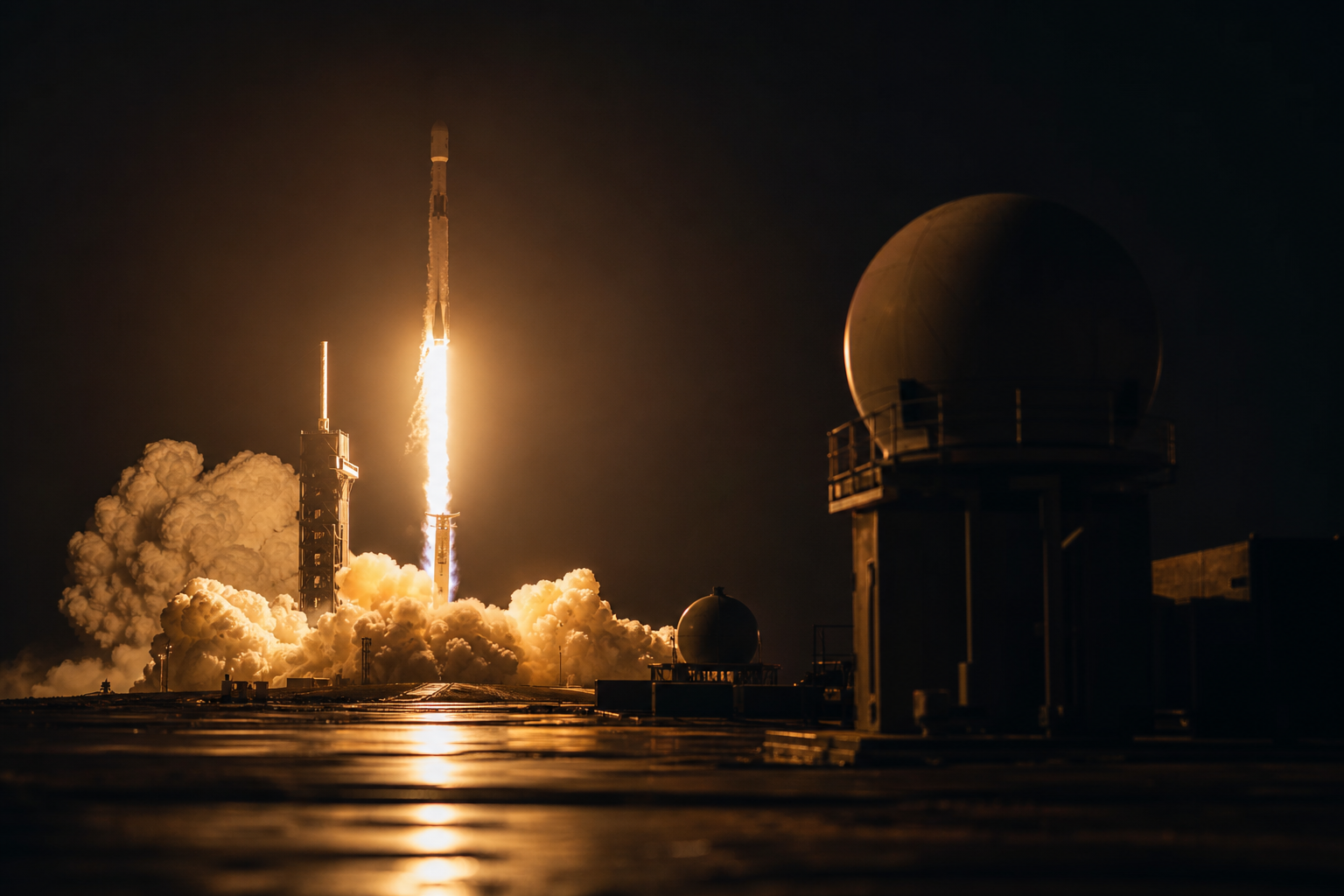
A classified launch with a public message
The payload was secret, but the signal was not. In the latest fresh launch listings, SpaceX’s Falcon 9 mission identified as USSF-366 was set for 2026-08-15 at 21:54 UTC from Vandenberg Space Force Base, California, with SpaceX as provider and a U.S. launch pad listed for the mission. The r/SpaceX launch thread, published within the freshness window, identified the site more specifically as Space Launch Complex 4 East and listed booster B1088-18, with the first stage planned to land on the droneship Of Course I Still Love You after its 18th flight.
That is the shape of modern national-security launch: little public detail about the spacecraft, extensive public evidence of the logistics. The mission name says “Space Force”; the pad says Vandenberg; the vehicle says Falcon 9; the booster number says reuse is no longer experimental but operational. Even when the customer’s payload is classified, the launch architecture is visible enough to show how deeply the U.S. government has embedded SpaceX into the routine movement of military capability to orbit.
Vandenberg matters because geography is strategy. Launches from California can support polar and sun-synchronous trajectories without crossing densely populated U.S. territory to the east. That makes the base a natural West Coast hub for reconnaissance, missile-warning, communications and other national-security architectures that need global coverage. In this case, the classification prevents a public payload description, but it does not obscure the procurement message: the Space Force continues to trust a commercial, reusable rocket system for missions it does not publicly describe.
Reuse as a military capability
The most important detail may be the booster count. A first stage on its 18th mission is not just a cost-saving device; it is a statement about cadence. For commercial customers, cadence lowers price and waiting time. For the U.S. military, cadence also means resilience: more launch opportunities, more practiced crews, more available hardware and a launch provider that can slot government missions into a high-volume manifest.
That does not mean every national-security mission is interchangeable with a Starlink flight. Classified missions bring additional security, integration and mission-assurance demands. But the underlying industrial base is shared. SpaceX’s ability to launch frequently from both coasts turns national-security access to orbit into something closer to an operating rhythm than a special event. The USSF-366 thread’s mission-success criterion was simply the successful deployment of spacecraft into orbit, a reminder that the public-facing objective is stripped down when the payload is sensitive.
This is why the customer is the headline. A Falcon 9 lifting an undisclosed Space Force payload from SLC-4E says more about U.S. defense space doctrine than any official description of the satellite might have said. The Pentagon is buying not only thrust, but availability, predictability and a launch ecosystem that has been stress-tested by sheer repetition.
The Space Force is broadening, not retreating
The deeper government tie does not mean SpaceX has the field to itself. Fresh reporting in the same 72-hour window shows the Space Force continuing to fund other commercial space firms. Space.com reported on 2026-08-14 that Rocket Lab received a $397 million Space Force contract to design, manufacture and launch “Flatellites” for threat tracking. The same report said Rocket Lab had announced four major U.S. government-funded defense contracts in 2026 worth a combined $943 million, including HASTE hypersonic test launches, geostationary satellites and missile-defense launch work from Alaska.
That context matters. The U.S. government appears to be doing two things at once: leaning heavily on SpaceX where it already has unmatched launch capacity, while nurturing alternatives across launch, satellite manufacturing, missile warning and data transport. In other words, SpaceX is becoming more central, but the government’s strategic aim is not single-vendor dependence. It is a layered ecosystem in which SpaceX supplies much of the backbone and others compete for nodes, payloads, demonstrations and specialized services.
A fresh discussion of the Space Force’s next-generation Space Data Network also points in that direction. The newly circulated Space Systems Command item describes a more resilient multi-vendor architecture, while contemporaneous discussion of the release notes that SpaceX had already won the backbone role for a proliferated optical-crosslink network and that the newer awards focus on how other systems connect to that backbone.
That is a subtle but important distinction. The Pentagon can rely on SpaceX for scale while still designing interfaces that let others plug in. If the government succeeds, SpaceX’s advantage becomes infrastructure rather than monopoly: it may carry the traffic, launch many of the satellites and provide a key network layer, but the broader architecture can still include Rocket Lab, York Space, traditional primes and future entrants.
Why classified launches are becoming routine
The paradox of USSF-366 is that secrecy now sits inside a highly public operational machine. SpaceX webcasts, launch trackers, local reporting and enthusiast communities can identify time, pad, vehicle and booster history even when the payload remains undisclosed. That is not a failure of secrecy; it is the reality of orbital logistics in a commercial era. The classified element is the mission, not the fact that the mission exists.
For the Space Force, that routinization is useful. A steady stream of Falcon 9 flights makes individual military launches less conspicuous in the broader cadence of commercial and government activity. It also supports faster replenishment. If satellites are threatened, degraded or simply aging, a government that can buy rides on a frequently flying reusable rocket has more options than one dependent on scarce bespoke vehicles.
There is also a signaling effect abroad. Rivals see that the United States can move sensitive payloads from both coasts using a commercial provider with repeated booster recovery. Allies see that U.S. space logistics are no longer confined to slow acquisition cycles and rare national-security launch events. Investors see defense space revenue spreading beyond the old prime-contractor model into a newer market of launch services, proliferated satellites and networked space infrastructure.
The risk side of dependence
Still, the very strength of the SpaceX model creates policy questions. If one company provides the fastest, most reliable and most frequently available path to orbit, the government will naturally use it more. But heavy reliance on a single operator can create exposure to technical stand-downs, business disputes, leadership volatility, regulatory conflict or geopolitical pressure. The Space Force’s parallel awards to other firms should be read partly as a hedge against those risks.
The classified California mission therefore captures the moment clearly. SpaceX is not merely a contractor that occasionally serves the government. It is becoming part of the operating fabric of U.S. military spacepower. But the government’s parallel investments in Rocket Lab and multi-vendor network architecture show that Washington understands the danger of confusing dominance with resilience.
The current state is a balance: SpaceX is deepening its government ties because it can deliver, repeatedly, from strategically valuable launch sites. The Space Force is deepening those ties because it needs speed, capacity and lower marginal cost. Yet the broader defense-space market is expanding precisely because the government wants the benefits of SpaceX’s cadence without building a future in which every critical orbital path runs through one company.
Sources from the last 72 hours
- [1]🚀 Upcoming Space Launches for August 15, 2026Aug 15, 2026, 12:00 AM UTC
- [2]r/SpaceX USSF-366 Official Launch Discussion & Updates Thread!Aug 13, 2026, 12:00 PM UTC
- [3]US Space Force gives Rocket Lab $397 million to build threat-tracking 'Flatellites'Aug 14, 2026, 5:00 PM UTC
- [4]Rocket Lab Wins $12m Award To Demonstrate Space Data Network - Award Enables Them To Compete For Mega-ConstellationAug 14, 2026, 12:00 AM UTC
AI-generated article based on recent web research, then preserved as a dated editorial snapshot.
Comments
Be the first to comment.