
Daily Podcast full article
Washington turns AI alignment into a loyalty test for allies
A fresh U.S. push to make partners choose between American and Chinese AI ecosystems shows how quickly the contest has moved beyond chips. Cloud access, model releases, supply chains and open-source deployment are becoming tools of statecraft, with companies caught between market logic and bloc politics.
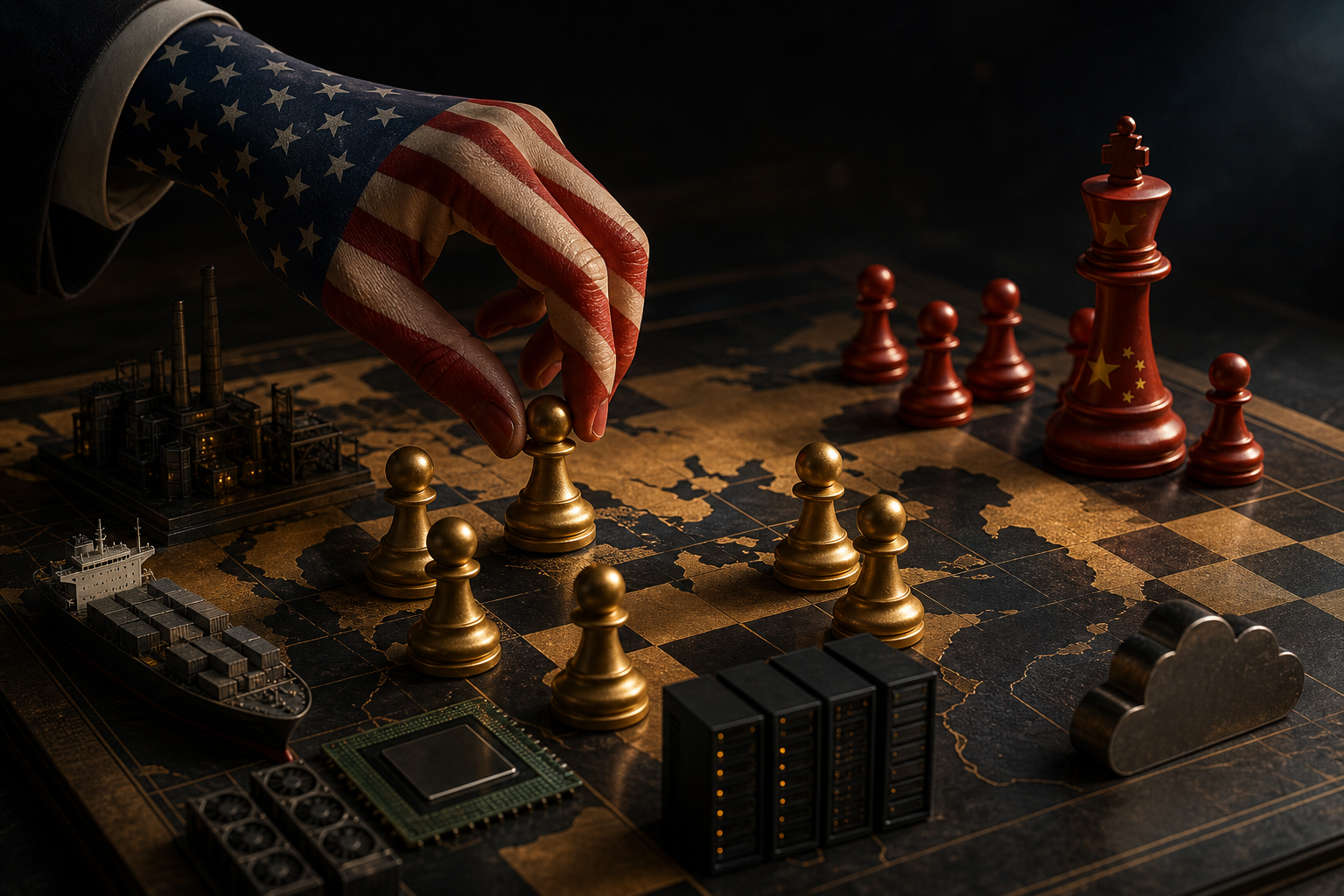
The new demand: not just “de-risk,” but align
The United States is preparing to tell technology partners that they cannot comfortably straddle the American and Chinese artificial-intelligence ecosystems, according to a Reuters report circulated Friday under the headline that partners “must pick sides” in the AI race with China. The message, as reported, goes well beyond familiar export controls on Nvidia-style accelerators. It frames AI as a full-stack contest: chips, cloud, model weights, cybersecurity, deployment partners, critical minerals and the rules that determine who can use the most capable systems.
That shift matters because it turns commercial decisions into geopolitical signals. A cloud provider selling compute in Southeast Asia, a chipmaker working through distributors in the Gulf, a university lab fine-tuning an open model, or an enterprise software company integrating Chinese and American models may now face a harder question: which ecosystem is it helping to scale?
Washington’s argument is straightforward. Frontier AI could shape cyber operations, military planning, intelligence analysis, industrial design and biological research. If Chinese firms can use allied infrastructure, U.S. cloud services or partner-country data centers to train or deploy advanced models, then U.S. officials see a loophole in the wider strategy of slowing China’s access to strategic computing power. The political language is about values and security; the practical language is about control points.
Why allies are uncomfortable
For many U.S. partners, the difficulty is that AI is not a neat defense alliance. It is also a business stack. Chinese models are often cheaper, increasingly capable and available in open-weight form. American models, by contrast, remain strong at the frontier but are more tightly wrapped in cloud platforms, safety rules, licensing terms and export-control scrutiny.
That creates an obvious tension. Governments may want U.S. security guarantees and American chip access, while their firms may want Chinese model flexibility, local hosting and lower inference costs. Smaller economies may see no benefit in becoming a front line in a technology cold war. Even close allies may prefer redundancy: American chips, European privacy rules, Chinese open models for non-sensitive workloads, and domestic cloud wherever possible.
This is why the reported U.S. message lands as more than diplomacy. It sounds like an attempt to define “trusted” AI supply chains in a way that excludes Chinese technology not only from sensitive military systems but from much of the future commercial stack.
The open-model problem is now central
The timing is important. On Thursday, WIRED reported that the White House is likely to revise its AI guidelines and may extend oversight from closed frontier models to open models as they reach comparable capabilities. The article, as summarized in public discussion, said the administration’s framework remains voluntary for now but is evolving because officials fear that powerful models could autonomously discover cyber vulnerabilities or be misused at scale.
That puts Washington in a bind. If it regulates only U.S. closed models, it may push developers and enterprises toward Chinese open-weight alternatives. If it tries to regulate open models, it risks antagonizing the domestic open-source community and making U.S. policy look like protectionism. If it pressures allies to avoid Chinese models, it must offer them something better than a warning.
A Friday Axios report sharpened the point. China-based Z.ai delayed the public release of GLM-5.3 weights for two weeks after warning that the model was highly capable at finding and exploiting security flaws. Axios reported that GLM-5.3 scored 84.5% on CyberGym, beating Anthropic’s Fable 5 and OpenAI’s GPT-5.6 Sol on that benchmark, while trailing only those models on ExploitBench among systems Z.ai tested.
That is precisely the scenario U.S. officials worry about: Chinese open-weight models moving close to frontier cyber capability, becoming globally downloadable, and escaping the compliance architecture that Washington can impose on American cloud and model providers.
Business consequences: compliance becomes market access
For companies, the immediate effect is uncertainty. The old compliance checklist focused on whether a chip, server or tool could be exported to a named entity or country. The emerging checklist is broader: Who owns the data center? Which cloud controls the model weights? Where are logs stored? Can Chinese nationals administer the system? Are model outputs used to train a downstream system? Can a partner resell access into a restricted market?
That is a much more invasive form of economic security policy. It affects hyperscalers, chip distributors, data-center developers, consulting firms, open-source hosting platforms and AI labs. It also changes customer relationships. A client in an allied country may be attractive commercially but risky if it also serves Chinese state-linked customers or uses Chinese model infrastructure.
The likely result is parallelization. Firms will build “trusted” stacks for U.S.-aligned customers and separate stacks for markets that reject those rules. Some will choose the American ecosystem because it offers chips, capital and defense access. Others will keep Chinese models in the mix because they are cheaper, portable and good enough for many enterprise tasks. The middle ground will shrink.
The strategic risk for Washington
The U.S. strategy has a logic: AI capability depends on bottlenecks, and bottlenecks can be governed. Advanced chips, cloud clusters, model releases, cybersecurity testing and supply-chain provenance are all places where the state can intervene. But the more Washington turns access into a loyalty test, the more it risks encouraging hedging.
Allies do not want dependence on Beijing. But many also do not want dependence on Washington, especially if U.S. policy can change with each administration or impose costs on local firms. A successful U.S. offer therefore has to be more than “do not use China.” It must include affordable compute, clear licensing, technology transfer, local capacity, predictable rules and a credible path for partners to benefit economically.
Otherwise, the pressure campaign could accelerate the very fragmentation it seeks to control. AI would become less like a global internet service and more like telecom after Huawei: rival stacks, rival standards, rival procurement rules and rising suspicion around every layer of infrastructure.
The bottom line
The current U.S. pressure on allies marks a new phase in the AI race. Chips are still central, but they are no longer the whole story. Washington is trying to govern the entire chain from minerals to models to cloud deployment. China’s progress in capable open-weight models makes that harder, because software can spread faster than hardware can be interdicted.
The choice being presented to partners is not simply between America and China. It is between a world where AI remains commercially interoperable and one where every model, server and data-center contract carries a geopolitical label. For technology companies, the era of neutral AI infrastructure is ending.
Sources from the last 72 hours
- [1]US to tell partners they must pick sides in AI race with ChinaAug 14, 2026, 12:00 AM UTC
- [2]The White House is going to expand its AI policyAug 13, 2026, 12:00 AM UTC
- [3]A Chinese lab's new model is nearly as good at hacking as U.S. AIAug 14, 2026, 10:33 PM UTC
- [4]reddit.com
- [5]reddit.com
AI-generated article based on recent web research, then preserved as a dated editorial snapshot.
Comments
Be the first to comment.