
Daily Podcast full article
Unitree IPO demand turns China’s robot race into a market test
Unitree’s Shanghai debut has become a live referendum on humanoid robotics: retail demand has reportedly reached thousands of times the available allotment, private markets are already pricing in a sharp first-day jump, and investors are treating embodied AI as the next investable layer of the AI boom.
A robot maker becomes a scarcity trade
Unitree’s planned listing on Shanghai’s STAR Market is no longer just another Chinese technology IPO. It has become a market event: according to The Economic Times, citing Reuters, retail investors subscribed for more than 8,000 times the shares available to them, while other fresh reporting put the retail-demand multiple above 5,500 times. That means the company’s float is being treated less like a normal equity offering and more like a rare ticket into China’s most visible humanoid-robotics story.
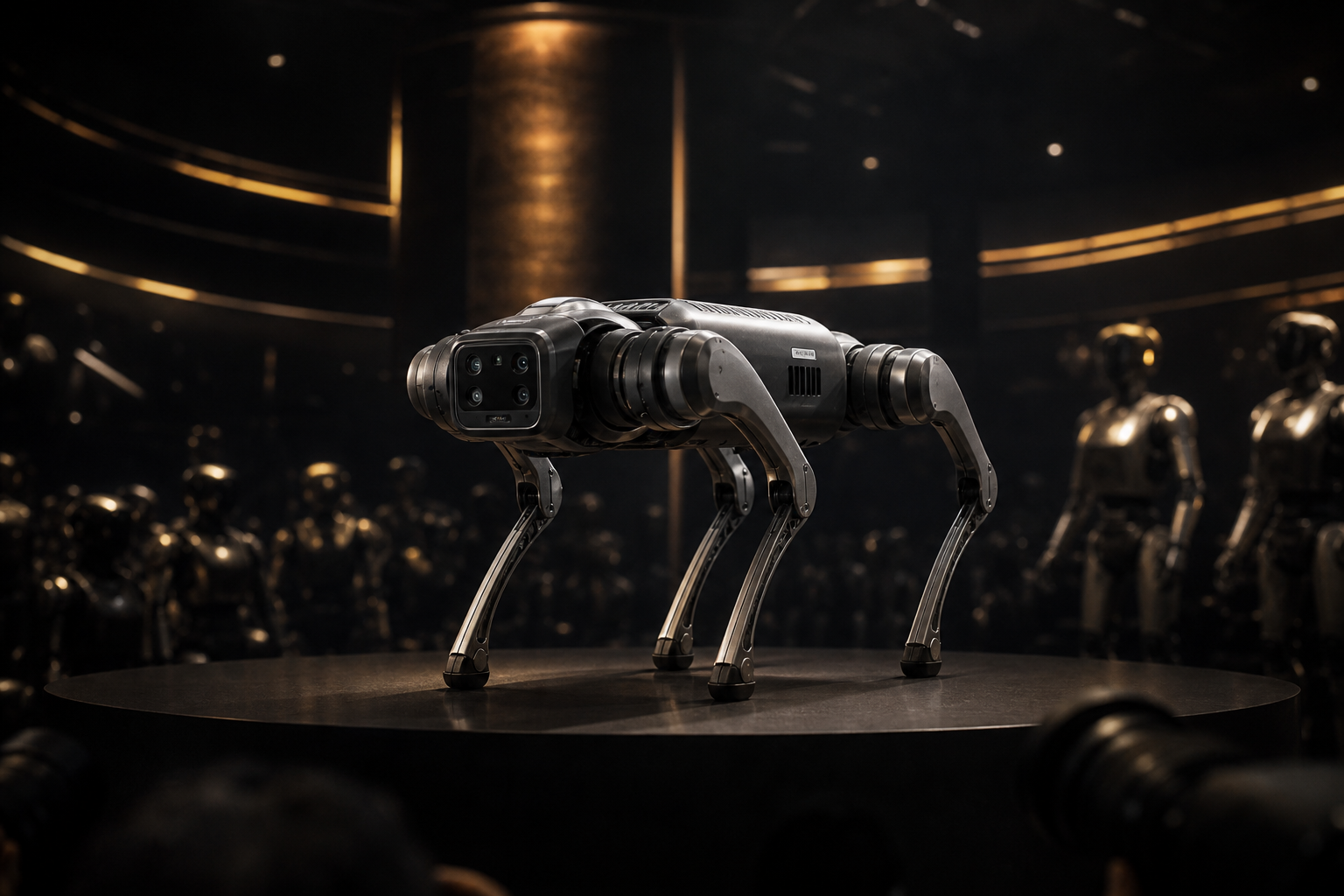
The frenzy is striking because Unitree is not selling an abstract AI model. It sells machines: quadruped “robot dogs,” humanoids and robot components. Yet the market’s reaction shows that investors are now attaching AI-style multiples to physical hardware when that hardware is seen as the body through which artificial intelligence could enter factories, campuses, warehouses and eventually homes.
The listing is expected in Shanghai next week, according to The Economic Times’ August 14 report. The offer price is 150.8 yuan per share, and the IPO raised about 6.1 billion yuan, or roughly $905 million, by selling only 10 percent of the enlarged share capital. That small free float matters. When the public supply is thin and the narrative is powerful, scarcity itself becomes part of the valuation story.
Private markets are already front-running the debut
The most revealing signal is not only the subscription ratio. It is the shadow pricing around the shares before trading begins. The Economic Times reported that private trading platforms such as EquityZen, UpMarket and Hiive were valuing Unitree at levels implying steep gains over the IPO price. Hiive was said to be pricing the stock near $62 early Friday, about 176 percent above the IPO price, while crypto-linked derivatives suggested even more aggressive expectations.
This does not guarantee the stock will trade there after listing. Pre-IPO markets can be thin, volatile and heavily influenced by scarcity. But they do show that Unitree has already escaped the usual frame for an industrial-equipment company. Investors are comparing it not with conventional machinery makers, but with AI infrastructure, frontier hardware and China’s recent run of high-profile technology listings.
That distinction is important. In previous cycles, robotics was often valued as a difficult manufacturing business: high engineering complexity, long sales cycles, service costs and uncertain margins. Unitree is being priced as a platform candidate. The implied question is not simply “how many robots can it sell this year?” It is “could this become China’s default hardware layer for embodied AI?”
Why Unitree is different from most robot startups
A core reason the IPO has attracted such attention is that Unitree is presented as unusually commercial for the humanoid sector. The Economic Times report says the company is already profitable, setting it apart from many humanoid-robotics peers still searching for mature applications. It also describes Unitree as the world’s largest humanoid robot maker by sales and as a competitor to global names including Boston Dynamics and Tesla.
That profitability narrative is powerful because humanoid robotics has been a graveyard of impressive demonstrations and weak business models. Walking, dancing and martial-arts videos are good marketing, but investors eventually need shipment volumes, repeat customers, margins and credible road maps. Unitree’s public-market story is that it has moved further along that path than most rivals.
Still, the risks are just as visible. The same August 14 reporting noted that competition is intensifying and that commercial applications in industrial and factory environments remain limited. That is the central tension in the IPO: markets are pricing the possibility of a general-purpose robotics platform, while the industry is still proving where humanoids can reliably outperform cheaper automation or human labor.
The “brain plus body” bet
The strategic angle became sharper this week because of DeepSeek’s reported role in Unitree’s IPO placement. A fresh August 13 report on ConfluxInsider said DeepSeek received 933,390 shares worth about 141 million yuan in Unitree’s strategic allocation, and that the companies signed a memorandum of understanding covering artificial general intelligence, robot embodiment and large AI models.
The size of that allocation is not the key point. Relative to Unitree’s IPO valuation, 141 million yuan is modest. The signal is the pairing: one of China’s most watched AI-model companies aligning publicly with one of its most watched robot-body companies. For Unitree, the benefit is obvious. Just before market pricing, it can point to a strategic investor whose name strengthens the embodied-AI narrative.
For DeepSeek, the payoff is less certain but potentially larger. Large models are mostly experienced on screens. Robots move that intelligence into the physical world, where perception, planning, balance, manipulation and safety have to work together in real time. If humanoids become a serious interface for AI, model companies will want a path into that hardware ecosystem.
But this model-company-plus-robotics-company formula is not automatically stable. The same ConfluxInsider report recalled the earlier Figure AI–OpenAI partnership, which ended after Figure shifted toward self-developed models. The lesson is that the “brain” and the “body” may start as partners, but they can later disagree over who controls the product road map.
A Chinese capital-market signal
The IPO also says something about China’s public markets. The Financial Times report shared on August 14 framed Unitree’s demand as part of a broader AI-driven valuation surge in Chinese technology shares, noting that the upcoming Unitree listing attracted more than 5,500 times the available retail allotment. In that reading, Unitree is not an isolated mania; it is one expression of a market trying to price Chinese AI leadership across chips, models and robotics.
Beijing’s industrial priorities reinforce that interpretation. Robotics, advanced manufacturing and AI are strategic sectors, and Unitree sits at their intersection. If the company trades sharply higher, it will encourage other robotics firms to accelerate IPO plans and give private investors a new public benchmark. If it disappoints after an initial pop, it could still become a warning that “embodied AI” valuations have run ahead of commercial proof.
What to watch after the first day
The first trading session will attract attention, but the more important test starts afterward. Investors should watch three things.
First, whether Unitree can turn IPO proceeds into manufacturing scale without eroding margins. Second, whether humanoid robots move beyond research, education, entertainment and demonstration use into repeatable industrial deployment. Third, whether the DeepSeek relationship becomes a real technical integration or remains mainly a signaling device for capital markets.
The IPO demand is extraordinary. But the valuation question is harder. Unitree has convinced investors that robots may be the next AI hardware platform. Now it must show that humanoids are not just a spectacular public-market story, but a durable business.
Sources from the last 72 hours
- [1]Unitree IPO: China’s humanoid robot starset for potentially explosive Shanghai debutAug 14, 2026, 7:53 AM UTC
- [2]AI frenzy drives Chinese tech valuations to multiples of US peersAug 14, 2026, 12:00 AM UTC
- [3]DeepSeek Bets RMB 140 Million on Unitree RoboticsAug 13, 2026, 12:00 AM UTC
AI-generated article based on recent web research, then preserved as a dated editorial snapshot.
Comments
Be the first to comment.