
Daily Podcast full article
Terafab Is Not the End of Chips. It Is a Warning Shot
Elon Musk’s proposed Terafab in Grimes County, Texas, is being sold as a semiconductor complex on a scale the industry has never seen. Fresh reporting points to a $16.8 billion opening commitment, a possible $100 billion-plus buildout, 100 million square feet of operating space and an AI demand curve that SpaceX says could reach 10 gigawatts by late 2027. The real story is not that Terafab has “destroyed” the chip industry, but that it exposes the industry’s next bottleneck: whoever controls chips, power and packaging controls the AI stack.
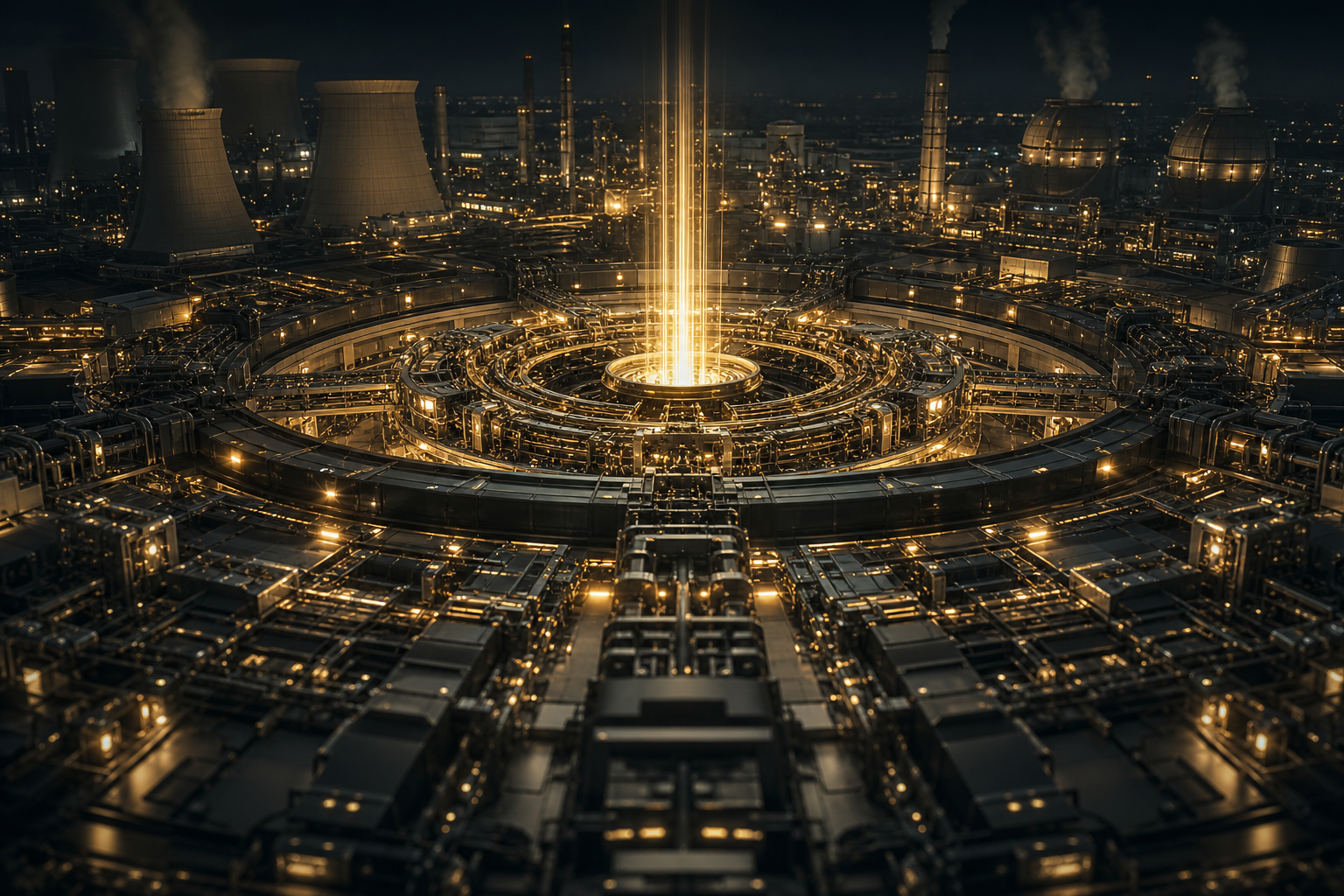
A megafab built around one premise: AI demand will break supply
Terafab has moved from Muskian provocation into a more concrete industrial proposal. AS reported on August 14 that Musk has given the green light to a huge semiconductor complex in Grimes County, Texas, with an initial investment of $16.8 billion and a possible cost above €100 billion over six years. The same report says the facility is intended to serve the AI needs of Tesla and SpaceX, rather than operate as a neutral foundry in the TSMC or Samsung mold.
That distinction matters. Terafab is not presented as another fab chasing outside customers. It is framed as a private supply engine for a vertically integrated empire: Tesla vehicles, robotaxis, Optimus robots, SpaceX satellites, Starlink-linked services and xAI compute. If the plan works even partially, Musk’s companies would be trying to internalize the most strategic layer of modern technology: advanced silicon.
The physical ambition is intentionally shocking. AS says the future plant would occupy more than nine million square meters of operating space, dwarfing several well-known industrial complexes, and that site-preparation works have already begun. It also reports that the first phase is expected to start in 2028 with 100,000 silicon wafers a month, with a long-term target of one million wafers a month and annual output estimated at 100 billion to 200 billion two-nanometer chips.
Those numbers should be read carefully. They are plans and projections, not proven production. In semiconductors, yield, equipment access, process control, chemicals, water, gases, masks, talent and packaging are the real battlefield. A cleanroom can be built faster than a competitive process can be mastered. But even as an ambition, Terafab is large enough to force rivals, suppliers and policymakers to ask whether the AI era will reward conventional foundry specialization or extreme vertical integration.
The circle in the center: power, not just silicon
The “big circle in the center” imagery around Terafab is useful because the most important circle may be the loop connecting chips, power and revenue. A fab that claims to produce AI hardware at terawatt scale is also a power infrastructure project. The chip shortage narrative is no longer only about wafers. It is about electricity, cooling, substations, gas generation, batteries and permits.
That is where the latest SpaceX/xAI compute claims become relevant. Tom’s Hardware reported on August 13 that Musk told SpaceX employees xAI data-center capacity is expected to rise roughly sevenfold to 10 gigawatts by late 2027. Musk attached a revenue claim to that power target, saying 10 gigawatts of AI compute could generate $300 billion to $500 billion annually. Tom’s Hardware also noted that SpaceX/xAI’s current rated data-center power draw is 1.4 gigawatts and warned that “compute capacity” should not be confused with raw electrical draw.
That caveat is crucial. Watts are not FLOPS, and nameplate power is not delivered accelerator performance. Still, the power target explains why Terafab is being pitched as something more radical than a normal semiconductor investment. Musk’s companies are treating compute demand as effectively insatiable, and that demand pulls the supply chain backward: from AI services to data centers, from data centers to accelerators, from accelerators to wafers, and from wafers to lithography, packaging and energy.
In that sense, Terafab is less a factory than a statement of dependency. Tesla and SpaceX appear to be saying that waiting for the existing chip industry to expand is not enough. The implied accusation is that even TSMC, Samsung, Intel and their equipment suppliers cannot scale quickly enough for a world of robot fleets, AI satellites and gigawatt clusters.
Does this “destroy” the chip industry?
No. Not today. Terafab has not yet produced the chips that would validate its claims. The established semiconductor industry still owns the things that matter most: proven process technology, supplier relationships, EUV tool experience, packaging know-how and the brutal institutional memory required to turn advanced nodes into high-yield manufacturing.
What Terafab can destroy is complacency. If one corporate ecosystem is willing to fund a fab, a power system and an AI demand pipeline as a single closed loop, then the traditional map of the industry changes. The old model separated chip designers, foundries, memory makers, packaging houses, hyperscalers and power utilities. The AI model is pulling those pieces together.
A Terafab success would pressure three groups. First, foundries would face a customer that no longer wants to be merely a customer. Second, equipment makers would gain a huge potential buyer but also a demanding integrator. Third, governments would confront the reality that industrial policy cannot stop at subsidies for fabs; it must include grid capacity, water rights, workforce housing and environmental oversight.
A Terafab failure would still be instructive. It would show that capital and ambition cannot shortcut semiconductor learning curves. It would reinforce the moat around incumbents. And it would remind investors that AI infrastructure claims often arrive before the engineering proof.
Markets are already reacting to the AI-infrastructure story
The Terafab narrative is also being absorbed by the market as part of a broader SpaceX AI story. A MarketFluxHub market rundown posted on August 12 said SpaceX shares rose roughly 7% to $142.62 after Musk’s AI revenue pledge, moving back above the $135 IPO price. The same rundown connected the move to Musk’s claim that AI revenue could exceed SpaceX’s rockets, spacecraft and Starlink revenue as soon as September.
That is speculative market color, not industrial proof. But it shows why Terafab matters before it ships anything. Investors are no longer valuing SpaceX only as a launch company or Starlink operator. They are being asked to value it as an AI infrastructure company with rockets, satellites, data centers and, eventually, chips.
The real current state
The current state of Terafab is therefore best described as: proposed, increasingly detailed, politically and financially consequential, but not yet proven. Fresh reporting supports the Grimes County location, the $16.8 billion initial figure, the possible $100 billion-plus scale, the 100 million-square-foot class of ambition and the 2028 initial operating target. Fresh reporting also supports the demand-side logic: SpaceX/xAI is publicly tying its future to gigawatt-scale AI capacity.
What is not proven is the leap from announcement to disruption. The chip industry is not destroyed by a plan. It is destroyed only if customers with enough capital and enough internal demand can build around it. Terafab’s importance is that Musk is testing exactly that proposition.
For now, Terafab is not the end of semiconductors. It is the clearest sign yet that the AI race has become an industrial race: chips, electricity, land, water, packaging and software all fused into one giant machine.
Sources from the last 72 hours
- [1]La gigafactoría que Elon Musk está montando en mitad del desierto de Texas: competirá con China y Europa por el reino de los chipsAug 14, 2026, 6:11 AM UTC
- [2]Elon Musk says xAI will increase data center capacity 7x by 2027 — targeting 10 gigawatts of compute, up to $500 billion in revenue by the end of next yearAug 13, 2026, 10:00 AM UTC
- [3]SpaceX Stock Jumps 7% After Musk AI Revenue Pledge as Cooler CPI Data Boosts Tech MarketsAug 12, 2026, 12:00 PM UTC
AI-generated article based on recent web research, then preserved as a dated editorial snapshot.
Comments
Be the first to comment.