
Daily Podcast full article
Tesla Semi 2027 Atlas refresh: lighter, faster-charging and still facing the hard part
Tesla’s rumored 2027 Semi update, described in a fresh 8news.ai briefing as the internal “Atlas” redesign, is less about spectacle than freight math: lower tractor weight, megawatt-class charging, Nevada manufacturing scale and early fleet adoption signals. The catch is that commercial trucking will judge the Semi not by acceleration headlines, but by payload, uptime, charging access, regulation and whether Tesla can deliver volume reliably.
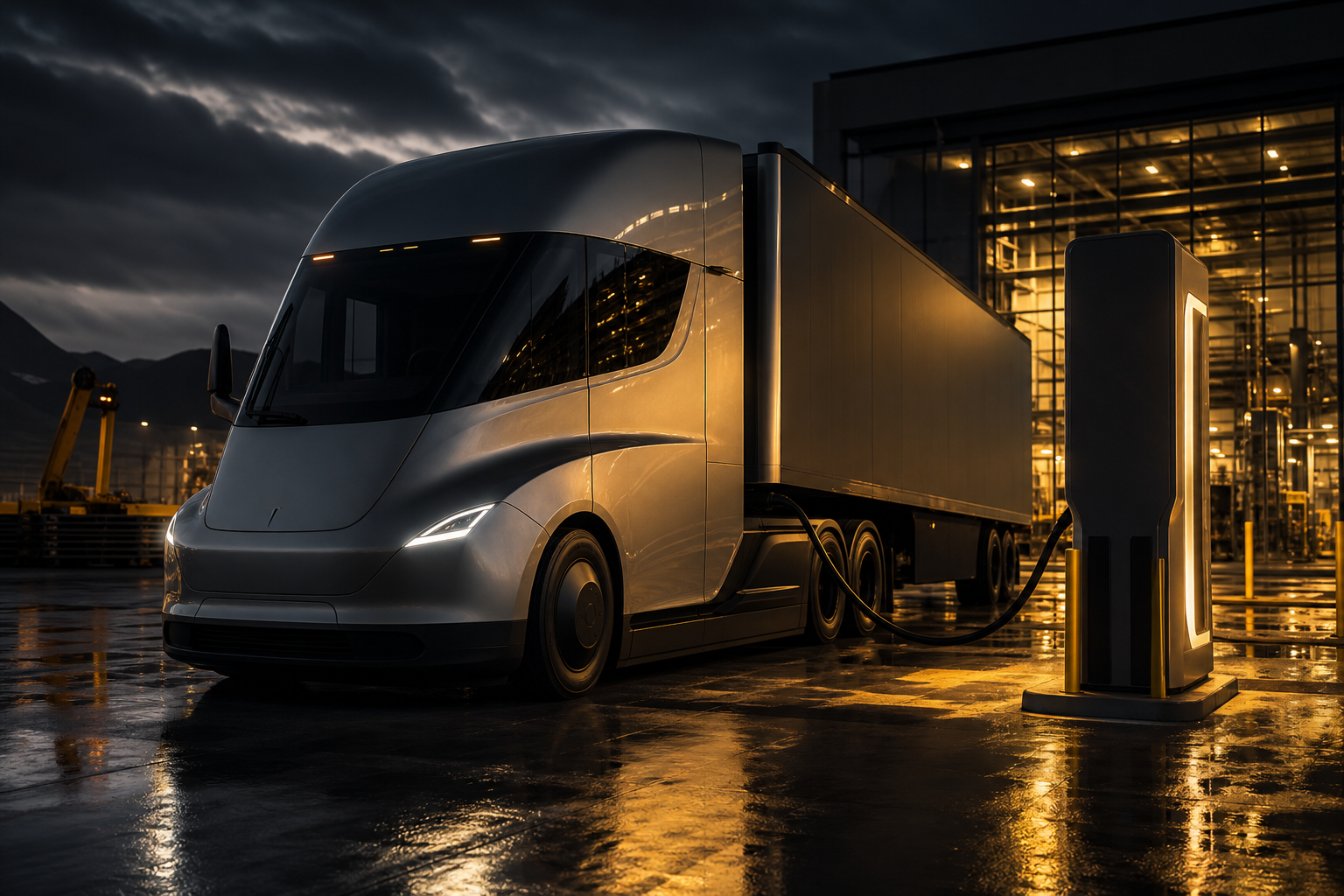
What changed in the 2027 Semi story
The latest 8news.ai briefing on August 13 presents Tesla’s updated Semi as a redesigned commercial product internally known as Atlas. The headline upgrade is weight: the report says Tesla has cut about 1,000 pounds from the updated truck compared with the earlier production version. For a passenger EV, that would sound like a performance story. For a Class 8 tractor, it is mostly a revenue story. Every pound removed from the tractor can potentially be returned to cargo while staying within legal gross vehicle weight limits.
According to the same fresh briefing, the long-range version is listed at about 23,000 pounds unloaded, with a maximum gross vehicle weight of 82,000 pounds, while the standard-range version is said to come in below 20,000 pounds. That framing matters because electric tractors often face skepticism over battery mass. If Tesla has materially reduced curb weight, the Semi becomes easier for fleets to compare against diesel on payload rather than treating zero-emission compliance as a sacrifice.
The new version is also described as retaining a rear-mounted three-motor layout delivering up to 800 kW, or more than 1,000 horsepower. But for logistics operators, the power figure is secondary. The real test is whether the truck can repeat predictable performance over long shifts, mountain grades, hot weather, cold starts, frequent stops and uneven depot schedules.
Megawatt charging is the operational upgrade
The most important number in the current report may be 1.2 MW. The updated Semi is described as supporting MCS 3.2 charging at up to 1.2 megawatts, with roughly 60 percent of range recoverable in about 30 minutes. That is not just a charging brag. It is the difference between a truck that requires a new operating model and one that can be inserted into existing freight windows.
In trucking, downtime is expensive. A charger that can fit into a driver break, a loading delay or a depot turn can reduce the friction of electrification. The Semi’s commercial case therefore depends on charging as much as vehicle engineering. If Tesla can pair a lighter tractor with dependable megawatt charging, the truck becomes more than a clean-transport symbol; it becomes a candidate for regional freight, port drayage and high-frequency dedicated routes.
That is why the 2027 story should be read as an ecosystem story. A battery-electric tractor cannot succeed alone. Fleets need chargers where trucks sleep, where trailers swap and where drivers already stop. They also need electricity prices that make the total cost of ownership predictable.
Fleet signals: Bali Express moves from trial to symbolism
One of the fresher commercial signals comes from Bali Express Services, which posted on LinkedIn that it was welcoming a Tesla Semi into the “Bali family.” The company framed the truck as part of a zero-emission transportation commitment driven by sustainability, innovation and the evolution of logistics. That kind of language is partly branding, but it is still significant because fleet branding usually comes after a vehicle has moved beyond curiosity.
The 8news.ai briefing also points to Bali Express as a useful test case because its routes connect Southern California and Mexico. That is exactly the kind of structured corridor where battery-electric freight is most plausible: predictable lanes, repeat customers, known depot points and a strong public-policy push for cleaner port and border logistics.
For Tesla, these corridor fleets are strategically more important than one-off demonstrations. The Semi does not need to replace every diesel sleeper tractor immediately. It needs to prove that it can win the routes where charging, distance and payload are controllable. Port-to-warehouse, warehouse-to-border and dedicated regional loops are the natural first battlefield.
Nevada scale remains the unresolved question
The current 8news.ai report says Tesla’s Nevada hiring points to a broader production ramp, with Semi-related roles spanning manufacturing, engineering, quality, logistics and maintenance. The larger claim is that Tesla is preparing dedicated capacity with a long-term target of up to 50,000 trucks per year.
That figure is the difference between a compelling product and an industrial business. A few hundred trucks can prove engineering. Thousands can prove customer demand. Tens of thousands require supply chain discipline, battery allocation, service infrastructure, parts availability and consistent quality.
This is where the Semi faces Tesla’s most familiar tension: the company is good at making ambitious technical leaps, but trucking customers buy uptime, not mythology. A fleet manager cannot explain missed deliveries by pointing to future software updates. The truck must be available, repairable and financeable.
Autonomy is becoming part of the freight debate
The Semi story is also unfolding as autonomous trucking becomes more politically charged. A fresh Reddit-linked discussion of a Hill report said Teamsters California sued state agencies over California self-driving truck rules, alleging officials had not completed the economic and practical-impact review required by law. The same discussion highlighted union concerns that self-driving trucks could affect more than 200,000 employee semitruck drivers in California.
That matters for Tesla because the Semi is no longer just an electric truck narrative. It increasingly sits inside a larger debate about automated freight, labor, safety and who captures productivity gains. If Tesla eventually ties Semi hardware to self-driving capability, regulatory battles may become as important as battery costs.
For now, Atlas should be judged as an electric truck first. But the long-term prize for Tesla is likely a platform: electric drivetrain, megawatt charging, fleet software, route optimization and eventually driver-assistance or autonomous features. The commercial upside is large, but so is the public scrutiny.
The skeptical reading
Not every current conversation is optimistic. In a fresh WallStreetBets thread about Musk-related expectations, commenters used the Tesla Semi as shorthand for delayed promises and questioned whether promised production timelines translate into trucks customers can broadly buy. That is not a technical source, but it reflects a real market mood: Tesla’s freight pitch is being evaluated against years of anticipation.
The skepticism is useful. It prevents the Atlas refresh from being treated as a finished revolution. A lighter tractor, faster charging and attractive fleet pilots are necessary. They are not sufficient. Tesla still has to prove cost per mile, residual value, charger uptime, service coverage, insurance behavior, driver acceptance and production consistency.
Bottom line
The 2027 Tesla Semi Atlas refresh looks most credible when stripped of hype. The shock is not that it may accelerate quickly. The real upgrade is economic: less tractor weight, more payload flexibility, 1.2 MW charging and a manufacturing push in Nevada. Early fleet signals such as Bali Express show the Semi has a plausible foothold in corridor logistics.
But the Semi’s next chapter will be decided by boring metrics: how many are built, how often they are down, how quickly they charge in real use, how much payload they preserve and whether fleets can model savings without heroic assumptions. If Atlas delivers there, Tesla’s electric truck becomes a serious freight tool. If not, it remains another impressive prototype waiting for the trucking industry’s tougher verdict.
Sources from the last 72 hours
- [1]Tesla Semi 2027 New Version Revealed — Shocking Upgrades! · Tesla · 8news.aiAug 13, 2026, 1:08 PM UTC
- [2]Bali Express Services | LinkedInAug 13, 2026, 12:00 AM UTC
- [3]Teamsters suing over California self-driving truck rulesAug 13, 2026, 2:00 PM UTC
- [4]Betting 50k on SpaceX reaching 300 by January 2028 to make 500kAug 12, 2026, 12:00 AM UTC
AI-generated article based on recent web research, then preserved as a dated editorial snapshot.
Comments
Be the first to comment.