
Daily Podcast full article
SpaceX adds $500B as lockup fears flip into a demand shock
SpaceX’s first post-IPO lockup expiry was supposed to test investor appetite. Instead, buyers overwhelmed the expected insider-selling wave, producing a roughly 35% rebound and adding about $500 billion in market value, while Elon Musk’s new AI revenue guidance pushed the company further away from a traditional aerospace valuation.
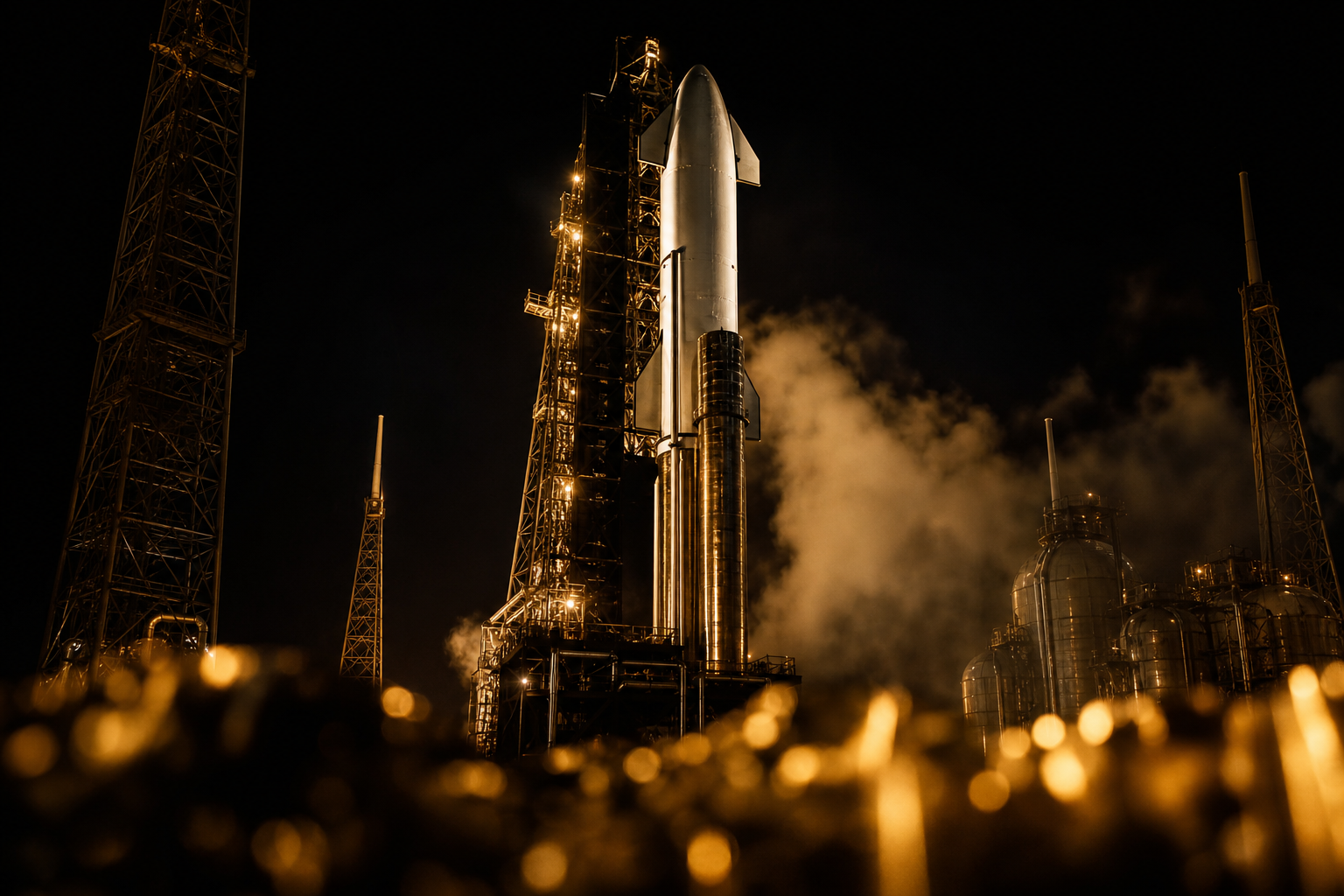
A lockup expiry that did not behave like a lockup expiry
The market entered SpaceX’s first post-IPO lockup expiry expecting gravity. It got thrust instead. Bloomberg reported on Aug. 13 that SpaceX shares had surged 35% after the first insider-selling window opened, adding roughly $500 billion in market value and defying the conventional script for newly listed companies. () A lockup expiry normally increases available supply: employees, early investors and other insiders can finally sell shares that had been restricted after an IPO. That often pressures a stock because the market must absorb a sudden wave of potential sellers.
In SpaceX’s case, the opposite signal dominated. The expiry became less a liquidation event than a liquidity event. Public investors, who had previously complained about a thin float and limited access to the company, treated the first release of restricted stock as a chance to build positions. A Reddit overnight-news thread that summarized Bloomberg’s item captured the market’s framing in blunt terms: SpaceX had risen 35% since the lockup expired, with about $500 billion added to equity value. The important point is not that social media confirmed Wall Street; it is that both professional and retail market narratives converged on the same interpretation — expected supply arrived, but demand was larger.
That is why the move matters beyond SpaceX. Lockups are usually a fear trade. If SpaceX can rally through one, investors are effectively saying the company is not being priced as a normal aerospace supplier or even as a conventional satellite-internet operator. It is being priced as a scarce mega-cap platform whose public float remains valuable precisely because so many institutions still want exposure.
The price action says “platform,” not “contractor”
Aerospace companies are usually valued on order books, launch cadence, defense contracts, margin stability and execution risk. SpaceX now trades in a different psychological category. The market reaction after the lockup suggests investors are underwriting a multi-business infrastructure platform: launch, Starlink connectivity, AI compute, orbital data-center ambitions and, increasingly, vertical chip manufacturing.
That re-rating is not based on certainty. It is based on optionality. The company is asking investors to believe that the same integration logic that lowered launch costs — build more in-house, iterate quickly, use scale as a moat — can be extended into AI infrastructure. In that view, rockets are not the final product. They are the logistics layer for a future compute network.
The latest market quote also shows how unstable that re-rating remains. The current SPCX price was $141.29 in late Aug. 13 trading, down 3.35% from the previous close, with intraday volume above 120 million shares. That is not a sleepy post-IPO digestion phase. It is the kind of trading tape seen when investors are still negotiating what category a company belongs in. At one moment SpaceX is a cash-burning space-industrial conglomerate; at the next it is an AI infrastructure bottleneck with unique access to orbit.
Musk’s guidance changed the center of the story
The stock reaction also followed a sharp change in SpaceX’s public narrative. Space.com reported on Aug. 11 that Musk told employees SpaceX’s AI revenue could exceed all other company revenue as soon as September and significantly exceed it in the fourth quarter. That statement was more than promotional language. It gave investors a bridge from the first public earnings report to a much larger growth story.
The same report said Musk described a target of bringing 10 gigawatts of AI compute online by the end of next year and argued that, at an estimated $30 to $50 of value per watt, that could imply $300 billion to $500 billion in annual revenue. Those are extraordinary numbers, and they should be read as guidance with major execution risk rather than as guaranteed revenue. But markets often move first on addressable imagination and only later on proof. For SpaceX, the guidance helped reposition the lockup expiry: insiders were not just being allowed to sell a rocket company; public investors were being offered access to what Musk framed as a future AI infrastructure company.
That framing helps explain why a lockup overhang could turn into a rally. If the market believes AI revenue may soon dominate SpaceX’s financial profile, then the shares unlocked after the IPO are not merely extra supply. They are rare inventory in a company whose perceived addressable market has just expanded.
The AI pivot is bold — and risky
The strongest bullish case is that SpaceX can combine assets no competitor has in one place: reusable launch capacity, a massive satellite network, AI software assets, power-hungry compute ambitions and manufacturing culture. Space.com’s Aug. 11 report also described Musk’s comments that SpaceX is “an AI company now,” with xAI, Grok, Terafab and Starmind-style orbital compute central to the company’s future. That combination is why investors are no longer comparing SpaceX only with Boeing, Lockheed Martin or satellite operators. They are comparing it, implicitly, with the largest AI and cloud platforms.
But the risk is equally clear. A valuation gain of roughly $500 billion after a lockup expiry can be read two ways. It may prove that institutional demand is deep and that the company’s float remains structurally scarce. Or it may show that investors are capitalizing distant, technically complex businesses before the market has evidence of margins, regulatory durability, deployment cost or customer concentration.
Space-based AI compute is not just an engineering problem. It is a financing, launch, thermal-management, power, orbital-debris, regulatory and customer-adoption problem. Terrestrial AI data centers already strain grids and supply chains; moving part of that future into orbit introduces new constraints even as it solves others. The market is therefore paying for SpaceX’s ability to compress timelines — the same ability that made Falcon reuse and Starlink credible after skeptics dismissed them.
Why the first unlock still matters
The first lockup expiry is not the end of SpaceX’s public-market test. It is the beginning. More restricted shares can become available over time, and each tranche will test whether demand remains strong after the initial surprise. A stock can rally through the first supply event and still struggle later if insiders sell more aggressively, if AI guidance slips, or if investors begin to demand conventional financial evidence.
Still, the Aug. 13 reaction is a powerful data point. The market had a clear reason to sell and chose to buy. It had a clear risk — insider liquidity — and treated it as access. It had a first earnings cycle that might have narrowed the story, and instead Musk broadened it dramatically toward AI revenue and space-based compute.
That is why the phrase “SpaceX gains $500B post-lockup” is not just a market headline. It marks a shift in how public investors are trying to classify the company. If SpaceX is an aerospace contractor, the valuation is difficult to defend. If it is a vertically integrated AI, communications and orbital-infrastructure platform, the debate changes — but so does the burden of proof.
For now, the market has delivered its first post-lockup verdict: the expected insider-selling wave did not swamp the stock. Demand did. The harder verdict will come later, when SpaceX must show that the AI revenue curve Musk described can move from spectacle to audited reality.
Sources from the last 72 hours
- [1]SpaceX could make $500 billion in 2028, Elon Musk says (video)Aug 11, 2026, 11:42 PM UTC
- [2]Top Overnight newsAug 13, 2026, 12:00 AM UTC
- [3]SpaceX Adds $500 Billion After Lockup ExpiryAug 13, 2026, 12:00 AM UTC
- [4]Space Exploration Technologies Corp. (SPCX) market quoteAug 13, 2026, 11:57 PM UTC
AI-generated article based on recent web research, then preserved as a dated editorial snapshot.
Comments
Be the first to comment.