
Daily Podcast full article
Unitree’s IPO turns China’s robotics boom into a public-market test
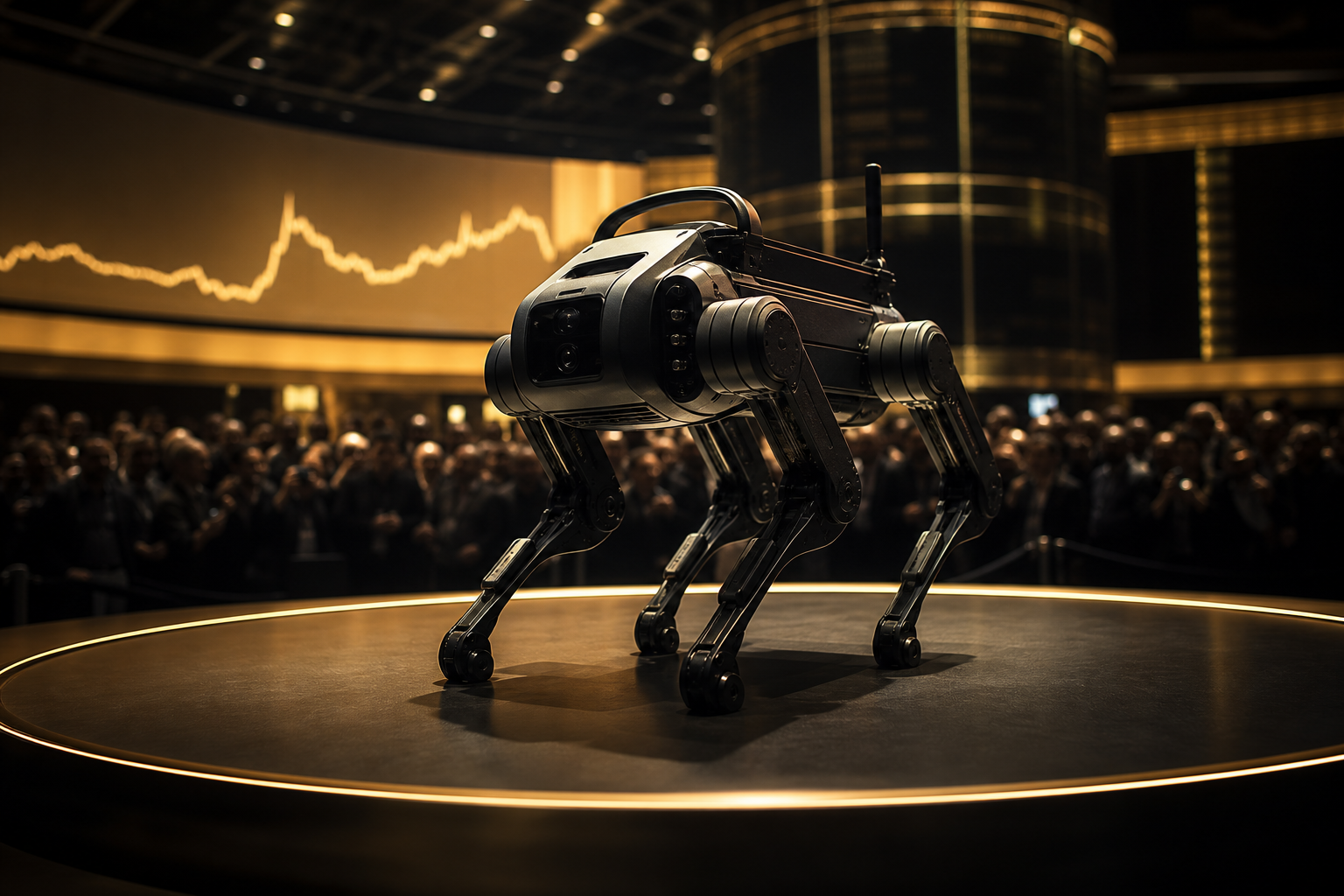
Unitree Robotics’ Shanghai IPO has become a defining test of investor appetite for embodied AI: 9.8 million retail orders, a vanishingly small final allocation rate and a valuation near $9 billion have pushed the humanoid and quadruped robot maker into the center of China’s next hardware-platform story.
Retail demand becomes the headline
Unitree Robotics’ IPO is no longer just a fundraising event for a Hangzhou robot maker. It has become a market signal. According to Moneycontrol, the retail portion of the Shanghai offering was oversubscribed 8,289 times before allocation adjustments, attracting around 9.8 million retail orders and leaving a final individual-investor allocation rate of about 0.0181 %. In practical terms, that implies roughly one successful applicant for every 5,500-plus hopefuls.
That scarcity is the point. In China’s A-share market, hot technology listings often become narratives before they become liquid assets. Unitree has priced its shares at 150.8 yuan and is seeking about 6.1 billion yuan, or roughly $900 million, at a valuation of about 61 billion yuan, close to $9 billion, according to figures Moneycontrol attributed to Reuters.
The 9.8 million-investor figure matters because it shows that robotics has moved from a niche engineering topic into the mainstream investment imagination. For many retail investors, Unitree sits in the same national-technology bucket as electric vehicles, semiconductors, batteries and generative AI. The promise is not simply that robots will sell; it is that embodied AI could become the next hardware platform after smartphones, drones and EVs.
From robot dogs to humanoids
Unitree first became known internationally for quadruped robots: agile, relatively low-cost machines used in research, education, entertainment and some industrial trials. The IPO story, however, is built around the company’s move into humanoids. Moneycontrol reported that Unitree generated about 1.7 billion yuan in 2025 revenue, more than four times the prior-year level, and that humanoid robots contributed 867.8 million yuan, overtaking quadrupeds as the company’s larger revenue source.
That product shift explains the excitement. Quadrupeds made Unitree visible and credible as a robotics manufacturer. Humanoids carry the more ambitious market thesis: a general-purpose robot with legs, arms, perception and AI models could eventually perform useful tasks in spaces designed for people. Investors are paying not only for today’s robots, but for the possibility that Unitree becomes one of the companies that defines that category.
A post relaying ACN Newswire’s announcement said Unitree opened subscription on August 10 at 150.80 yuan per share and cited a price-to-earnings ratio of 219.23 times, far above an industry average quoted at 38.56 times. That framing captures the central tension: public investors are being asked to value Unitree less like a conventional hardware company and more like an option on a future robotics platform.
China’s manufacturing-first robotics strategy
Unitree’s IPO sits inside a larger Chinese industrial push. A Bloomberg excerpt shared on Reddit said Chinese humanoid robot makers accounted for more than 97 % of global shipments in the first half of 2026, with total global shipments at roughly 19,100 units. It also said Shanghai-based Agibot led the period with 8,400 units, ahead of Unitree’s 5,900 units.
Those numbers require caution. Shipments do not necessarily prove autonomy, reliability or economic usefulness. A robot delivered to a research lab, a showroom or a pilot line is not the same as a robot replacing a human workflow at scale. Still, the industrial message is clear: Chinese companies are trying to win the body of embodied AI through volume, price and rapid iteration.
That strategy is familiar. China used similar combinations of supply-chain depth, manufacturing learning curves, local competition and policy support in solar panels, batteries, EVs and drones. Unitree is attractive to investors because it appears to embody that playbook in robotics: ship units, lower costs, expand the supplier base and improve the software stack through repeated deployment.
Public capital arrives before full maturity
The IPO raises a deeper question: should public markets fund humanoid robotics before the business model is fully mature? In China, the answer increasingly appears to be yes. A successful listing gives Unitree capital to expand factories, secure components, invest in robot bodies, hire software talent and deepen embodied-AI research.
That funding matters because robotics is expensive in a way pure software is not. Humanoids require simultaneous progress in actuators, batteries, sensors, motor control, vision systems, safety, manipulation, model training, manufacturing and after-sales support. If an app fails, it can be patched. If a robot fails, the problem can become inventory, warranty cost, reputational damage or a safety issue.
Moneycontrol noted that Unitree’s challenge after going public will be to turn IPO enthusiasm into sustained growth. The same report also pointed to possible headwinds from restrictions in the United States on foreign-made humanoid and quadruped robots, which could affect future sales opportunities.
Scarcity can inflate expectations
A tiny allocation rate can create powerful debut momentum. It can also create a heavy expectations burden. A roughly $9 billion valuation demands more than viral videos and national pride. It implies future revenue growth, defensible margins, software progress and credible deployment beyond demonstrations.
Three questions now matter most. First, what kind of revenue is Unitree generating? If humanoid sales are concentrated in research, education, entertainment and pilot projects, the growth curve may be impressive but still early. Second, how strong is Unitree’s software layer? The long-term value of humanoids will depend less on walking and more on perception, manipulation, task planning and safe autonomy. Third, can Unitree scale manufacturing without sacrificing quality or burning too much capital?
The distinction between a spectacular robot and a useful robot is crucial. Public markets often reward the first; customers ultimately pay for the second. Unitree’s advantage is that it has real products, real sales and real manufacturing experience. Its risk is that investors may extrapolate too quickly from today’s demand to tomorrow’s profitability.
A global signal
Unitree’s IPO also sends a message beyond China. If mainland public markets are willing to fund embodied-AI companies aggressively, competitors in the US, Japan, South Korea and Europe will face pressure not only to build better models, but also to match China’s manufacturing tempo. Robotics competition will not be decided solely by the “brain”; it will also depend on the cost of joints, the reliability of batteries, the availability of sensors and the speed at which factories can improve each generation.
For China, Unitree is a symbol of technological ambition moving from policy documents into public portfolios. For investors, it is a high-risk, high-visibility wager on the idea that AI needs a body. For the robotics industry, it may become a precedent: public markets can finance embodied AI before the final use cases are fully known.
That is the power of the Unitree moment. The company has not yet proved that humanoids will become profitable general-purpose workers. But its IPO has proved that millions of investors want exposure before that proof arrives. The result is both an opportunity and a warning: public capital can accelerate a new hardware platform, but it can also inflate expectations faster than robots can learn to work.
Sources from the last 72 hours
- [1]9.8 million investors chase Unitree as China’s robot IPO takes offAug 12, 2026, 10:56 AM UTC
- [2]Unitree Robotics (688836.SH) Opens for Subscription Today: Shoucheng, Meituan and Other Early Investors Poised for Significant Gains as Core Investor Valuations Re-rateAug 10, 2026, 12:00 PM UTC
- [3]China Humanoid Makers Hold 97% of Global Shipments, Report SaysAug 10, 2026, 12:00 PM UTC
- [4]BYDFi Daily Announcement Thread: August 11, 2026Aug 11, 2026, 12:00 AM UTC
AI-generated article based on recent web research, then preserved as a dated editorial snapshot.
Comments
Be the first to comment.