
Daily Podcast full article
Elon Musk’s TeraFab: Texas AI-chip megafactory is a plan, not yet a revolution
Elon Musk’s SpaceX and Tesla have put a fresh spotlight on TeraFab, a proposed Grimes County, Texas semiconductor complex with a reported first-phase commitment of $16.8 billion, a claimed footprint above 100 million square feet, and a strategic role in Musk’s push to make AI compute for robots, autonomous vehicles and space-based data centers. ([techradar.com](https://www.techradar.com/pro/spacex-is-spending-usd16-8-billion-on-a-texas-chip-fab-that-musk-says-will-be-50-times-the-size-of-the-pentagon))
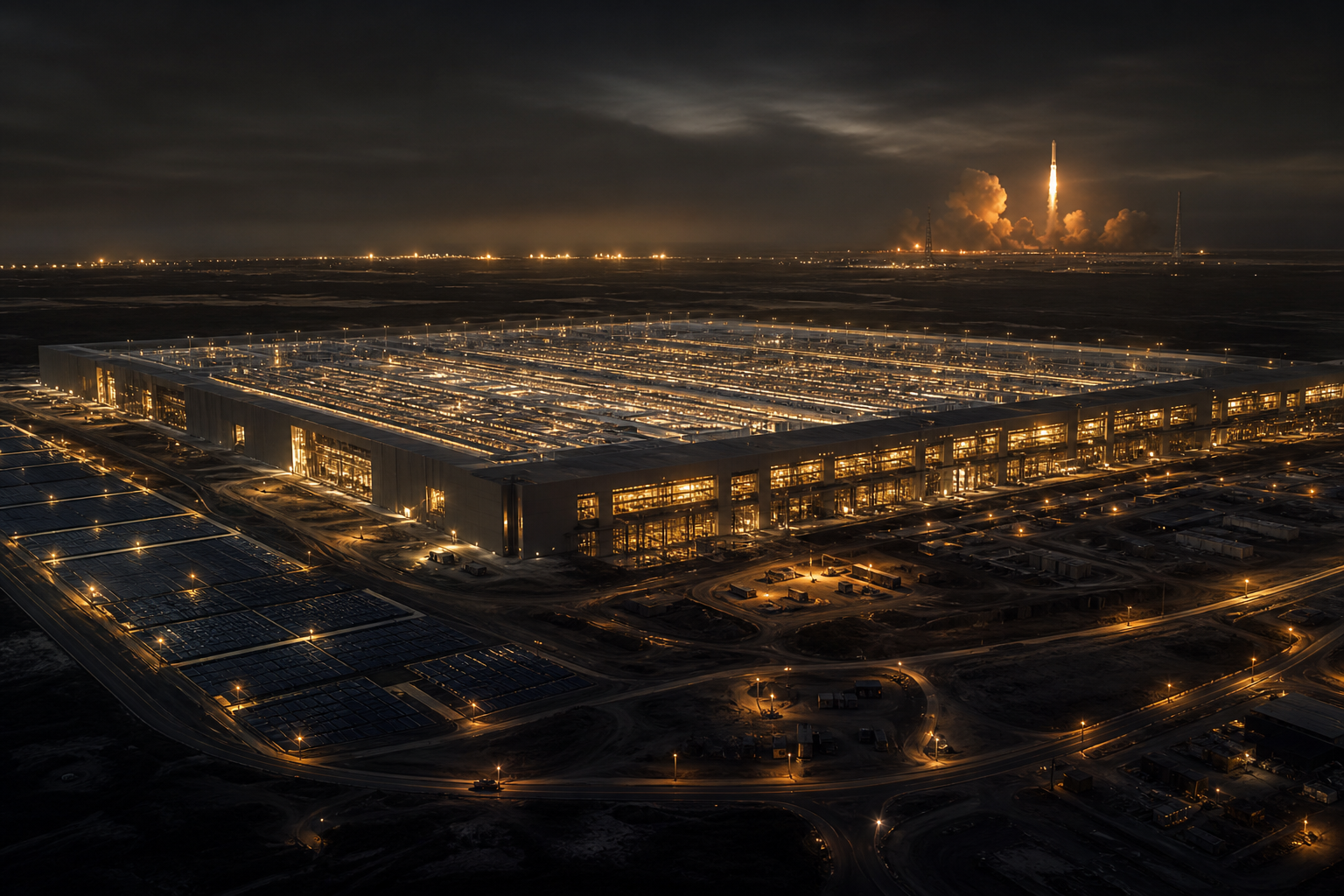
The reveal: an AI factory sized like a city
Elon Musk’s new TeraFab pitch is less a conventional factory announcement than a declaration of vertical integration. Fresh reporting says SpaceX and Tesla have detailed a plan to invest $16.8 billion in the initial phase of a semiconductor manufacturing complex in Grimes County, Texas, roughly northwest of Houston and near the College Station region. The project is being framed as a joint SpaceX-Tesla effort to produce advanced chips for Musk’s highest-compute ambitions: Tesla’s Optimus robots and Cybercab autonomous vehicles, as well as SpaceX’s planned space-based AI infrastructure.
The headline figure is the building itself. TechRadar reports that SpaceX has confirmed TeraFab could exceed 100 million square feet at full construction, while Musk has claimed it could be “50 times the size of the Pentagon.” The same report notes an important caveat: the confirmed 100-million-square-foot figure is far smaller than what would be required to literally equal 50 Pentagons, so the “50 times” line should be treated as Musk-style scale signaling rather than a disclosed construction specification.
What TeraFab is supposed to make
The industrial logic is straightforward: Musk’s companies increasingly sell or depend on products that consume vast amounts of compute. Space.com reported on August 11 that Musk told employees SpaceX’s AI revenue could exceed all other company revenue as soon as September and that SpaceX aims to bring 10 gigawatts of AI compute online by the end of next year. In that context, TeraFab is described as the chip-manufacturing backbone for a broader AI strategy, including terrestrial compute, satellites and future orbital data centers.
Unlike a standard fab specializing in one production stage, the plan being described is vertically integrated: logic, memory, packaging and testing under one roof. That matters because modern AI hardware bottlenecks are not only about transistor density. Advanced packaging, memory bandwidth and system-level integration are now central to whether an AI accelerator can deliver useful performance at scale. A TeraFab that actually combined those steps would be an attempt to shorten supply chains and let Tesla and SpaceX iterate on chips, boards and products together.
The Texas bet
Texas is central to the story. The fresh accounts put the proposed TeraFab site in Grimes County, with public attention focused on the promised capital spending and jobs. A widely shared discussion of the Fortune report on Reddit quoted Texas Gov. Greg Abbott saying the first phase represents more than $16.8 billion in capital investment and 3,000 new jobs. The same discussion also shows how quickly the project has become a local political argument, with commenters debating tax incentives, infrastructure costs, electricity, water and whether Musk will deliver on the full promise.
That reaction is not incidental. A semiconductor factory is not just a building; it is a water, power, road, workforce and chemical-management system. TechRadar reports that the companies say operations would use water from Gibbons Creek Reservoir rather than nearby groundwater, and that wastewater treatment, reuse and conservation measures are part of the plan. Those commitments will be scrutinized because leading-edge chipmaking requires industrial precision and heavy utilities, even before considering the power draw of the AI systems the chips are meant to feed.
Musk’s strategic motive: escape the chip queue
The most compelling argument for TeraFab is that Musk does not want Tesla, SpaceX and xAI to remain ordinary customers in the global chip queue. Space.com’s August 11 report portrays SpaceX as moving rapidly from a launch company into an AI company, with Musk projecting AI as the overwhelming driver of SpaceX value in the coming years. If that is the strategic destination, then dependence on outside suppliers becomes a limiting factor.
Tesla’s robotaxi plans, humanoid robotics ambitions and in-car inference needs all require chips optimized for low-latency, power-efficient AI. SpaceX’s proposed Starmind satellites and other AI infrastructure would require a different class of hardware: high-power processors designed for data-center-like work in radically different environments. A single internal manufacturing program could, in theory, allow Musk’s companies to prioritize their own architectures rather than compete with every hyperscaler, automaker and defense contractor for foundry capacity.
The hard part: a fab is not a gigafactory
The risk is that TeraFab’s language borrows from the Gigafactory playbook while entering an industry that is less forgiving than battery packs or vehicle assembly. Semiconductor fabs require extreme process control, deep supplier ecosystems, specialist labor and years of yield learning. Even if capital is available, advanced lithography, metrology, deposition, etching, cleanroom operations and packaging technology are governed by supplier bottlenecks and technical know-how that cannot simply be purchased overnight.
The fresh reports therefore support a sober reading: TeraFab is an enormous announced project, not an operating chip factory. TechRadar describes the investment as an initial commitment and says later filings pointed to much larger possible spending; Space.com frames TeraFab as part of SpaceX’s newly aggressive AI roadmap, not as a current source of chips.
The scale claim should be separated from the business case
Musk’s largest-building language will dominate social media, but the more important question is whether TeraFab can produce chips at competitive yield, cost and timing. A 100-million-square-foot shell is impressive; a stable, high-yield advanced semiconductor line is transformational. Those are different milestones.
The project’s strongest case is internal demand. Tesla and SpaceX would not need to become a merchant foundry on day one if they can consume the output themselves. The weakest point is execution timing. If TeraFab takes years to ramp, the companies will still rely on existing chipmakers during the most intense phase of the AI buildout. That means TeraFab is best understood as a long-term hedge against compute scarcity, not an immediate solution.
Bottom line
TeraFab is Musk’s most audacious industrial proposal in Texas: an AI-chip megafactory that would tie together cars, robots, satellites and data centers into one supply chain. The current facts point to a $16.8 billion first phase, a Grimes County site, a potential footprint above 100 million square feet, and a role in SpaceX’s accelerating AI business.
But the difference between announcing the world’s largest building and producing world-class chips is enormous. For now, TeraFab is a signal: Musk wants control of the compute stack from silicon to orbit. Whether Texas gets a new semiconductor powerhouse or another oversized Musk promise will depend on permits, equipment, power, water, talent and years of manufacturing discipline.
Sources from the last 72 hours
- [1]SpaceX is spending $16.8 billion on a Texas chip fab Musk says will be '50 times the size of the Pentagon'Aug 10, 2026, 12:00 PM UTC
- [2]SpaceX could make $500 billion in 2028, Elon Musk says (video)Aug 11, 2026, 11:42 PM UTC
- [3]Everything’s bigger in Texas: Musk’s planned $16.8 billion chip factory is five times bigger than the world’s current largest buildingAug 11, 2026, 12:00 AM UTC
AI-generated article based on recent web research, then preserved as a dated editorial snapshot.
Comments
Be the first to comment.