
Daily Podcast full article
Starlink expands coverage through orbital density and international launch deals
SpaceX’s latest Starlink activity shows that coverage is no longer just a map of countries served. It is a question of launch cadence, orbital density, regulatory access and commercial partnerships. In the latest 72-hour news window, a Vandenberg Starlink mission and Vietnam’s VinSpace launch contract point to the same model: SpaceX is building both the network and the launch infrastructure that others increasingly use.
Coverage is becoming a cadence story
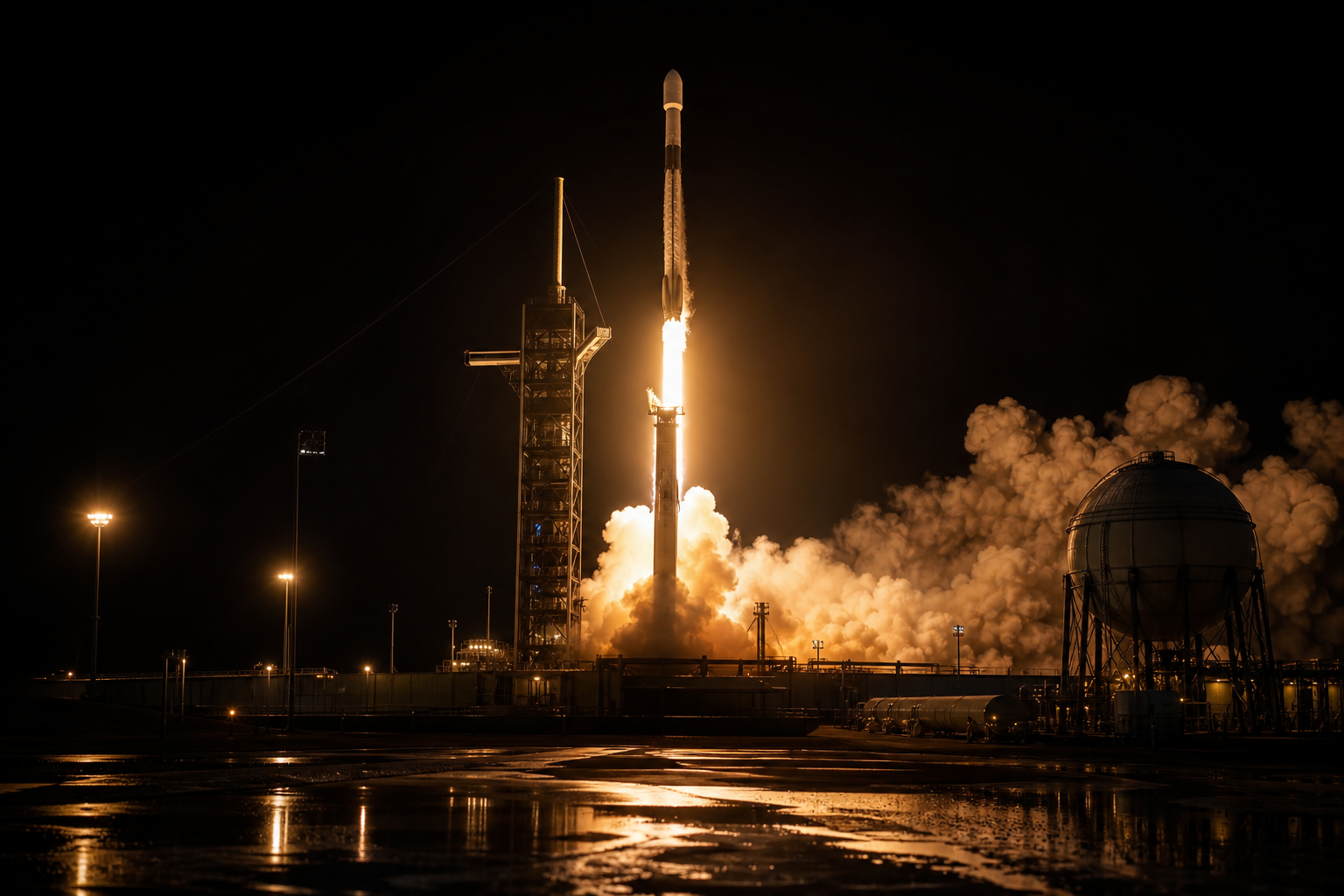
The current Starlink story is not a single dramatic milestone. It is a pattern: frequent Falcon 9 missions add capacity to the broadband constellation, while SpaceX also sells launch access to emerging space companies. During the 72-hour window ending at 07:09 UTC on August 12, 2026, two developments captured that pattern. Launch-tracking updates for Starlink 17-49 showed a Falcon 9 mission from Space Launch Complex 4E at Vandenberg Space Force Base in California, with liftoff updated to 04:48 UTC on August 12 and booster B1103 landing on the drone ship Of Course I Still Love You after its fifth flight. Separately, the Associated Press reported on August 11 that Vietnam’s VinSpace had signed with SpaceX to launch its first satellites in 2027 on a Transporter rideshare mission.
These are different kinds of news, but they point in the same direction. SpaceX’s advantage is not only that it operates Starlink as an internet service. It is that the company controls the rocket system, the satellite network, the customer-launch pipeline and, increasingly, the international market relationships that connect them.
Vandenberg’s role in a thicker network
Starlink 17-49 highlights why Vandenberg matters to SpaceX’s coverage strategy. The California base supports trajectories that complement missions launched from Florida, helping SpaceX populate orbital planes that are useful for coverage, redundancy and regional capacity. The r/SpaceX Starlink 17-49 mission thread, which states that its information is supplied through The Space Devs’ Launch Library 2 API, listed a launch window from 02:00 to 06:00 UTC on August 12, a SpaceX customer, a SLC-4E launch site and a Starlink deployment mission.
For customers, this matters because satellite internet coverage is not just geographic availability. A country can appear “covered” while users still experience constraints if too many terminals are competing for the same overhead capacity. More satellites in more useful orbital planes can mean lower congestion, more service resilience and better support for mobile or enterprise use cases. In that sense, every Starlink deployment is less about a headline number and more about network density.
Two Starlink missions in one launch alert
The pace was also visible in a launch alert published on August 11, which listed two Falcon 9 Starlink missions within a 24-hour period: Starlink Group 10-19 from Cape Canaveral Space Force Station and Starlink Group 17-49 from Vandenberg Space Force Base. The alert gave 04:46 UTC on August 12 for 17-49 and placed that mission at the California launch site.
A community launch alert is not the same as a formal regulatory filing, but it reinforces the operational point supported by the dedicated Starlink 17-49 thread: SpaceX is using multiple U.S. launch pads to sustain the Starlink buildout. That rhythm has become a core part of the product. For a low-Earth-orbit broadband service, launch cadence affects customer experience. It provides spare capacity for high-demand regions, helps replace aging spacecraft and gives SpaceX room to layer specialized services on top of residential broadband.
VinSpace turns to the rideshare model
The VinSpace contract shows the other side of SpaceX’s strategy. According to AP, the Vietnamese aerospace company said on August 11 that it had signed a contract to send its first satellites to orbit in 2027 on a SpaceX Transporter rideshare mission. In that model, multiple customers share one rocket, lowering the cost of access to orbit. AP reported that VinSpace will develop and operate the satellites, using them to test technology in orbit and support future commercial applications, but that the company did not disclose the number of satellites, their specifications or the contract value.
Those missing details matter. The announcement should not be treated as evidence that Vietnam already has a large private constellation ready to operate. It is better read as an early access-to-orbit commitment. Still, the strategic signal is clear: a new national space-sector player can buy a seat on SpaceX’s launch infrastructure rather than wait for a sovereign rocket program. Falcon 9 becomes a commercial bridge between satellite ambition and actual orbital testing.
Vietnam is both market and partner
The Vietnam angle is broader than VinSpace. AP also reported that Vietnam allowed SpaceX to launch Starlink service in the country in February 2026 and that Starlink has since begun accepting orders there. That puts SpaceX in a layered position: connectivity provider, launch provider and partner to a domestic aerospace newcomer.
For Vietnam, the logic is practical. Starlink can help address connectivity gaps, while Transporter missions can accelerate the learning curve for satellite development and operations. For SpaceX, the benefits run in parallel. Starlink gains market access and potential subscribers, while Falcon 9 gains external payload customers. This is the central business logic of SpaceX’s vertically integrated model: the same launch system that builds the company’s own broadband network can also monetize spare or scheduled capacity for other customers.
Demand is the pressure behind the buildout
A paper posted to arXiv on August 9, 2026, proposed a method for estimating consumer demand for megaconstellation internet services, using Starlink as a case study based on historical data from December 2021 through November 2023. The paper is not a live Starlink sales report, but its timing underlines why the current launch cadence matters: megaconstellations are not only engineering projects; they are demand-allocation systems.
That demand is increasingly segmented. Rural households, ships, aircraft, businesses, disaster response agencies, governments and future direct-to-device users all compete for the same orbital architecture. The more varied the customer base becomes, the more SpaceX needs density, spectrum access, ground infrastructure and sophisticated traffic management. In that context, “coverage expansion” means more than entering a new national market. It means ensuring the network has enough capacity to be useful when and where customers actually need it.
What the latest developments reveal
The August 10–12 sequence is not a break with SpaceX’s existing strategy. It is a confirmation of it. Starlink grows by accumulation: another batch of satellites, another orbital plane, another market permission, another international contract. That kind of progress can seem routine, but routine is the point. SpaceX has turned repeated launches into the operating system of its communications business.
The key question now is not whether SpaceX can keep launching Starlink satellites. The question is how the company will allocate the resulting capacity among residential broadband, mobility, national markets, government demand and third-party satellite customers. Vandenberg shows the launch tempo; VinSpace shows the international pull of SpaceX’s launch services. Together, they suggest that Starlink’s expansion is no longer only a constellation story. It is an infrastructure story, with Falcon 9 as the delivery mechanism and Starlink as the most visible service built on top.
Sources from the last 72 hours
- [1]r/SpaceX Starlink 17-49 Official Launch Discussion & Updates Thread!Aug 10, 2026, 12:00 AM UTC
- [2]Upcoming Space Launches for August 11, 2026Aug 11, 2026, 12:00 AM UTC
- [3]Estimated Demand for Mega-Constellation Internet ServiceAug 9, 2026, 6:26 PM UTC
- [4]Vietnam's VinSpace signs deal with Elon Musk's SpaceX to launch its first satellites in 2027Aug 11, 2026, 5:21 AM UTC
- [5]apnews.com
AI-generated article based on recent web research, then preserved as a dated editorial snapshot.
Comments
Be the first to comment.